
MP Sujeet Kumar Calls for Indigenous English Proficiency Test With EWS Fee Waivers, MEA Support for Global Recognition
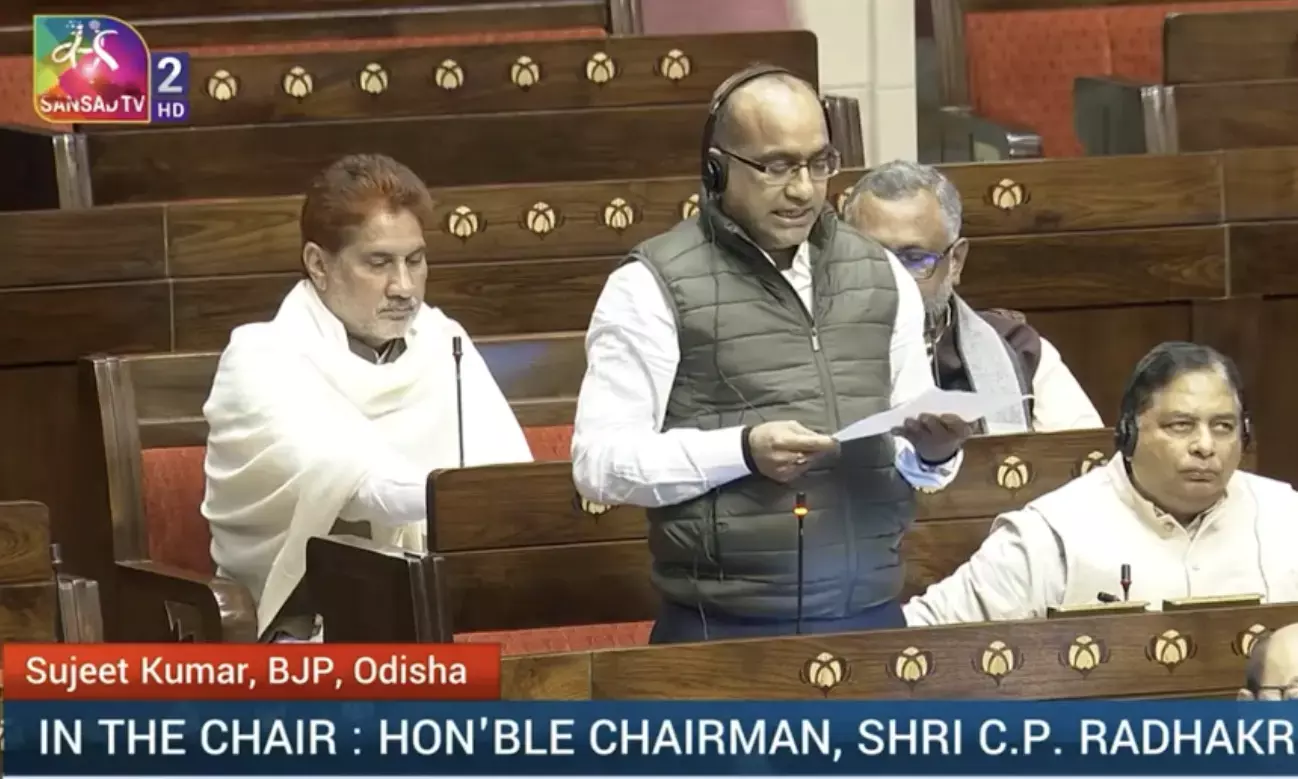
MP Sujeet Kumar raised concerns in Parliament over India’s dependence on foreign English language tests and urged diplomatic efforts for global acceptance of an Indian alternative.
Raising concerns over the financial and structural dependence of Indian students on foreign English proficiency examinations, Rajya Sabha MP Sujeet Kumar on Tuesday urged the Union Government to develop a domestic English language assessment mechanism with global recognition, calling the issue one of “educational sovereignty and national respect.”
Speaking during Zero Hour in Parliament, Sujeet Kumar began by acknowledging recent strides in India’s higher education sector under the leadership of Union Education Minister Shri Dharmendra Pradhan. He referred to India’s improved global academic presence, noting that Indian higher education institutions are now increasingly visible in international rankings and abroad.
Referring to the QS World University Rankings, the MP stated that India today has 54 higher education institutions featured, which is “five times the number in 2015 and double the number in the last five years.”
He further highlighted that premier Indian institutions such as the IITs and IIMs have expanded their global footprint, with campuses in Tanzania and the UAE, and plans underway for future expansion in the United States.
Having set this context, Sujeet Kumar drew the House’s attention to what he described as a pressing issue impacting lakhs of Indian students pursuing higher education overseas, particularly in English speaking countries such as the United States, the United Kingdom, Canada, Australia, and New Zealand.
He pointed out that each year, approximately 13 lakh Indian students appear for English proficiency tests such as TOEFL and IELTS, paying an estimated Rs. 3,000 crore annually to foreign testing agencies including the British Council and ETS. Emphasising the economic implications, he noted that each attempt at IELTS or TOEFL costs around Rs. 20,000, which constitutes a significant financial burden, especially for middle-class and economically weaker students.
The MP contrasted India’s position with that of other countries which, he said, have successfully developed their own English proficiency assessments and secured international recognition for them.
By way of illustration, he cited Canada’s Canadian Academic English Language (CAEL) test, which is accepted by leading universities globally. He also referred to Japan’s English testing systems, including the College English Test; CET and TEM, as well as South Korea’s Test of English Proficiency developed by Seoul National University (TEPS).
“These examples show that nations have developed domestic English testing services and have negotiated their acceptance internationally,” MP Sujeet Kumar said, adding that India, despite its scale and capability, is yet to establish a comparable mechanism.
Rejecting any suggestion of institutional incapacity, the MP asserted that India already possesses the infrastructure, expertise and administrative experience required to conduct such large scale examinations. He cited the successful annual conduct of competitive tests such as JEE, taken by around 13 lakh students, and NEET, taken by approximately 24 lakh candidates.
In this backdrop, MP Sujeet Kumar urged the Government to establish an English proficiency assessment aligned with international benchmarks, to be conducted by the National Testing Agency. He proposed that the test be priced affordably, with complete fee waivers for students from economically weaker sections.
He further suggested that the examination be conducted in every district headquarters across the country to ensure accessibility and inclusivity. Emphasising the need for international acceptance, he called upon the Ministry of External Affairs (MEA) to actively take up the issue during diplomatic engagements, so that scores from an Indian-developed test are recognised by universities abroad.
According to the MP, such a move would not only ease the financial burden on Indian students but also help retain thousands of crores within the domestic economy. “This is about saving Rs. 3,000 crore every year,” he remarked, while also framing the proposal as consistent with the broader vision of Atmanirbhar Bharat.
The intervention places the issue firmly within the policy discourse on higher education reform, signalling a push towards building indigenous, globally recognised testing frameworks that reduce financial barriers for students and strengthen India’s role in shaping international academic standards.