
UGC Equity Regulations 2026: The Constitutional Debate Over Equality, Caste And Alleged Misuse
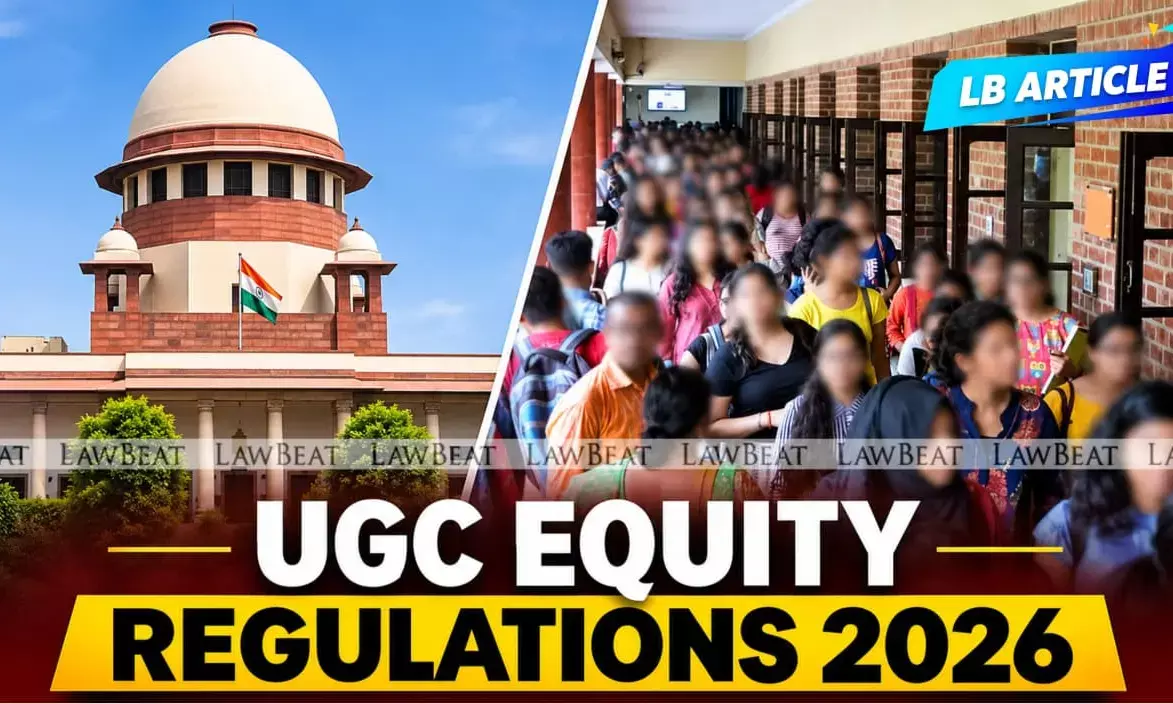
Can A Law Against Caste Discrimination Become A Tool For Discrimination? Understanding The UGC Regulations Row
In India, legislating on the issues concerning social justice is perhaps one of the most formidable challenges. We all know how caste and gender-based discrimination remain deeply entrenched in Indian society and they have survived decades of political, economic and social transformation.
In fact, successive economic models and political ideologies have struggled to dismantle these structural inequalities. Recently, the University Grants Commission (Promotion of Equity in Higher Education Institutions) Regulations, 2026, acquired a centre stage of this continuing challenge.
Notified on January 13, 2026, the Regulations had a seemingly clear and undoubtedly significant purpose: to establish a framework for promoting equity and addressing discrimination in higher educational institutions (HEIs) on several grounds, including religion, race, caste, gender, place of birth, or disabilities.
However, almost immediately after they were notified, the Regulations became the subject of widespread protests across the country. They also sparked political controversy and sharp disagreements across different sections of society and political arrangements.
Pressing concerns were raised over "reverse discrimination" seemingly appearing in the regulations and the potential misuse of institutional mechanisms therein. The debate is far from over, as the controversy has also acquired a distinct regional and political dimension.
Amidst all the brouhaha, on January 29, 2026, the Supreme Court directed that the Regulations be kept in abeyance. While doing so, the Court directed that the 2012 Regulations, will continue to operate and remain in force till further orders.
In latest development, the Apex Court was on Thursday informed that the Centre is mooting to formulate a committee to revisit the Regulations.
"The government has taken a decision that every student should be taken care of. Nobody should have any apprehension. Nobody should feel dissatisfied. We are also considering the interests of the younger generation. The government is contemplating appointing a committee" SG Mehta told the Top Court.
But, how could a regulatory framework, which was conceived to promote equity and eliminate discrimination across universities, has generated apprehensions about reverse discrimination and the possible weaponisation of institutional processes?
Answering this question, which happens to be the purpose of this piece, requires a careful examination of the Regulations themselves, the constitutional objections raised vis-à-vis the framework and not to forget, the deeper social and political anxieties that the controversy has brought to the surface.
So let's attempt to demystify the entire controversy.
What the 2026 regulations are all about?
The 2026 Regulations were not born in a vacuum, rather, they were the culmination of years of judicial prodding and civil society activism after the country witnessed national tragedies, especially, the suicide cases of Rohith Vemula (a Dalit research scholar at Hyderabad Central University in 2016) and Dr. Payal Tadvi (a tribal medical student in Mumbai in 2019).
In 2019, Radhika Vemula and Abeda Salim Tadvi, mothers of Rohith Vemula and Payal Tadvi, filed a Public Interest Litigation (PIL) in the Supreme Court, highlighting the inadequacy of the existing UGC Regulations of 2012 to deal with caste-based discrimination in educational institutions.
Their petition specifically prayed for a robust anti-discrimination mechanism across higher education institutions as they argued that the authorities had failed to implement the 2012 framework.
It was their argument that the then existing 2012-framework was largely advisory in nature and it lacked punitive teeth. Vemula and Tadvi contended that the 2012 regulations left marginalized students to suffer institutional bias in silence, with no effective measures at their disposal.
In fact, the data submitted to the apex court and the parliamentary panel by the UGC also underscored this crisis: the complaints of caste-based discrimination in higher educational institutions (HEIs) had surged by 118% between 2019-20 and 2023-24.
In January 2025, the Supreme Court offered a ray of hope by directing the UGC to come up with new regulations in 6 weeks to combat caste-based discrimination and suicides in higher education institutions. The Court clarified that the fresh norms cannot be a mere “ream of white paper” but must be effective.
In response, the UGC came up with the 2026 regulations and notified the same on January 13 this year.
If seen with a Sociological lens, the 2026 Regulations represented a paradigm shift. For decades, Indian educational policy hid behind euphemisms like addressing ‘backwardness’ or celebrating ‘diversity’ by treating inequality as a passive, victimless condition. However, the new regulations finally named the invisible elephant in the room as active, systemic ‘discrimination’ and the same was properly, categorically defined in the regulations.
With SC, ST, and OBC students now constituting roughly 60.8% of total enrolment in Indian higher education (according to AISHE data), democratizing the campus environment was no longer just a moral imperative, but a demographic necessity.
If seen side by side, unlike the 2012-framework, the 2026 Regulations shifted from an advisory model to a strict compliance regime. The framework mandated a highly structured internal architecture for all HEIs, including Equal Opportunity Centres (EOCs), Equity Committees, and Equity Squads.
It also prescribed rigid timelines: the equity committees must convene within 24 hours of a complaint, conclude their inquiries within 15 days and institutional heads must act within 7 days. In fact, non-compliant institutions faced severe penalties, including the withdrawal of UGC grants and de-recognition.
However, some legal and academic experts have pointed to a paradoxical dilution in the new framework. They argue that the 2012 Regulations explicitly listed 28 specific forms of discrimination, including hostel segregation, discriminatory grading and denial of access to scholarships.
The 2026 Regulations, however, omitted these specific instances and replaced them with a broader, arguably vague mandate to promote ‘equity’. For instance, they direct HEIs to eradicate discrimination and “to promote equity among stakeholders”.
The Regulations define ‘equity’ as “a level playing field for all stakeholders with respect to the entitlement and opportunity for the enjoyment of all legitimate rights”.
Simply put, the main concern is that, in the absence of clearly defined forms of discrimination and specific standards, the responsibility of interpreting what constitutes ‘discrimination’ would largely rest with internal institutional committees.
By necessary implication, this could lead to inconsistent decisions on the complaints, arbitrary interpretation and selective enforcement of the regulations.
The Case Against the Regulations
So if the intent was to “promote equity”, why did the regulations provoke outrage, particularly among students from the general (unreserved) category?
One of the principal concerns regarding the Regulations pertain to the relationship between two definitions under Section 3(1) [Regulation 3(1)(e) and Regulation 3(1)(c)] and whether their interaction could result in unequal protection against caste-based discrimination.
The Exclusive Definition and the Question of Unidirectionality
Regulation 3(1)(e) broadly defines "discrimination" to include any unfair, differential or biased treatment against "any stakeholder" on grounds including caste.
However, Regulation 3(1)(c) introduces a separate definition of "caste-based discrimination", limiting it to discrimination "only on the basis of caste or tribe against the members of the scheduled castes, scheduled tribes, and other backward classes."
Critics argue that this restrictive definition runs on the assumption that caste-based discrimination can operate only against members of these identified communities. In their view, this creates an asymmetry in the regulatory framework and it leaves a gap on the nature and extent of protection available to students belonging to the general category if they face discrimination on caste grounds.
Yes, one could argue that caste-based oppression in India has historically and disproportionately affected marginalised communities. However, that historical reality does not, by itself, resolve the primary issue (and concern) as to whether a regulatory framework can exclude other stakeholders from the specific definition of caste-based discrimination.
A necessary corollary would be a constitutional concern regarding whether such a distinction has a reasonable basis under Article 14 (Equality before law) and whether the broader definition under Regulation 3(1)(e) adequately addresses the potential gap.
Omission of the False-Complaint Provision
Perhaps one of the most debated changes occurred between the February 2025 draft and the final 2026 notification. The draft contained a provision proposing a fine, to be determined by the Equity Committee, against a person found to have made a false complaint. This provision has, however, been omitted from the final Regulations.
For students belonging to the general category, the absence of a specific mechanism to deal with knowingly false or malicious complaints raises concerns about the possibility of misuse and the lack of an adequate remedy against such complaints.
Another concern arises from the consequences prescribed for institutional non-compliance. Under Regulation 11, if an inquiry committee constituted by the UGC establishes that an institution has failed to comply with the Regulations, the Commission may debar it from participating in UGC schemes, offering degree programmes or offering programmes through online and distance-learning modes.
Such an institution could also be removed from the lists maintained under Sections 2(f) and 12B of the UGC Act.
Critics argue that, when these consequences are read alongside the time-bound complaint mechanism, they could create considerable pressure on institutions to demonstrate compliance.
The regulations also do not specify detailed procedural standards governing the assessment of evidence, the right of the person complained against to be heard and the standard of proof to be applied.
Such pressure, it is being argued, could incentivise institutions to prioritise visible compliance over careful and impartial adjudication.
The Case for the Regulations: Why Asymmetry is Necessary?
An objective legal analysis, however, requires examining the robust defense of the regulations. Proponents of the regulations argue that the Indian Constitution does not mandate a context-blind, one-size-fits-all neutrality.
As per Articles 15(4) and 15(5) of the Constitution of India, the State can make "special provisions" for marginalized classes. This is the doctrine of Substantive Equality.
While formal equality assumes all groups are situated identically, substantive equality, on the other hand, recognizes that marginalized groups carry the weight of historical and structural disadvantages.
Academics point out that caste discrimination is deeply asymmetric and that the General category students do not face systemic academic boycotts or institutional ostracization based on their birth in a particular caste.
Therefore, to demand a "caste-neutral" law, proponents argue, is to collapse structural oppression into a universal grievance framework, thereby diluting the ability of the law to protect its intended beneficiaries.
Furthermore, the proponents of these regulations also highlight the institutional power dynamics which is hard to be ignored. It is their case that in a vast majority of Universities, the Vice-Chancellors and senior professors belong to the general category and hence, the fear of an "anti-upper caste" institutional bias is empirically weak.
Regarding the deleted "false complaints" clause, the people backing the regulations argue that introducing a penalty for perjury would be inherently discourages genuine victims, who already lack social capital, from coming forward to voice their grievances and complaints.
The fear of facing retaliatory disciplinary action, if they fail to prove their case beyond a reasonable doubt, is liable to create a chilling effect which will ultimately render the regulations toothless.
Supreme Court's Intervention
When on January 29, 2026, the Supreme Court stayed the 2026 regulations, a bench comprising Chief Justice of India Surya Kant and Justice Joymalya Bagchi made certain relevant observations.
The Court noted that the regulations suffered from "ambiguities" and that the "possibility of their misuse cannot be ruled out". Justice Bagchi also questioned if ‘discrimination’ on the grounds of caste was already broadly defined under Section 3(1)(e), what was the jurisprudential necessity of creating a restrictive sub-clause 3(1)(c)?
The CJI also made philosophical observations regarding the goal of a "casteless society," questioning whether campuses should be perpetually divided into camps of the marginalized and the privileged.
While these oral remarks drew sharp criticism from anti-caste activists, who argued the bench was overlooking the lived, structural realities of Dalit and Adivasi students, the legal rationale for staying the regulation appear to remain firmly rooted in preventing the potential infringement of natural justice.
Road Ahead: Reconciling Equity with Due Process
The UGC Equity Regulations of 2026 represent a classic clash between the urgent need for social justice and the immutable principles of due process.
There is no denying that Indian campuses require a robust, enforceable mechanism to protect marginalized students from the deeply entrenched prejudices of caste. The systemic biases highlighted by academic committees and the tragic losses of students like Vemula and Tadvi demand accountability and such accountability cannot be ensured merely by advisory guidelines.
However, a law drafted to cure an injustice cannot give birth to a new one. Justice that moves with breakneck speed but lacks procedural clarity inevitably destroys institutional trust. The reviewing committee has a tough task to make the framework legally airtight and socially acceptable.
After all, true equity is not achieved by transferring vulnerability from one group to another. Rather, it is achieved by establishing an impartial, robust system where the oppressor is held accountable based on evidence and the victim is protected based on rights.