
Can The Government Really 'Withdraw FIRs'? Why Student Protesters' Demand May Be Legally Misconceived
Indian law has no mechanism to "withdraw" a registered FIR. Criminal proceedings can only end through closure reports, withdrawal from prosecution under Section 360 BNSS, or quashing.
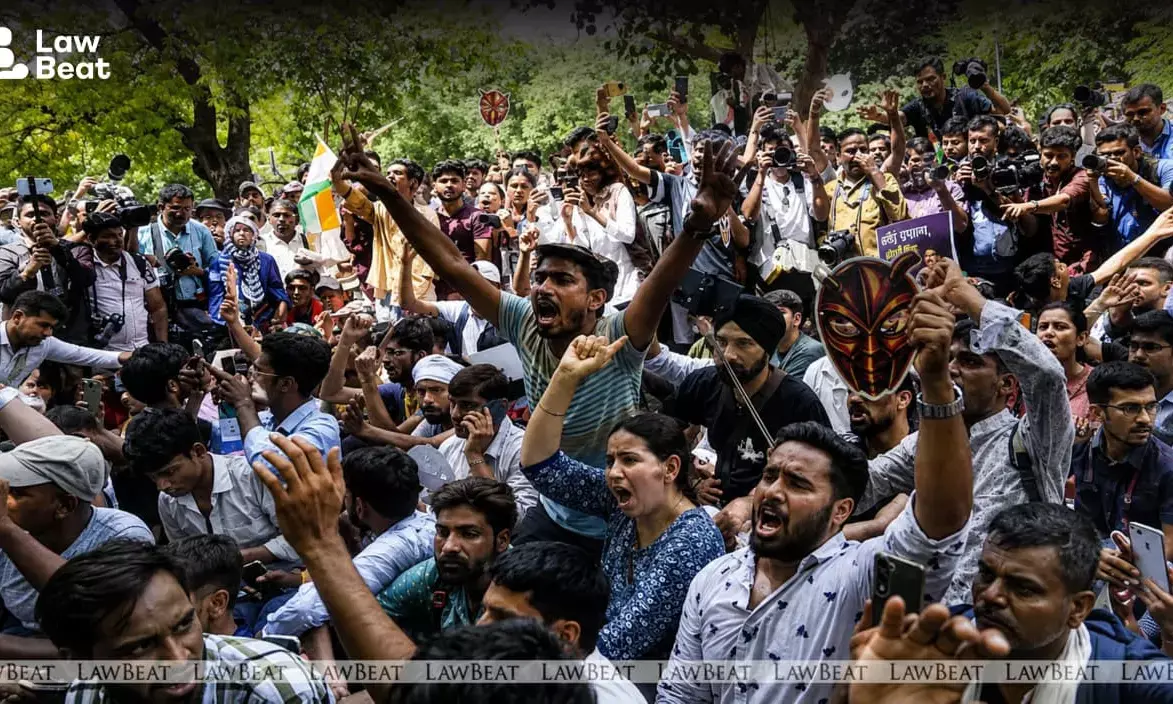
The Centre's reported assurance that it would "withdraw all FIRs" registered against students who participated in the nationwide protests over the alleged NEET-UG 2026 paper leak has sparked an important legal debate.
The issue gained further prominence after the Supreme Court, while granting interim protection to protesting students without criminal antecedents, permitted investigation into the registered FIRs to continue.
Because the FIRs thus remained live despite the interim order, the Cockroach Janta Party (CJP) renewed its demand that the government fulfil its assurance by 'withdrawing' the registered FIRs.
However, the controversy turns on a fundamental legal distinction that is often overlooked in public discourse. Indian criminal law does not recognise any statutory mechanism for "withdrawing" a First Information Report (FIR) once it has been registered. Instead, it provides several legally recognised procedures through which criminal proceedings arising from an FIR may eventually come to an end.
The debate, therefore, is not really about whether the government wishes to bring these cases to an end. Governments have, over the years, made policy decisions to discontinue prosecutions arising from political agitations, labour disputes, and student movements. Rather, the real legal question is how such a decision can be implemented within the framework of criminal law.
This distinction is significant because an FIR is not an executive order that can be revoked by another executive decision. Once a cognizable offence is registered, the criminal process is set in motion under the Bharatiya Nagarik Suraksha Sanhita, 2023 (BNSS), and its course is thereafter governed by statute and judicial oversight.
Consequently, if the demand is understood literally to require the government to "withdraw" registered FIRs, the law does not confer such a power.
If, however, it is understood as calling upon the government to facilitate the termination of criminal proceedings through legally recognised mechanisms, such as a closure report after investigation, withdrawal from prosecution under Section 360 BNSS (Section 321 CrPC), or other remedies available under law, the BNSS does provide such avenues, subject to statutory safeguards and the independent roles of the investigating agency, the Public Prosecutor and the courts.
It is this distinction between withdrawal of an FIR and withdrawal of criminal proceedings arising from an FIR that lies at the heart of the present controversy.
Supreme Court's Interim Order: Investigation Can Continue, But Students Protected
The legal debate unfolded against the backdrop of the Supreme Court's interim order passed on July 28 while hearing petitions alleging police excesses during the nationwide protests over the alleged NEET-UG 2026 paper leak.
A Bench led by the Chief Justice of India noted allegations that the police had used excessive force against students, including pellet guns, rubber bullets, electronic batons and lathis allegedly embedded with nails, causing serious injuries to protesters and members of the media.
The Court also recorded the Union government's submission, represented by Solicitor General of India Tushar Mehta, that anti-social elements had infiltrated the protests and attacked police personnel, resulting in injuries to more than 280 officers.
Observing that the allegations disclosed a prima facie case warranting an independent and impartial investigation, the Court issued notice to the concerned States and directed preservation of CCTV footage, drone recordings, body-camera footage, wireless communication records and other electronic evidence.
It further restrained authorities from publishing or disclosing personal information and digital data collected from protesters.
Most significantly, the Court ordered that Delhi and the concerned States may proceed with the investigation of the FIRs already registered; however, no coercive measures shall be taken against protesting students who do not possess criminal antecedents.
The order, however, does not state that the FIRs must necessarily culminate in prosecution or trial. Nor does it prohibit any legally recognised method by which criminal proceedings may subsequently come to an end.
The Court merely ensured that the investigation is not prematurely halted while simultaneously protecting eligible students from coercive action.
The Court's approach appears to balance two competing considerations. While it protected students without criminal antecedents from coercive action, it did not halt the investigation itself.
Had every investigation been stayed at the threshold, the investigating agencies would have been unable to ascertain whether any individual FIR disclosed a prosecutable offence or whether any particular person had any role beyond participating in a peaceful protest.
Equally, continuation of the investigation preserves the statutory process through which the police may determine whether the allegations are unfounded and deserve closure, or whether the evidence justifies filing a chargesheet.
In that sense, the interim order protects bona fide student protesters without foreclosing the investigation into allegations against any other persons, if the evidence so warrants.
Why "Withdrawal of FIR" Is Legally Different From Withdrawal of Prosecution
The controversy largely stems from the language used in political discourse.
Expressions such as "withdrawing FIRs" are frequently used by governments when announcing policy decisions and by political parties and protesters seeking relief. Legally, however, the phrase does not describe any recognised statutory procedure.
An FIR is merely the earliest information relating to the commission of a cognizable offence recorded by the police. It is neither substantive evidence nor an executive order that can be revoked by another executive decision. Rather, it is the document that sets the criminal law in motion.
Once an FIR is registered, the investigation proceeds in accordance with the BNSS. From that stage onwards, the criminal process is regulated by statutory provisions and judicial supervision. Consequently, an executive announcement by itself cannot erase or nullify a registered FIR.
This explains why the expression "withdrawal of FIR" is legally imprecise. While criminal proceedings initiated through an FIR may eventually come to an end, they can do so only through procedures specifically recognised under law.
Closure Report: The First Statutory Route
One such statutory route is through the investigation itself. If, upon completing the investigation, the police conclude that the allegations are false, based on a mistake of fact or law, or that the available evidence is wholly insufficient to justify prosecution, the investigating officer may submit a Final Report before the jurisdictional Magistrate.
Depending upon the practice followed in different States, such reports are commonly referred to as closure reports, 'B' Summary Reports or 'C' Summary Reports.
However, submission of a Final Report does not automatically terminate the proceedings.
In Abhinandan Jha v. Dinesh Mishra (1967), the Supreme Court held that although the investigating agency may conclude that no case for prosecution exists, the Magistrate is not bound by that opinion.
The Magistrate may accept the Final Report and close the proceedings, reject it and take cognisance of the offence, or direct further investigation.
Thus, even where the investigating agency itself concludes that prosecution should not continue, judicial scrutiny remains an indispensable safeguard.
The Supreme Court's decision permitting investigation into the student protest FIRs assumes significance in this context.
Continuation of the investigation does not necessarily mean that every FIR will culminate in prosecution. Rather, it preserves the statutory process through which the investigating agency may ultimately conclude that particular allegations are unsupported by evidence and submit a Final Report seeking closure.
Equally, it enables the authorities to distinguish between those who merely participated in peaceful protests and persons who, if the evidence so establishes, may have committed independent criminal offences.
The interim order, therefore, does not grant blanket immunity, nor does it presume criminal liability; it allows the investigative process to determine which statutory course is warranted in each case.
Withdrawal From Prosecution Under Section 360 BNSS
The second, and perhaps the most discussed, statutory mechanism is Section 360 of the Bharatiya Nagarik Suraksha Sanhita, 2023, which corresponds to the erstwhile Section 321 CrPC.
The provision authorises the Public Prosecutor or Assistant Public Prosecutor, with the court's consent, to withdraw from prosecuting any accused before judgment is pronounced.
The distinction is significant. Section 360 does not authorise withdrawal of an FIR. Instead, it enables withdrawal from prosecution after criminal proceedings have entered the judicial stage.
Where withdrawal is permitted before charges are framed, the accused is discharged. If it is permitted after charges have been framed, the accused stands acquitted in respect of the offences from which prosecution has been withdrawn.
Accordingly, the provision concerns termination of prosecution, not cancellation of the FIR itself.
Can the Government Direct the Public Prosecutor?
A recurring misconception is that once a government decides to withdraw criminal cases, the Public Prosecutor is bound to implement that decision. The Supreme Court has consistently rejected this proposition.
In Rajender Kumar Jain v. State through Special Police Establishment (1980), the Court held that although withdrawal from prosecution is an executive function, the discretion under the statute is vested in the Public Prosecutor and not the government. The Public Prosecutor must independently evaluate whether withdrawal advances the cause of public justice.
The judgment assumes particular significance because the Supreme Court expressly recognised that prosecutions arising out of student unrest, labour disputes, political agitations and communal disturbances may, in appropriate cases, be withdrawn if doing so promotes larger public interest, social harmony or public justice.
“Wherever issues involve the emotions and there is a surcharge of violence in the atmosphere it has often been found necessary to withdraw from prosecutions in order to restore peace, to free the atmosphere from the surcharge of violence, to bring about a peaceful settlement of issues and to preserve the calm which may follow the storm. To persist with prosecutions where emotive issues are involved in the name of vindicating the law may even be utterly counter-productive. An elected Government, sensitive and responsive to the feelings and emotions of the people, will be amply justified if for the purpose of creating an atmosphere of goodwill or for the purpose of not disturbing a calm which has descended it decides not to prosecute the offenders involved or not to proceed further with prosecutions already launched” the Supreme Court had observed.
However, the Court cautioned that the Public Prosecutor cannot merely act on executive instructions.
That principle was reiterated by the Constitution Bench in Sheo Nandan Paswan v. State of Bihar (1986), where the Supreme Court emphatically observed that the Public Prosecutor is not a "post office" of the government. Although the government may formulate policy, the ultimate decision to seek withdrawal must reflect the prosecutor's independent application of mind.
Judicial Consent Is Not An Empty Formality
Even an independently formed opinion of the Public Prosecutor is insufficient by itself. Section 360 expressly requires the court's consent before prosecution may be withdrawn.
In State of Kerala v. K. Ajith (2021), the Supreme Court clarified that the court is not expected to undertake a detailed appreciation of evidence at this stage. Nevertheless, it must satisfy itself that the Public Prosecutor has exercised independent judgment and that withdrawal would advance the administration of justice rather than defeat it.
More recently, in Bal Kumar Patel @ Raj Kumar v. State of Uttar Pradesh (2025), the Supreme Court reiterated that judicial consent under Section 321 CrPC (now Section 360 BNSS) is not a mechanical exercise. Courts must be satisfied that the statutory requirements have been genuinely fulfilled before permitting withdrawal.
Therefore, even when the executive publicly announces its intention to discontinue criminal cases, implementation ultimately depends on two independent statutory authorities: the Public Prosecutor and the judiciary.
Quashing By The High Court
A separate legal remedy lies before the High Court under Section 528 BNSS (formerly Section 482 CrPC), which preserves the Court's inherent powers.
The High Court may quash criminal proceedings where the continuation of the prosecution would amount to an abuse of the process of law, or where intervention is necessary to secure the ends of justice.
The Supreme Court in State of Haryana v. Bhajan Lal (1990) laid down illustrative categories in which criminal proceedings may be quashed. Subsequently, in Neeharika Infrastructure Pvt. Ltd. v. State of Maharashtra (2021), the Court cautioned that this extraordinary jurisdiction should be exercised sparingly and with great circumspection, particularly at the investigation stage.
Unlike withdrawal from prosecution, however, quashing is an exclusively judicial remedy. Neither the executive nor the police can compel the High Court to exercise its inherent jurisdiction.
Other Statutory Outcomes
Apart from closure reports, withdrawal from prosecution, and quashing, criminal proceedings may also terminate through discharge where the court finds no sufficient ground to proceed, or through acquittal after trial if the prosecution fails to establish guilt beyond reasonable doubt.
Each of these outcomes flows from judicial determination and not from unilateral executive action.
Concluding remarks
The controversy surrounding the demand to "withdraw FIRs" is therefore as much about legal terminology as about legal power.
Governments have, on several occasions, announced decisions to discontinue criminal cases arising from political agitations, labour movements, and student protests. Such policy decisions are not unknown to Indian criminal jurisprudence.
However, once an FIR has been registered, the executive cannot simply erase it through an administrative declaration.
If the intention is to terminate criminal proceedings, the law provides recognised mechanisms, including closure reports, withdrawal from prosecution under Section 360 BNSS and appropriate proceedings before constitutional courts.
Each of these mechanisms, however, carries statutory safeguards and involves independent decision-making by the investigating agency, the Public Prosecutor and the judiciary.
The Supreme Court's interim order has not foreclosed any of these statutory avenues. It has merely ensured that investigations continue in accordance with law while protecting students without criminal antecedents from coercive action.
Ultimately, whether the FIRs culminate in closure, withdrawal from prosecution, quashing, discharge or trial will depend not on executive announcements alone, but on the legal procedures prescribed under the BNSS and the independent exercise of statutory powers by the authorities entrusted with administering criminal justice.
Thus, while the government's political promise may indicate its intended policy, its implementation must still pass through the procedural safeguards established by criminal law.