
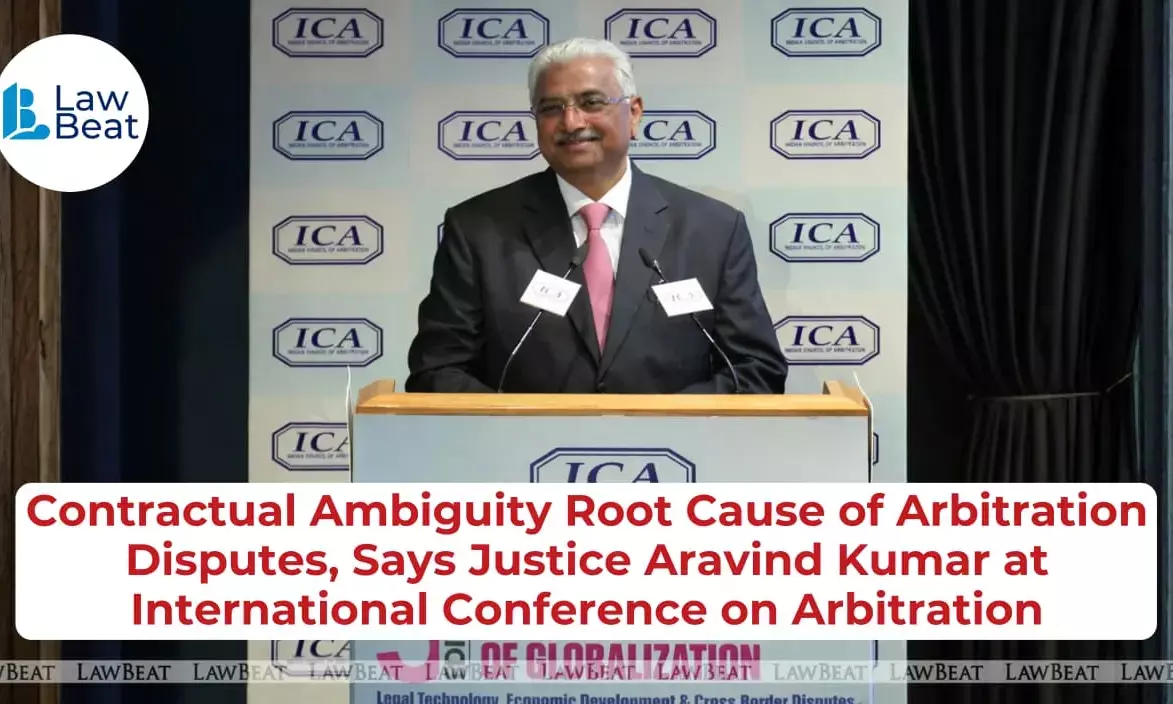
Contractual Ambiguity Root Cause of Arbitration Disputes, Says Justice Aravind Kumar
“Autonomy Without Accountability Is Abdication”: Justice Aravind Kumar Calls for Guardrails in Arbitration
At the 5th Edition of the ICA International Conference on “Arbitration in the Era of Globalization,” Justice Aravind Kumar, Judge of the Supreme Court of India offered a reflective and structurally grounded perspective on the evolving contours of arbitration, positioning India at a critical inflection point in global dispute resolution.
Framing arbitration as a “universal language of fairness, balance, and resolution,” the Justice Kumar drew a philosophical distinction between courts and arbitral processes. While courts intervene after disputes have hardened, arbitration, he noted, seeks to preserve agreement even in disagreement. Yet, this aspirational framework must contend with practical realities where process integrity and legitimacy come under strain.
Rejecting the simplistic binary of judicial intervention versus arbitral autonomy, Justice Kumar reframed the debate around “legitimacy versus abuse.” Arbitration, he emphasized, cannot become a shield for procedural unfairness or jurisdictional excess. “Autonomy without accountability is not arbitration, it is abdication,” he remarked, advocating for a calibrated judicial role that preserves the sanctity of the process without undermining its independence.
The address gains significance against the backdrop of India’s surging arbitration landscape. Citing institutional data, Justice Kumar highlighted a dramatic rise in filings at the Delhi International Arbitration Centre and a sharp increase in cases at the Mumbai Centre for International Arbitration. India’s growing recourse to international forums such as the Singapore International Arbitration Centre further signals its emergence as a serious arbitration jurisdiction. These developments, he observed, reflect not just numerical growth but a structural shift in India’s dispute resolution ecosystem.
However, the expansion brings with it heightened responsibility. Arbitration today serves as a “jurisdictional signal of commercial credibility,” where global investors evaluate not only statutory frameworks but also the consistency and restraint of judicial responses. India’s challenge, therefore, lies in ensuring that growth is matched by doctrinal clarity, predictability, and institutional maturity.
In a significant doctrinal contribution, Justice Kumar proposed a structured framework for assessing anti-arbitration injunctions, limiting judicial intervention to three categories: jurisdictional illegitimacy, procedural unconscionability, and abuse of process. Beyond these narrowly tailored grounds, he cautioned, courts must exercise restraint to avoid undermining arbitral autonomy.
Interpreting the Arbitration and Conciliation Act, 1996, he reiterated that while Section 5 mandates minimal judicial interference, it does not altogether exclude judicial oversight. Instead, courts retain a “threshold guardianship” role, particularly in assessing the validity and enforceability of arbitration agreements under provisions such as Section 45.
Drawing from precedent, including Modi Entertainment Network v WSG Cricket and subsequent rulings, Justice Kumar underscored that anti-arbitration injunctions must be exercised sparingly, guided by principles of comity and caution. Courts, he clarified, are not appellate forums over arbitral proceedings but custodians of their foundational legitimacy.
Significantly, the judge traced the root of many arbitration disputes not to judicial overreach but to defective drafting. Ambiguities in seat, governing law, and procedural clauses, he noted, often sow the seeds of future litigation. Echoing earlier jurisprudence, he described the arbitration agreement as the “foundation stone” upon which the entire process rests.
Closing on a personal note, Justice Kumar urged young lawyers to embrace rigor, discipline, and commitment, linking professional dedication with long-term success. His address ultimately situates arbitration not merely as a procedural alternative but as a test of institutional credibility in an increasingly interconnected legal order.
Event Name: 5th Edition of ICA International Conference on “Arbitration in the Era of Globalization”
Event Date: April 11, 2026