
Don’t Blame Judges For Disposal Rates, Said Justice A. Amanullah At ADR Conference
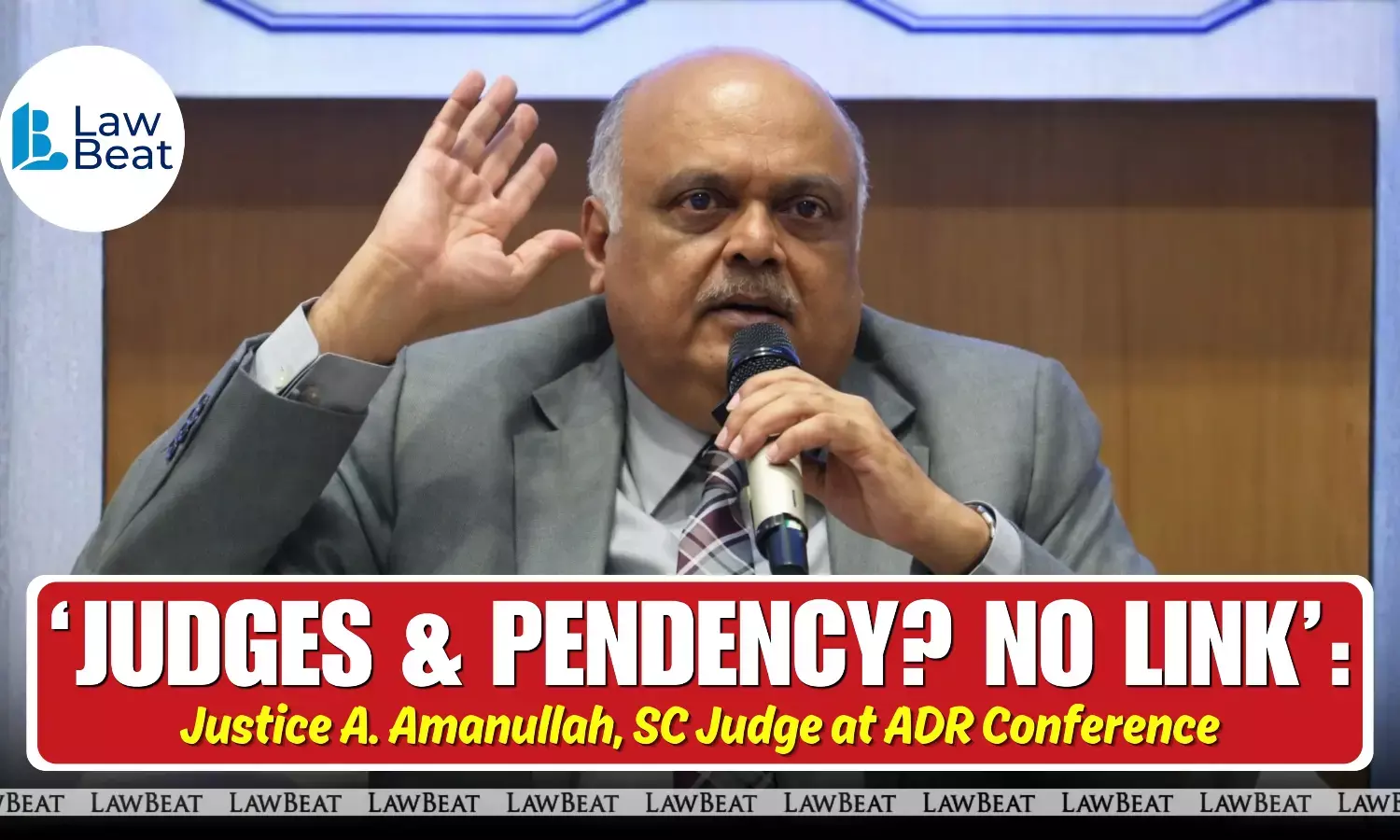
Justice A. Amanullah speaks at 5th ICA International Conference on Arbitration in the Era of Globalization”
Supreme Court judge Justice A Amanullah on Friday squarely placed responsibility for India’s mounting case pendency on the legal profession rather than the judiciary, speaking at a conference on “ADR Mechanisms: A Catalyst for Global Economic Growth and Investor Confidence” organised by the Indian Council of Arbitration ICA).
Pushing back against the widely held view that judges are responsible for the disposal crisis, Justice Amanullah pointed to the sheer volume of cases on a judge’s roster as evidence that the bench has limited room to manoeuvre. A lower court judge carries between 400 and 500 cases at any given time. A High Court judge handles upwards of a thousand. The Supreme Court’s numbers, he suggested, are beyond reasonable reckoning.
“There is absolutely no connection with the judge and the disposal rate,” he said. “It depends on the bar, how long they want to argue.”
Justice Amanullah acknowledged that judges do have the power to stop lawyers mid-argument, and said he exercises that power himself. But he noted that structural delays driven by the bar remain largely unchecked, and that the culture of seeking and granting adjournments has become so entrenched that it now shapes expectations on all sides of a dispute.
He cited the example of civil court practice where lawyers routinely seek and receive adjournments spanning years. He described a scenario where a tenant’s counsel walks into court, asks for two years on a matter, and walks away with exactly that. The exchange, he noted, takes place almost as a matter of course.
“If you begin with this, how do you expect honesty in the system?” he asked. “How do you expect honesty to be delivered and conveyed? We have to do some soul-searching.”
The remarks were pointed, coming at a conference where the central argument was that alternative dispute resolution mechanisms can serve as a catalyst for investor confidence and economic growth. Arbitration, mediation, and conciliation are frequently presented as solutions to the delays that plague conventional litigation. Justice Amanullah’s observations about adjournment culture and professional conduct raised implicit questions about whether those delays follow disputes into ADR forums as well.
On the question of judicial expectations, Justice Amanullah was equally direct. He cautioned against placing unrealistic demands on judges in terms of either output or intellect. A judge, he argued, works within fixed court hours, takes up as many matters as time permits, and moves to the next. The expectation that judges alone can turn around disposal rates without corresponding discipline from the bar, he suggested, is misplaced.
On brilliance, he was unequivocal. Judges, he said, need not be exceptional intellects. They are already sensitised to the human and legal dimensions of the disputes before them by the very nature of the work they do every day. “Don’t expect brilliance from a judge,” he said.
For a conference examining how ADR can build investor confidence in India, the intervention carried weight. Investors and businesses considering India as a seat for arbitration or dispute resolution look not just at statutory frameworks and enforcement records but at the broader culture of the legal system they are entering.
Justice Amanullah’s remarks suggested that the conversation around judicial reform and case disposal cannot be confined to the bench alone. The bar, he argued, is an equal and perhaps more consequential participant in how long disputes take to resolve and how much trust the system is ultimately able to command.
The conference brought together legal practitioners, policymakers, and stakeholders to examine the expanding role of ADR mechanisms in supporting economic growth and strengthening the confidence of domestic and foreign investors in India’s dispute resolution ecosystem.