
Sovereignty, Dharma and the Limits of Global Power: Reflections from VK 4.0 Session 7
Sovereignty Beyond Power: Reclaiming Dharma in the Architecture of Global Governance
The seventh session of Vasudhaiva Kutumbakam Ki Oar 4.0 unfolded as a searching interrogation of multilateral institutions in what the organisers described as a sankraman kaal; a period of civilisational and geopolitical transition. Titled "Sovereignty: Ancient and Modern”, the discussion questioned whether global institutions, conceived in a very different historical moment, remain capable of addressing contemporary anxieties around sovereignty, justice and equitable global order.
Opening the session, His Holiness Maharaj ji anchored the debate in the vulnerability of human beings and the necessity of sovereign power for their protection. He traced sovereignty in ancient India to a moral foundation, arguing that it was never absolute or unbounded. Power, both territorial and extra-territorial, was consciously limited by rajneeti and dharma, ensuring that the sovereign did not transgress ethical boundaries.
Sovereignty, he noted, was vested in the State in modern India and codified through the Constitution, from which even the judiciary derives its authority. This codification, he suggested, distinguishes India from many other nation-states, while also revealing the inherent tensions that arise when sovereignty is continuously contested.
Drawing a contrast with Europe, Maharaj ji recalled the 16th century rupture when King Henry VIII asserted absolute sovereignty over both temporal and spiritual domains, breaking from ecclesiastical authority. That moment, he argued, marked the emergence of an unrestrained idea of absolute sovereignty, immune from moral accountability and prone to misuse. Such absolutism, he suggested, later found expression in global institutions that claim authority over states without adequate ethical checks.
The discussion then turned to the emergence of multilateral institutions in the 19th and 20th centuries.
Maharaj ji questioned why such institutions did not exist earlier and what historical compulsions led to their formation.
In his assessment, bodies like the United Nations were born out of global conflict but evolved into structures that could intrude into national sovereignty. While cooperative forums such as G20 and BRICS function without compelling states to surrender sovereign authority, the same could not be said of the UN system.
Recalling India’s own struggle for membership in the United Nations in 1945, when it was a nation but not yet a sovereign state, he underscored how international law privileges statehood over civilisational continuity.
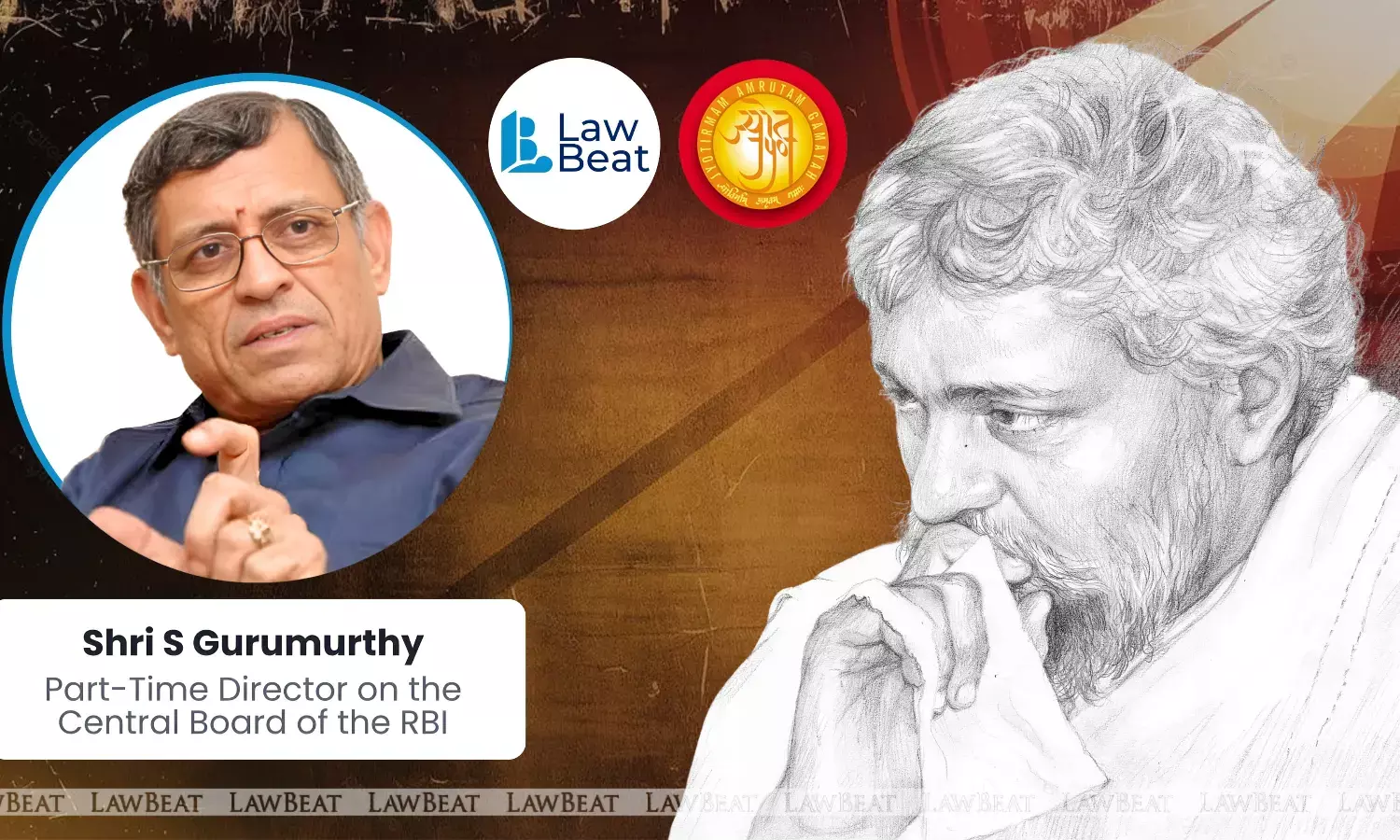
Panelist Shri S Gurumurthy, Part-Time Director, Central Board of RBI extended this critique by situating multilateralism within India’s civilisational worldview. He argued that collectivising human concerns is a strength, but finding a truly common ground is difficult when modernity rejects tradition. For Gurumurthy, Vasudhaiva Kutumbakam does not merely signify that the world is one family, but that the earth itself is a shared home accommodating all living beings. This ecological and ethical inclusivity, he contended, is absent from modern global governance structures.
Contrasting Western notions of sovereignty with India’s dharmic tradition, Gurumurthy argued that while the former is rooted in power and violence, the latter is anchored in dharma. In ancient India, he claimed, punishment and coercion were exceptional rather than routine, and justice was guided by principles of non-harm, even in warfare. Modern international law, he suggested, arrived only after devastating wars that normalised the killing of non-combatants; an outcome of domineering sovereignty rather than moral restraint.
The session also engaged with contemporary geopolitical realities, particularly the growing impatience of the Global South with the slow pace of reform in multilateral institutions.
Questions were raised about whether the time had come to intensify diplomatic pressure, explore disassociation, or build alternatives through platforms like BRICS+. Gurumurthy framed this moment as an inflection point, noting that as India rises as both a civilisation and a power, it is uniquely placed to revive a discourse rooted in dharma rather than domination.
Closing the session, Gurumurthy invoked Jawaharlal Nehru’s reflection on India’s civilisational confusion, caught between rejecting tradition and uncritically embracing modernity. That confusion, he warned, risks leaving future generations without moral direction. The discussion ultimately converged on a shared concern: that multilateral institutions, unless reimagined through ethical limits, respect for sovereignty and civilisational wisdom, may continue to lose legitimacy in an increasingly multipolar world.
At its core, Vasudhaiva Kutumbakam Ki Oar 4.0 attempts to bridge ancient Indian value systems with contemporary constitutional and legal frameworks. Drawing from ideas rooted in Indian Rajneeti, philosophy, jurisprudence, and civilisational ethics, the conclave explores whether India’s modern legal system is sufficiently equipped, both structurally and institutionally, to integrate indigenous constitutional thought while responding to present-day legal, political and governance challenges.