
“We Ask What the State Gives Us, Not What We Give the Nation”: Justice S V N Bhatti on Fundamental Duties
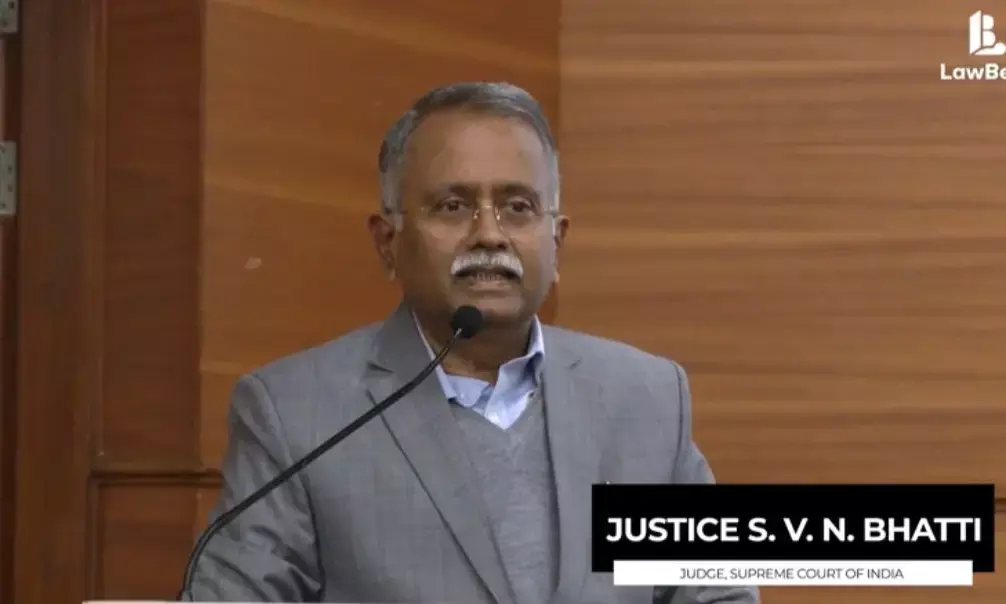
Supreme Court judge Justice S V N Bhatti speaking at the Adhivakta Parishad Supreme Court Unit event in New Delhi on the need to strengthen awareness of fundamental duties under Article 51A.
Justice S V N Bhatti of the Supreme Court of India said that citizens increasingly view the nation as a service provider rather than recognising their own constitutional obligations. Speaking at an event organised by the Adhivakta Parishad Supreme Court Unit, the judge stated that public discourse focuses heavily on fundamental rights while the performance of constitutional duties under Article 51A receives limited attention. He said this imbalance has created a civic culture where people expect services from the state but do not assess their own duty based contributions to national development.
Justice Bhatti, addressing lawyers, senior advocates, academicians and law officers, began by highlighting the significance of discussing duties at a time when rights dominate legal and public conversations. He stated that the weakening of duties has not begun in the Constitution. Instead, the dilution begins when citizens stop seeing themselves as co owners of the Republic. He said that fundamental duties must be treated as constitutional obligations similar to the responsibilities a person owes to a family.
The judge said that the topic of fundamental duties was selected to encourage group discussions within the Parishad because discussions generate ideas and strengthen constitutional awareness. He noted that Adhivakta Parishad, since its establishment in 1992, has worked on social justice, research, public engagement and legal awareness, and that duties are fully aligned with these objectives.
Justice Bhatti used economic indicators to explain why civic responsibility must grow in proportion to national progress. India’s GDP in 1950 to 1951 was 50.6 billion dollars and is now 4.19 trillion dollars. The Union Budget in the early years of the Republic was less than two rupees per individual but stands today at 50,65,345 crore rupees. He said this increase in national wealth requires a proportional increase in public commitment to safeguarding constitutional values and the wellbeing of citizens.
He said that external threats to the sovereignty and integrity of India are managed by the armed forces. However, the risks created by internal elements can be addressed only when citizens voluntarily perform their duties. He described certain elements within society as capable of undermining national development and said the performance of duties can help citizens identify whether an action protects or affects their own rights.
Justice Bhatti said that while asserting rights is important, the voluntary performance of duties gives rights their full meaning. He invoked the idea that rights and duties are connected and quoted the view that the true source of rights is duty. He asked the audience whether citizens have ever actively asked themselves what their holy duty is toward the country.
The judge emphasised that the legal fraternity plays a central role in strengthening awareness about Article 51A. According to him, lawyers have significant influence across society and can improve public understanding of constitutional duties through engagement, education and example. He said that advocates are often viewed as models of disciplined conduct and therefore must demonstrate voluntary compliance with duties in their professional lives.
Justice Bhatti encouraged members of the Parishad to study clauses A, C, D, E, H and I of Article 51A and interpret them in ways that can be applied in daily civic behaviour. He suggested that the Parishad prepare yearly priority lists on duties and conduct seminars, discussions and campaigns across chapters in different states and districts to make the subject more accessible.
Discussing the constitutional framework, Justice Bhatti noted that fundamental duties were introduced through the Forty Second Amendment which inserted Part IVA into the Constitution. Although duties are not enforceable by a writ, they are described as fundamental and are therefore not subordinate to fundamental rights. He said rights may appear significant in isolation but lack long term strength if duties are not performed.
Looking ahead to the centenary year of independence in 2047, Justice Bhatti said India can progress more effectively if citizens follow their duties and the state responds by implementing directive principles with greater vigour. He said that a civic environment built on mutual responsibility between citizens and the state forms the basis for future development.
Justice Bhatti concluded by urging the Parishad to circulate soft copies of Article 51A to members and organise campaigns focused on the education and implementation of fundamental duties. He said that a duty based civic culture will help safeguard both national resources and constitutional values.