
2020 Delhi Riots | 'Jai Siya Ram', 'Har Har Mahadev' Slogans Alone Not Enough To Make Out Communal Offence: Court Acquits 12
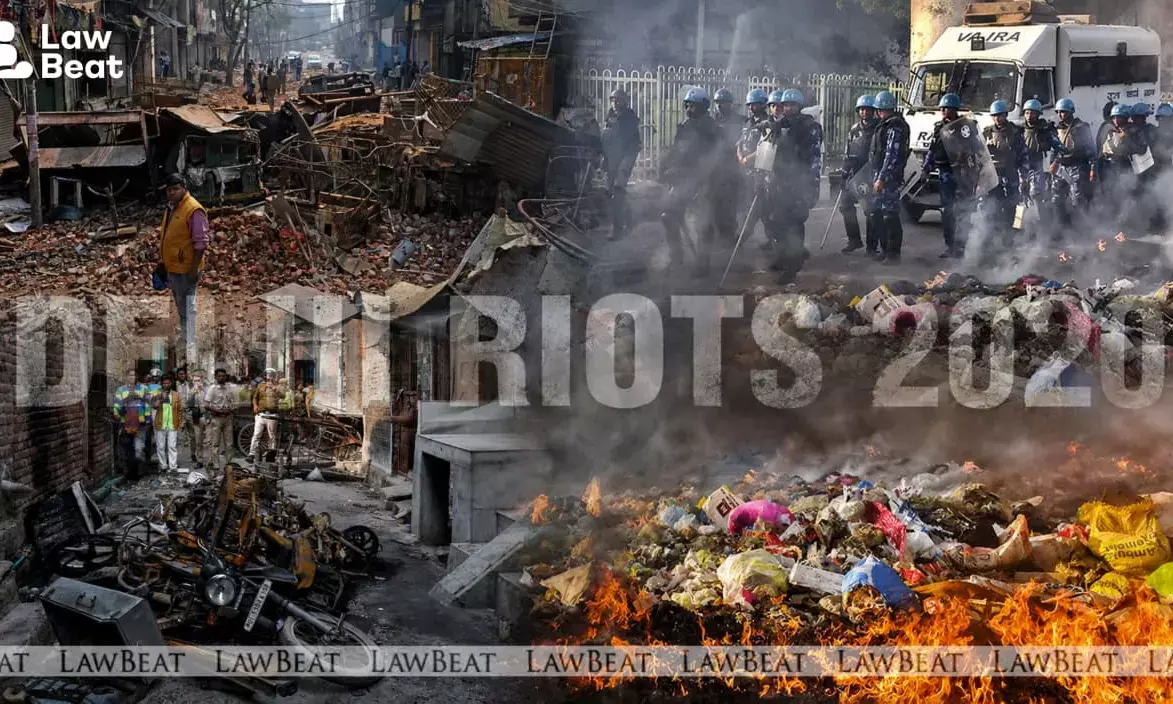
Five convicted by Delhi court for attacking police during Delhi riots.
A Delhi court recently acquitted 12 accused in a 2020 Delhi riots case concerning the death of one Mursaleen, holding that merely raising slogans such as "Jai Siya Ram" and "Har Har Mahadev" was not sufficient, by itself, to establish communal offences punishable under Sections 153A or 505 of the Indian Penal Code (IPC).
The Court clarified that the slogans could not be treated as proof of the charged communal offences unless accompanied by acts satisfying the ingredients of the relevant penal provisions.
The judgment was delivered by Additional Sessions Judge Parveen Singh, North East District, Karkardooma Courts, Delhi, on August 25, 2026.
The case involved charges under Sections 144, 147, 148, 149, 302, 201, 395, 396, 412, 432, 435, 153A, 505 and related provisions of the IPC. All 12 accused were acquitted of the principal charges, while one Himanshu Thakur was separately convicted under Section 411 IPC.
Court on 'Jai Siya Ram', 'Har Har Mahadev' slogans
The issue of religious slogans arose specifically while the Court was considering the Sections 153A/505 IPC charges.
The prosecution argued that the accused were members of a large armed mob during the riots and that the mob was chanting "Jai Siya Ram" and "Har Har Mahadev" allegedly to incite communal frenzy. The prosecution relied on this circumstance to contend that Sections 153A/505 read with Section 149 IPC were established.
The Court rejected the contention that the slogans, standing alone, were sufficient. It held: "However, merely raising these slogans is not an offence unless these slogans are accompanied by some acts falling foul of either section 153A IPC or section 505 IPC."
The Court had already observed that no overt act of a communal nature had been proved against the alleged unlawful assembly. It therefore found that the mere fact that the crowd was raising the two slogans could not establish the ingredients of Sections 153A or 505 IPC.
Eyewitness turned hostile in Murder case
The prosecution case also centered on the alleged murder of Mursaleen during the February 2020 Delhi riots.
However, the prosecution's Special Public Prosecutor conceded that its principal eyewitness, Divesh Rajpoot (PW7), had turned hostile. The prosecution had no other evidence establishing how, where, when and who had killed Mursaleen.
Consequently, the prosecution conceded that there was no evidence to sustain the charges under Section 302 read with Section 149 IPC or Sections 395/396 read with Section 149 IPC.
The Court independently found that none of the witnesses produced as eyewitnesses to the murder supported the prosecution's case or stated that they had witnessed Mursaleen being murdered by the riotous mob at Johripur Pulia.
It further found no evidence establishing dacoity, the offence under Section 432 IPC, mischief by fire under Section 435 IPC, or destruction of evidence under Section 201 IPC.
No specific weapons or overt acts attributed
The prosecution sought to establish that the accused were members of an armed unlawful assembly involved in rioting and vandalism.
However, the Court emphasised the absence of specific evidence connecting the individual accused with the alleged offences. In examining Section 144 IPC, the Court noted that no weapon had been attributed to any particular accused while they were allegedly members of the unlawful assembly.
It therefore held that the prosecution had failed to prove the ingredients of Section 144 IPC.
This finding also undermined the prosecution's attempt to sustain the related rioting and unlawful-assembly charges through Section 149 IPC.
'Kattar Hindu Ekta' WhatsApp chats
The Court also considered the WhatsApp group "Kattar Hindu Ekta", which the prosecution relied upon as evidence of communal hatred and incitement.
Significantly, the Court found that the chats did have an intent to spread "hatred and animosity between two communities" and that the effect of this intent was also visible from the chats.
However, the prosecution itself acknowledged that one Lokesh Solanki had already been convicted and sentenced under Sections 153A or 505 IPC in another FIR on the basis of the same chats.
The Court consequently held: "Therefore, in my considered opinion, in view of Article 20 of the Constitution of India, the accused cannot be convicted for the same offence again."
Himanshu Thakur convicted under Section 411 IPC
While the principal charges failed, the Court found separate evidence against Himanshu Thakur regarding Mursaleen's mobile phone.
The VIVO phone belonging to Mursaleen was recovered from Himanshu, who was also found to have been using it with a SIM card issued in his father's name. The prosecution produced evidence establishing the phone's connection with Mursaleen.
The Court did not sustain the charge under Section 412 IPC (Dishonestly receiving property stolen in the commission of a dacoity), since the prosecution had failed to establish the underlying dacoity. However, it found the ingredients of Section 411 IPC (Dishonestly receiving stolen property) proved and convicted Himanshu under that provision.
Court acquits 12 of major charges
In its final findings, the Court held that the prosecution had failed to prove beyond reasonable doubt the offences under Sections 144/147/148 read with Section 149; Sections 302/201/432/435/34 read with Section 149; Sections 395/396 read with Section 149; and Sections 153A/505 read with Section 149 IPC.
All 12 accused were accordingly given the benefit of doubt and acquitted of these offences. Himanshu Thakur alone was convicted under Section 411 IPC.
Case Title : State v Lokesh Solanki