
Bhojshala Hearing Begins: Plea For Exclusive Hindu Worship Raised Before Madhya Pradesh High Court
Sanskrit Inscriptions, Yantras Signal Temple Character: Plea in MPHC Bhojshala Hearing
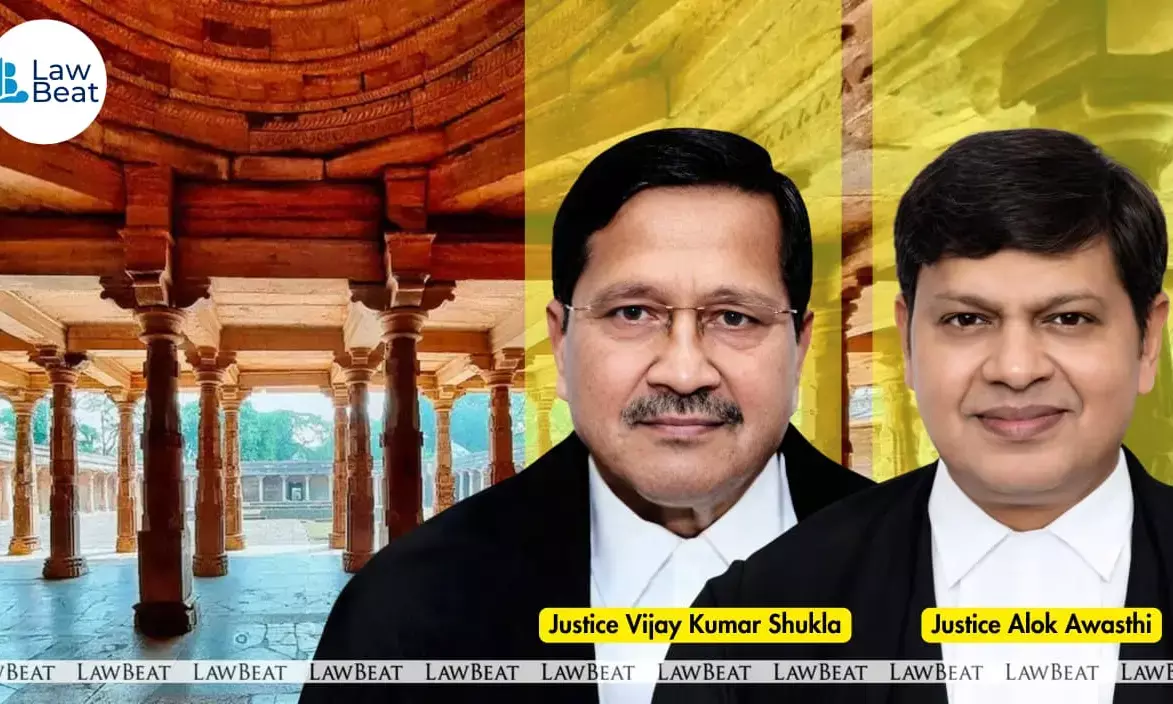
The Madhya Pradesh High Court at Indore on Monday commenced hearing in the long-pending Bhojshala dispute before a division bench of Justice Vijay Kumar Shukla and Justice Alok Awasthi, with advocate Vishnu Shankar Jain leading arguments, framing the case not as one of title or possession but as one concerning the right to worship.
At the outset, Jain clarified, “This is not a case for ownership or possession. This is a case for right of worship,” as he outlined prayers seeking exclusive rights for Hindus to perform puja at the disputed premises in Dhar. The petition challenges the Archaeological Survey of India’s April 7, 2003 order, which currently allows Muslims to offer namaz on Fridays while permitting Hindu worship on specified occasions.
Central to Jain’s submissions was the argument that the 2003 ASI order forms the “heart of the controversy” and is legally unsustainable for failing to determine the true character of the site before regulating its usage. He contended that the statutory scheme under the Ancient Monuments and Archaeological Sites and Remains Act, 1958 mandates such determination as a prerequisite.
Referring extensively to Section 16 of the 1958 Act, Jain argued that a protected monument which is also a place of worship “shall not be used for any purpose inconsistent with its character.” Emphasising the mandatory nature of the provision, he submitted that the use of the word “shall” imposes a binding restriction on the State and the ASI. “The mandate is clear; the authority must first ascertain the character of the place of worship and then ensure that no action is inconsistent with that character,” he argued.
The bench engaged with the statutory framework, questioning whether a distinction exists between a protected monument and a monument of national importance. Jain responded that under the 1958 Act, every monument declared to be of national importance qualifies as a protected monument, thereby bringing it within the statutory regime.
Tracing the legislative history, Jain submitted that the site was initially protected under the Ancient Monuments Preservation Act, 1904, later declared of national importance under the Ancient and Historical Monuments and Archaeological Sites and Remains (Declaration of National Importance) Act, 1951 (now repealed), and is presently governed by the 1958 Act. He relied on Section 3 of the 1958 Act to argue that monuments earlier declared of national importance continue to be governed under the present statute without overlap.
A significant portion of the arguments focused on the requirement of determining the “true character” of the site. Jain cited a prior order of the High Court dated March 11, 2024 directing an ASI survey, which was subsequently affirmed by order dated January 22, 2026 of the Supreme Court, to contend that such ascertainment is foundational. He read from the order to submit that “ascertainment of character of a place of worship is a precondition to determine its essential purpose.”
The court also examined the interplay between Sections 16 and 18 of the Act. While Section 16 restricts usage inconsistent with the monument’s character, Section 18 guarantees public access. Justice Shukla observed that the statute appears to balance restrictions on the State with access rights for the public, indicating that both provisions must be read harmoniously.
Jain, however, maintained that the right of access cannot override the primary obligation to preserve the character of the monument. “The first duty is to determine what the place is. Only then can rights be regulated,” he argued, adding that any arrangement permitting use contrary to that character would amount to a continuing illegality.
In support of his claim that the site is a Saraswati temple, Jain referred to photographs, inscriptions, and historical materials placed on record. He argued that features such as Sanskrit inscriptions, yantras, and alleged remnants of Hindu deities indicate the temple character of the structure. “These features cannot exist in a mosque,” he submitted, while acknowledging the need to substantiate such claims through documented research.
He further submitted that two idols of Vagdevi and Amba, allegedly recovered from the site during the colonial period, are presently housed in the British Museum in London. Relying on historical records and research material, he contended that these idols originated from the Bhojshala complex and their existence abroad reinforces the claim of a pre-existing temple at the site.
The bench, however, cautioned against reliance on general assertions, observing that claims regarding architectural or religious features must be backed by credible material. “This is a court of law. We require supporting research,” Justice Shukla remarked.
Jain further invoked provisions relating to judicial notice under Section 52 of the Bharatiya Sakshya Adhiniyam, 2023 (corresponding to Section 57, Indian Evidence Act, 1872), arguing that courts are entitled to rely on historical texts, gazetteers, and scholarly works in matters involving ancient history. Drawing parallels with the Ayodhya judgment, he submitted that such materials are admissible to establish historical context where direct evidence is unavailable.
The hearing remained focused on the legal framework governing protected monuments and the extent of the State’s obligations under the 1958 Act, with the court indicating that the matter would continue tomorrow (April 7, 2026) for further arguments.
Case Title: Hindu Front for Justice (Regd. Trust No. 976) Through its President Ms. Ranjana Agnihotri v. Union of India Ministry of Culture and other connected matters
Date of Hearing: April 6, 2026
Bench: Justice Vijay Kumar Shukla and Justice Alok Awasthi