
Bhojshala-Kamal Maula Mosque | ASI Argues Protected Monument Status Overrides Worship Claims
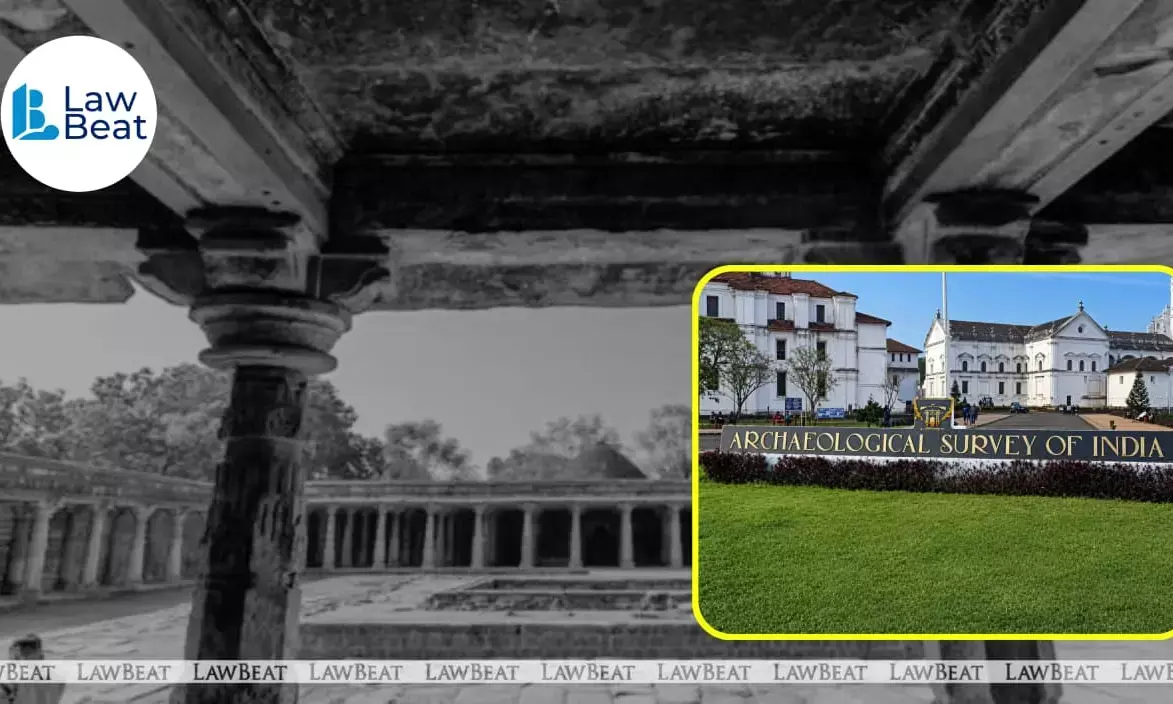
ASI Says Survey Report Prevails, Rejects Claims of Exclusive Religious Rights
The Indore Bench of the Madhya Pradesh High Court on Monday continued hearing in the Bhojshala dispute, with Additional Solicitor General Sunil Kumar Jain advancing submissions on behalf of the Archaeological Survey of India (ASI), asserting that the site has been a protected monument since 1904 and remains under the regulatory control of the ASI.
Appearing before a Division Bench of Justice Vijay Kumar Shukla and Justice Alok Awasthi, Jain began by recapitulating earlier arguments on the historical and statutory status of the monument. He relied on archival materials including the 1902–03 ASI Annual Report, Imperial Gazetteer entries, and early 20th-century records to contend that the structure at Dhar was built using materials from pre-existing Hindu temples, which had already fallen into ruin.
Referring to extracts from the Gazetteer and other colonial-era sources, Jain submitted that the site has long been described as “Raja Bhoj’s school” or Bhojshala, and later as a mosque constructed from temple remains. He argued that inscriptions, Sanskrit slabs, and architectural features consistently pointed to the existence of an earlier temple dedicated to Goddess Saraswati at the site.
ASG Jain emphasised that Bhojshala and the Kamal Maula mosque were declared protected monuments under the Ancient Monuments Preservation Act, 1904, and that subsequent legislations reinforced this status.
He referred to the Ancient and Historical Monuments and Archaeological Sites and Remains (Declaration of National Importance) Act, 1951 to argue that monuments recognised under earlier regimes were granted retrospective protection, thereby affirming Bhojshala’s protected status from 1904 onward. This, he submitted, was further continued under the Ancient Monuments and Archaeological Sites and Remains Act, 1958.
Jain argued that once a site is declared a protected monument, its management vests in the ASI as a statutory guardian. He submitted that the ASI has the authority to regulate access, timing, and usage of such monuments in accordance with law.
Defending the order dated April 7, 2003, which permits limited religious access to both communities, Jain contended that the power to regulate entry flows from Rule 4 of the 1959 Rules read with Sections 16 and 18 of the 1958 Act. He argued that the provision allowing closure “for a specified period” inherently enables controlled access at designated times.
Responding to arguments invoking the Places of Worship (Special Provisions) Act, 1991, Jain submitted that the statute does not apply to ancient and protected monuments governed by heritage laws. He pointed to Section 4(3) of the 1991 Act, which excludes monuments covered under the 1958 Act from its ambit. Therefore, he argued, claims based on the religious character of the site as on August 15, 1947 cannot override its status as a protected monument.
Jain also placed reliance on official correspondence and minutes from 1935 to argue that the dispute over nomenclature and religious use arose from local agitation rather than any settled legal right. According to him, these records show that the structure was consistently treated as an archaeological monument and that use for religious purposes was restricted under preservation rules.
Addressing allegations of inconsistency in ASI’s replies, Jain submitted that earlier filings were based on limited material, whereas the present position is supported by a scientific survey conducted pursuant to court orders. He argued that the survey report now placed before the court represents the authoritative factual position.
Concluding his submissions for the day, Jain maintained that the core issue before the court is whether the property belongs to the ASI as a protected monument. He submitted that once this is established, questions of exclusive religious rights cannot arise, and regulation of access must remain with the statutory authority.
The hearing will continue Tomorrow (May 5, 2026), with further arguments expected on the ASI’s survey report.
Case Title: Hindu Front for Justice (Regd. Trust No. 976) Through its President Ms. Ranjana Agnihotri v. Union of India Ministry of Culture and other connected matters
Date of Hearing: May 4, 2026
Bench: Justice Vijay Kumar Shukla and Justice Alok Awasthi