
Bhojshala-Kamal Maula Mosque | Muslim Society Argues No Historical Evidence Of Saraswati Temple Demolition
Madhya Pradesh High Court Hears Challenge to Bhojshala Claims; Counsel Calls Demolition Theory Concocted
Before the Indore Bench of the Madhya Pradesh High Court, a detailed set of arguments was advanced by Mr. Tausif Warsi, counsel appearing for the Maulana Kamaluddin Welfare Society, challenging both the factual and procedural foundations of claims surrounding the Bhojshala-Kamal Maula Mosque dispute at Dhar.
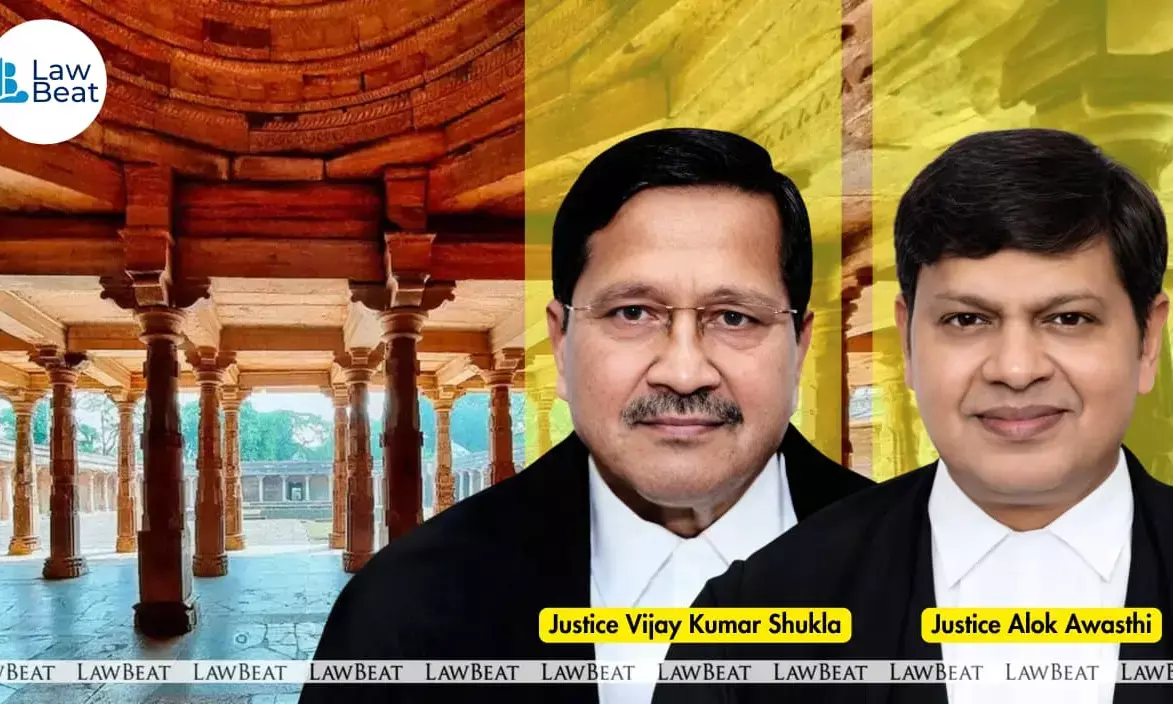
The matter was heard by a Division Bench comprising Justice Vijay Kumar Shukla and Justice Alok Awasthi.
At the outset, Warsi underscored that an earlier writ petition filed in 2019 by the society did not seek any adversarial relief against the Archaeological Survey of India but rather sought enforcement of the ASI’s own order dated April 7, 2003, particularly to prevent religious activities inside the protected monument and to maintain communal harmony in Dhar. It was argued that this foundational context has been overlooked in subsequent proceedings.
A significant portion of the submissions focused on the conduct of the ASI, which, according to Warsi, has filed multiple replies over time without seeking prior permission of the court, each presenting materially different stands.
The court was told that separate replies exist, leading to inconsistencies that ought to estop the ASI from selectively adopting positions. This “shifting stand,” it was argued, undermines the integrity of the adjudicatory process, particularly in a matter involving sensitive religious claims.
Turning to the reliefs sought in connected petitions, especially the plea to install a Saraswati idol allegedly located in London, Warsi relied on correspondence involving the British authorities and the British Museum to contend that the sculpture in question is not of Goddess Saraswati but of the Jain deity Ambika.
The submission emphasized that the claim linking the artifact to Bhojshala is based on a historical misunderstanding originating from incomplete readings of inscriptions in early 20th-century scholarship. Consequently, it was argued that the prayer for retrieval and installation of the idol is legally unsustainable.
On the broader historical question, Warsi undertook an extensive review of multiple historians and archival sources to argue that there is no documented evidence of a Saraswati temple being demolished at Dhar during the invasions of Alauddin Khilji in the early 14th century.
Citing works by historians such as V.D. Mahajan, R.C. Majumdar, and others, it was submitted that while the conquest of Malwa in 1305 is well recorded, none of these sources mention the destruction of a temple or conversion of such a structure into a mosque. The argument stressed that repeated references across independent historians consistently speak only of territorial expansion and administrative consolidation, not religious destruction.
Warsi further contended that architectural evidence indicating the use of temple materials in mosque construction does not ipso facto establish demolition or conversion. Instead, it reflects a historical practice of reuse of available materials, particularly in newly established administrative centers.
Reliance was also placed on early archaeological reports from the late 19th and early 20th centuries, which describe the presence of Jain and Hindu architectural elements in the mosque complex but do not attribute them to any documented act of demolition.
Addressing the narrative of a massacre at the site, the court was told that no credible historical record substantiates claims of large-scale killings of scholars or students at Bhojshala. Such assertions, it was argued, are speculative and unsupported by contemporaneous sources.
The submissions also touched upon internal inconsistencies in the petitioner’s own material, pointing to references describing the site as a “madrasa,” which, according Warsi, contradicts the claim of an exclusively temple-based origin. This, it was argued, further weakens the coherence of the petitioners’ case.
As the hearing progressed, the Bench indicated that historical texts alone may not conclusively determine questions of title, echoing broader judicial caution in similar disputes. The matter remains part-heard, with the Bench indicating that further arguments would address alleged procedural lapses in the ASI’s survey and challenge to videographic records.
The matter will continue before the Bench on Monday (May 4, 2026).
Case Title: Hindu Front for Justice (Regd. Trust No. 976) Through its President Ms. Ranjana Agnihotri v. Union of India Ministry of Culture and other connected matters
Date of Hearing: April 30, 2026
Bench: Justice Vijay Kumar Shukla and Justice Alok Awasthi