
MP High Court: Compassionate Appointment Not A Hereditary Right, 28-Year-Old Claim Dismissed
MP High Court: Gender Cannot Decide Who Gets Compassionate Appointment Under Policy
The Madhya Pradesh High Court has dismissed a writ appeal filed by a man seeking compassionate appointment nearly 28 years after his father, a police constable, died in harness, holding that the claim is barred by delay as well as the wording of the compassionate appointment policy.
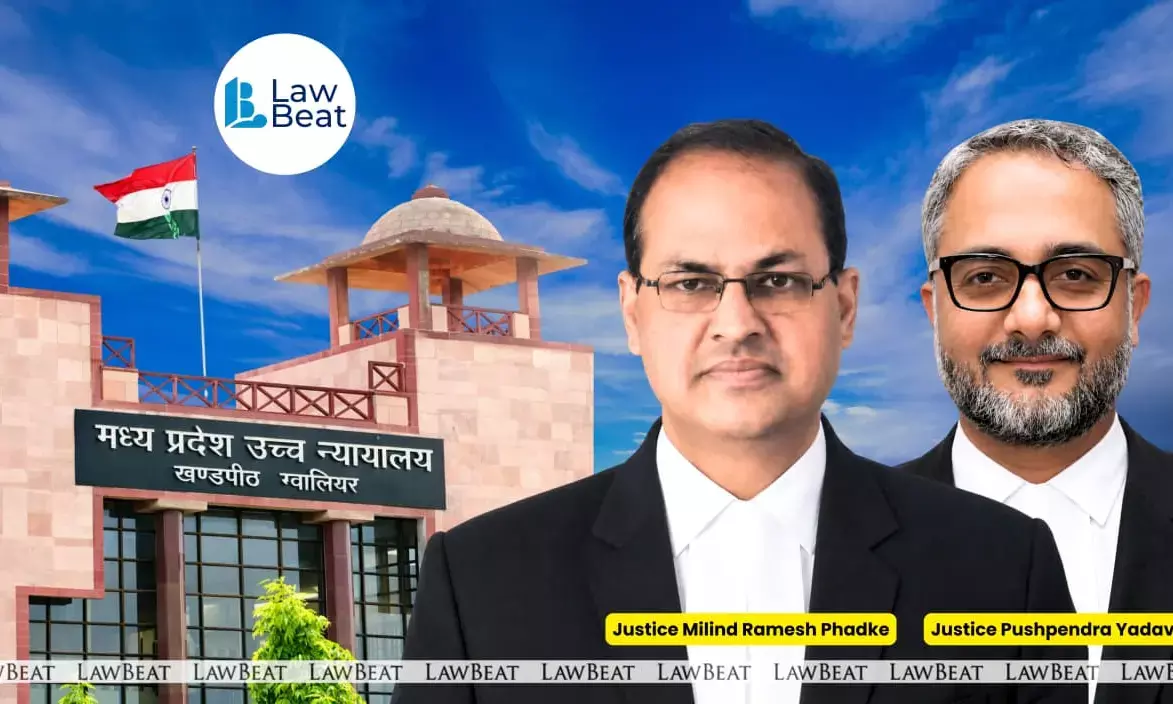
A Division Bench of Justice Milind Ramesh Phadke and Justice Pushpendra Yadav upheld a single judge's order that had already rejected the same claim in November 2022, finding no illegality in that decision.
The appellant, Alok Sharma, is the son of Late Rajesh Sharma, a constable with the 13th Battalion of the Madhya Pradesh Special Armed Force in Gwalior, who died in harness on January 19, 1998. He was survived by his wife, two daughters and a minor son, who was then just a year old.
Despite repeated representations over the years, the State rejected the family's claim for compassionate appointment on the ground that it had been filed beyond the seven-year window prescribed under the policy. The appellant's mercy petition met the same fate. He then approached the High Court through a writ petition, dismissed by a single judge in 2022, holding that the purpose of compassionate appointment stood defeated after nearly a quarter century.
Before the division bench, advocate Harshad Bahirani, appearing for the appellant, argued that since Alok Sharma was barely a year old at the time of his father's death, his case fell squarely within the proviso to Clause 3.2 of the compassionate appointment policy issued by the General Administration Department vide its circular dated September 29, 2014. That proviso allows the "first child" of a deceased employee, if a minor on the date of death, to apply for compassionate appointment within one year of attaining majority, even after the ordinary seven-year period prescribed under the main clause has lapsed. It was also argued that his mother had separately applied for compassionate appointment on the family's behalf, but that claim too had been turned down by the authorities. Counsel further contended that since the appellant was the only son among three siblings, with two elder sisters, his case deserved exceptional consideration under the policy despite the passage of time.
Government Advocate Dharmendra Nayak, appearing for the State, opposed the appeal, submitting that all representations had been examined and rejected through reasoned orders, and that compassionate appointment could not be treated as regular recruitment 25 years after the employee's death.
The bench, examining the text of Clause 3.2 and its proviso, found that the appellant's case did not fit either limb of the policy. The main provision, requiring appointment within seven years of death, had expired on January 18, 2005. As for the proviso, the court held that it applies only to the "first child" of the deceased employee, and Alok Sharma, having two elder sisters, could not claim that status regardless of being the only son.
The court also rejected the argument that being the "only boy" in the family should count in his favour. It observed that the policy "does not differentiate or create a class within a class between girls and boys" and refers strictly to the first child, adding that such differentiation "would be violative of the basic principles of the Constitution of India, which explicitly prohibits discrimination on the basis of gender."
On the question of delay, the bench reiterated that compassionate appointment is not a vested or hereditary right but a narrow exception to the equal-opportunity guarantees under Articles 14 and 16 of the Constitution, meant to provide immediate relief to a family suddenly deprived of its breadwinner. Since the appellant's family had survived without such appointment for over 25 years, the court held that "the very foundation on which compassionate appointment rests stands eroded, and belated claims cannot be entertained."
Concluding that the single judge had correctly appreciated the facts and the law, the Division Bench found no infirmity in the impugned order.
Case Title: Alok Sharma vs. The State of Madhya Pradesh and Others
Date of Order: August 14, 2026
Bench: Justice Milind Ramesh Phadke and Justice Pushpendra Yadav