
Complete Justice Requires Necessary Parties, Rules Madhya Pradesh High Court
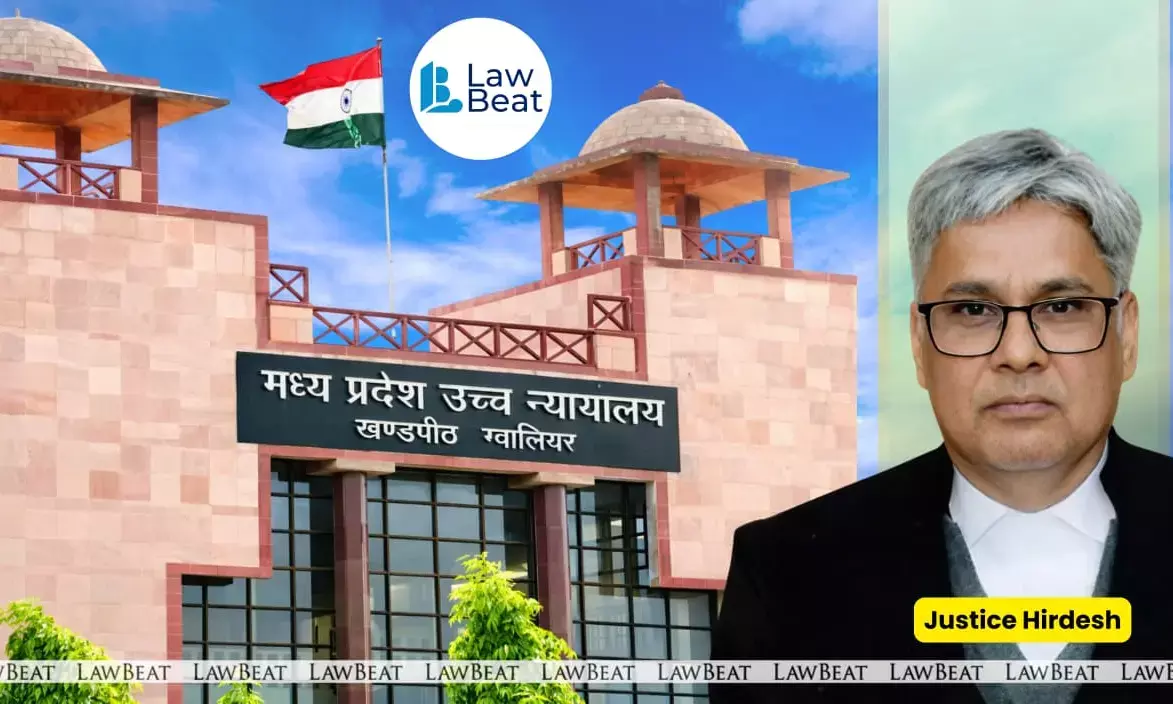
MP High Court: Necessary Party Cannot Be Excluded Due to Plaintiff’s Choice
The Madhya Pradesh High Court at Gwalior has reiterated the scope of impleadment under Order I Rule 10 of the Code of Civil Procedure, holding that a person claiming a direct and substantial interest in the disputed property cannot be shut out of proceedings merely on the ground of the plaintiff’s choice of parties.
In a recent order, Justice Hirdesh set aside a trial court decision that had rejected an application for impleadment, observing that such exclusion would hinder effective adjudication of the dispute.
The petition arose from a civil suit filed by a woman seeking declaration of ownership and permanent injunction over a residential property situated in Gwalior. She claimed title through a registered will executed in her favour and relied on historical ownership records, tax receipts, and construction approvals to assert her possession. The suit was filed against certain individuals and municipal authorities who had allegedly threatened to demolish the property and treat it as municipal land.
During the pendency of the suit, the petitioner moved an application under Order I Rule 10 CPC, asserting that the disputed property formed part of a larger land parcel bearing Survey No. 1817, which, according to him, belonged to his late father and continued to be reflected in revenue records.
He contended that while he and his family were away, certain persons had conspired with officials to manipulate records and encroach upon the land. Since the plaintiff herself had acknowledged that the property formed part of Survey No. 1817, the petitioner argued that he was a necessary and proper party without whose presence no effective decree could be passed.
The trial court, however, rejected the application, relying on the principle of dominus litis, which grants the plaintiff autonomy in choosing the parties to the suit. Challenging this rejection, the petitioner approached the High court under Article 227 of the Constitution.
Allowing the petition, the High court observed that while the principle of dominus litis remains relevant, it is not absolute. The court emphasized that judicial discretion under Order I Rule 10 CPC must be exercised to ensure that all necessary parties are before the court, particularly where their rights are directly affected by the outcome of the litigation. The court noted that the primary objective of the provision is to enable complete and effective adjudication and to avoid multiplicity of proceedings.
The court found that both the plaintiff and the petitioner were staking claims over land forming part of the same survey number. In such circumstances, exclusion of the petitioner would result in an incomplete adjudication and could potentially lead to conflicting decisions in separate proceedings. It held that the petitioner had demonstrated a prima facie interest in the subject matter of the dispute and therefore qualified as a necessary party.
In its reasoning, the court also drew upon settled principles laid down by the Supreme Court, reiterating that a person whose rights are likely to be directly affected by a decree must ordinarily be impleaded. It underscored that the test is not merely whether the plaintiff chooses to include a party, but whether the presence of such party is essential for effectively resolving the controversy.
Rejecting the trial court’s approach as overly technical, the High court observed that “the petitioner appears to be a necessary party” in light of the pleadings on record, particularly when the suit property was admittedly part of Survey No. 1817. It further held that the judgments relied upon by the plaintiffs were inapplicable to the facts of the present case.
Accordingly, the court set aside the impugned order and allowed the application for impleadment, directing the trial court to proceed with the suit after adding the petitioner as a party. It clarified that the matter must now be adjudicated in accordance with law, with all concerned parties given an opportunity to present their claims.
Case Title: Dhananjay Jadhav S/O Late Shri Devraj Jadhav Through its Power of Attorney Holder Chandrajee Rao Sal v. Jitnedra Singh Vaishya and Others
Date of Order: March 25, 2026
Bench: Justice Hirdesh