
CORD Launches Rules 2.0 With Tiered Arbitration Fees, AI Guidelines For Mid-Value Commercial Disputes
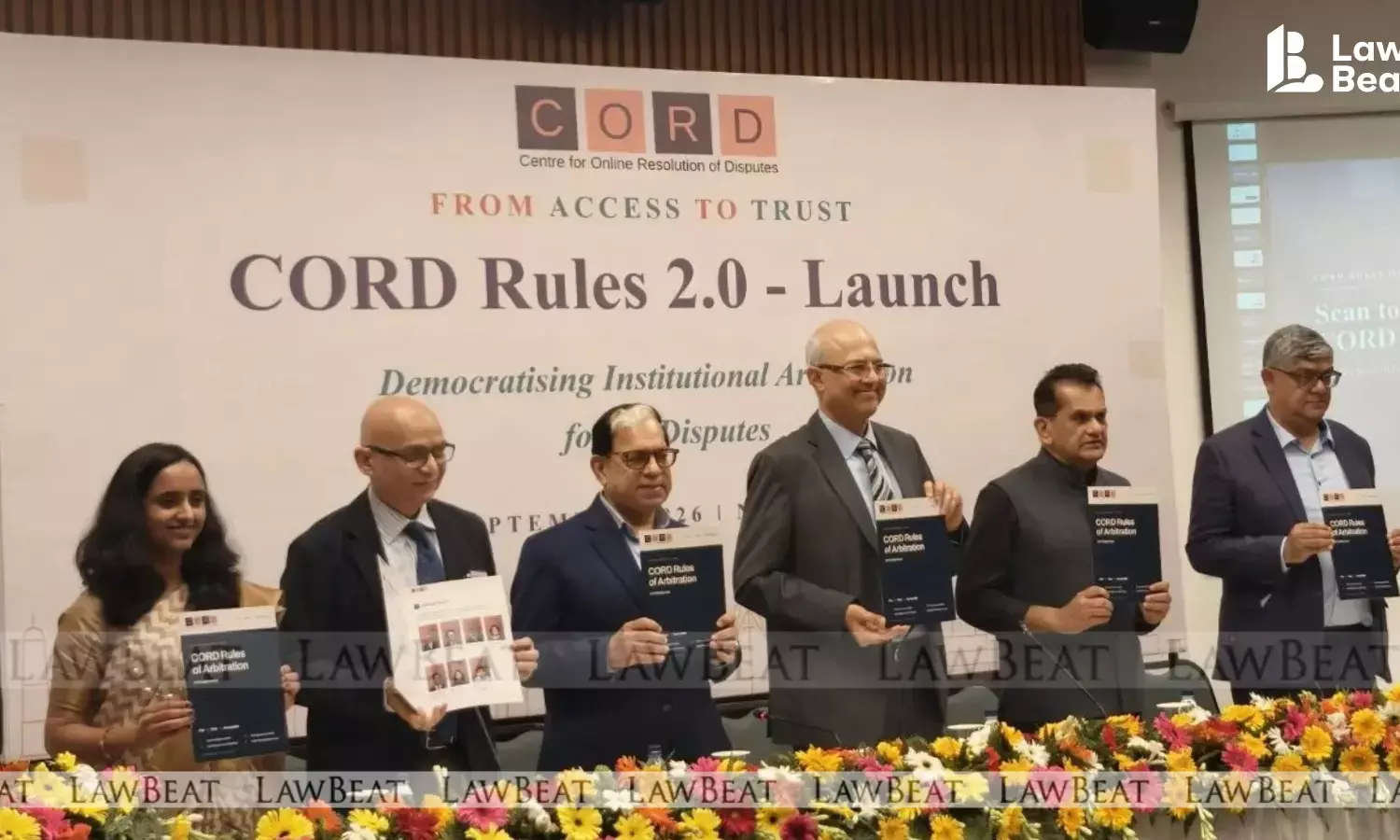
CORD launched Rules 2.0, introducing a revised institutional arbitration framework with tiered fees, an appellate mechanism and AI guidelines for mid-value commercial disputes
The Centre for Online Resolution of Disputes (CORD) has launched CORD Rules 2.0, introducing a revised institutional arbitration framework aimed at addressing concerns over cost, delays and predictability in mid-value commercial disputes.
The revised rules introduce a tiered fee structure, an Independent Appointments Council, an opt-in appellate mechanism, cost consequences for missed procedural deadlines and specific guidelines governing the use of artificial intelligence in arbitral proceedings.
CORD said its proceedings are administered on a digital-first basis, with the institution targeting resolution of disputes within approximately six months.
The Rules were launched in New Delhi in the presence of Justice (Retd.) A.K. Sikri, former Supreme Court judge; Justice Manmohan, Supreme Court judge; Justice (Retd.) Rajiv Shakdher, former Chief Justice of the Himachal Pradesh High Court; former NITI Aayog CEO Amitabh Kant; Avnit Singh Arora, Director, Department of Legal Affairs; Gourab Banerji, President of the Arbitration Bar of India; Vijaya Sampath, former Group General Counsel of Bharti Airtel; and Jyothi V.K., General Counsel of Aditya Birla Fashion and Retail.
Justice Manmohan flags gap in Arbitration for mid-value disputes
Speaking at the launch, Justice Manmohan highlighted what he described as a gap in India's commercial arbitration ecosystem, noting that arbitration largely operates at two ends of the spectrum.
According to him, high-value disputes involving large corporations and high-volume disputes arising from the banking and financial services sectors receive significant institutional attention, while mid-value commercial disputes remain relatively underserved.
Referring to India's judicial capacity, Justice Manmohan noted that the country has approximately 21 judges per million people and stressed the importance of strengthening alternative dispute resolution and institutional arbitration.
He said arbitral institutions can provide parties with established procedural frameworks, administrative support and mechanisms to identify defective arbitration clauses and procedural issues at an early stage.
“Access means you democratise arbitration,” Justice Manmohan said.
Justice Sikri says ODR has moved beyond pilot stage
Justice (Retd.) A.K. Sikri, who chaired the NITI Aayog committee on Online Dispute Resolution (ODR), spoke about the development of India's ODR ecosystem during the COVID-19 pandemic.
He said ODR had been conceived as a policy intervention rather than merely a pilot project, particularly for resolving high-volume and relatively lower-value disputes.
Justice Sikri also highlighted the growing role of technology in dispute resolution and noted that Indian dispute-resolution technology was increasingly being adopted by institutions and courts outside India, including in Singapore and Hong Kong.
Former NITI Aayog CEO Amitabh Kant said India's adoption of technology-enabled dispute resolution offered an opportunity to build institutions capable of operating at international standards.
He also stressed the importance of transparency and human oversight in the use of artificial intelligence in dispute resolution.
CORD Rules 2.0 introduce tiered fees, appellate mechanism
Under CORD Rules 2.0, arbitrator fees will follow a tiered schedule ranging from 60% to 140% of the fees prescribed under the Fourth Schedule of the Arbitration and Conciliation Act, 1996, depending on the nature and complexity of the dispute.
The framework also establishes an Independent Appointments Council, which will determine challenges to arbitrators and prescribe empanelment criteria.
Another key feature is an opt-in appellate mechanism. Parties can agree in advance to permit an arbitral award to be challenged before an independent tribunal constituted under the Mumbai Centre for International Arbitration (MCIA). The Rules also provide for daily cost consequences for missed procedural deadlines, based on published rates.
CORD introduces AI practice note
CORD has also introduced an AI Practice Note categorising the use of artificial intelligence in arbitral proceedings into three categories: prohibited, disclosable and permitted uses.
Deepika Kinhal, CEO of CORD, said the revised rules were designed around key concerns typically considered by general counsels when agreeing to arbitration, including the cost and duration of proceedings, the availability of appellate review and transparency around the use of AI.
The launch also featured discussions on continuing challenges facing arbitration, including cost, timelines, predictability, accountability and confidence in the arbitral process.
ODR has increasingly been incorporated into India's regulatory framework, particularly in the financial sector. The Securities and Exchange Board of India (SEBI) introduced its SMART ODR framework in 2023, while ODR mechanisms have also expanded across the broader financial dispute-resolution ecosystem.
CORD said Rules 2.0 are intended to cater to commercial disputes that are significant enough to warrant formal adjudication but where conventional arbitration may become disproportionately expensive or time-consuming.