
Defamation Case: Delhi HC Advances M J Akbar’s Appeal Against Priya Ramani’s Acquittal To March 16, 2026
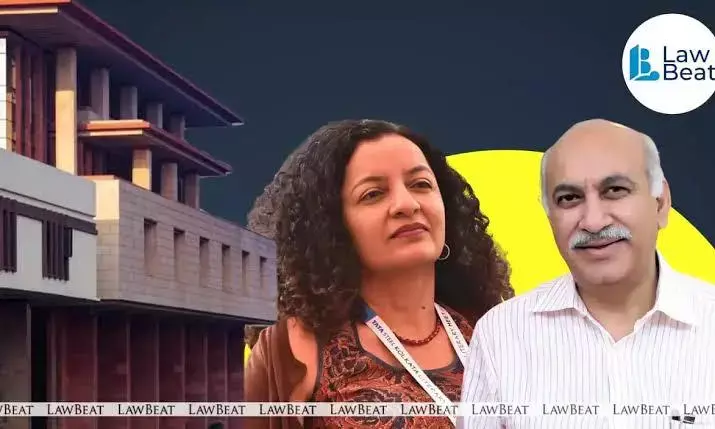
Delhi High Court advances hearing in M J Akbar’s appeal against Priya Ramani’s acquittal to March 16, 2026
The Delhi High Court on December 16, 2025 advanced the hearing in an appeal filed by former Minister of State for External Affairs M J Akbar, challenging a trial court verdict that had acquitted journalist Priya Ramani in a criminal defamation case arising out of allegations made during the #MeToo movement.
A Bench of Justice Ravinder Dudeja allowed the application moved by Akbar seeking advancement of the hearing, which was earlier scheduled for May 7 next year. The Court has now listed the matter for hearing on March 16, 2026.
Before the High Court, Akbar has challenged the trial court order dated February 17, 2021, by which Ramani was acquitted in the criminal defamation case. The High Court had admitted Akbar’s appeal in 2022, after it was filed in 2021.
In his appeal, Akbar has argued that the trial court decided the criminal defamation case on the basis of surmises and conjectures and treated it as though it were a case of sexual harassment rather than defamation.
The criminal defamation complaint was filed by Akbar in 2018 after Ramani accused him of sexual harassment during a job interview. Akbar alleged that her statements, made through tweets and articles published in platforms such as Vogue magazine, Firstpost and Twitter, were defamatory and aimed at damaging his reputation and political career. He contended that the allegations related to an incident nearly two decades old, for which no statutory complaint had been lodged at the relevant time, and claimed that the accusations were imaginary.
Ramani, on the other hand, maintained that her statements were true and made in the public interest. On February 17, 2021, Additional Chief Metropolitan Magistrate Ravindra Kumar Pandey acquitted Ramani after a trial that lasted nearly two years. The trial court held that the possibility of the alleged incident could not be ruled out and observed that a woman’s right to dignity after facing sexual harassment would prevail over a man’s right to reputation. The court also noted that the series of events and the testimonies on record did not support Akbar’s claim of being a person of “stellar reputation.”
Taking note of the broader issue of systemic abuse at workplaces, the trial court observed that the Vishaka Guidelines on sexual harassment at the workplace, laid down by the Supreme Court in 1997, were not in force at the time of the alleged incident. The trial court accepted Ramani’s defence that she had spoken the truth about the alleged sexual harassment at the Oberoi Hotel in Bombay in December 1993, relying on her testimony and its corroboration by witness Niloufer Venkatraman.
Case Title: M.J. Akbar vs Priya Ramani
Hearing Date: 19 December 2025
Bench: Justice Ravinder Dudeja