
Delhi HC Asks Centre To Decide In 6 Months On SOP For Mandatory Body-Worn Cameras For Police During Protests
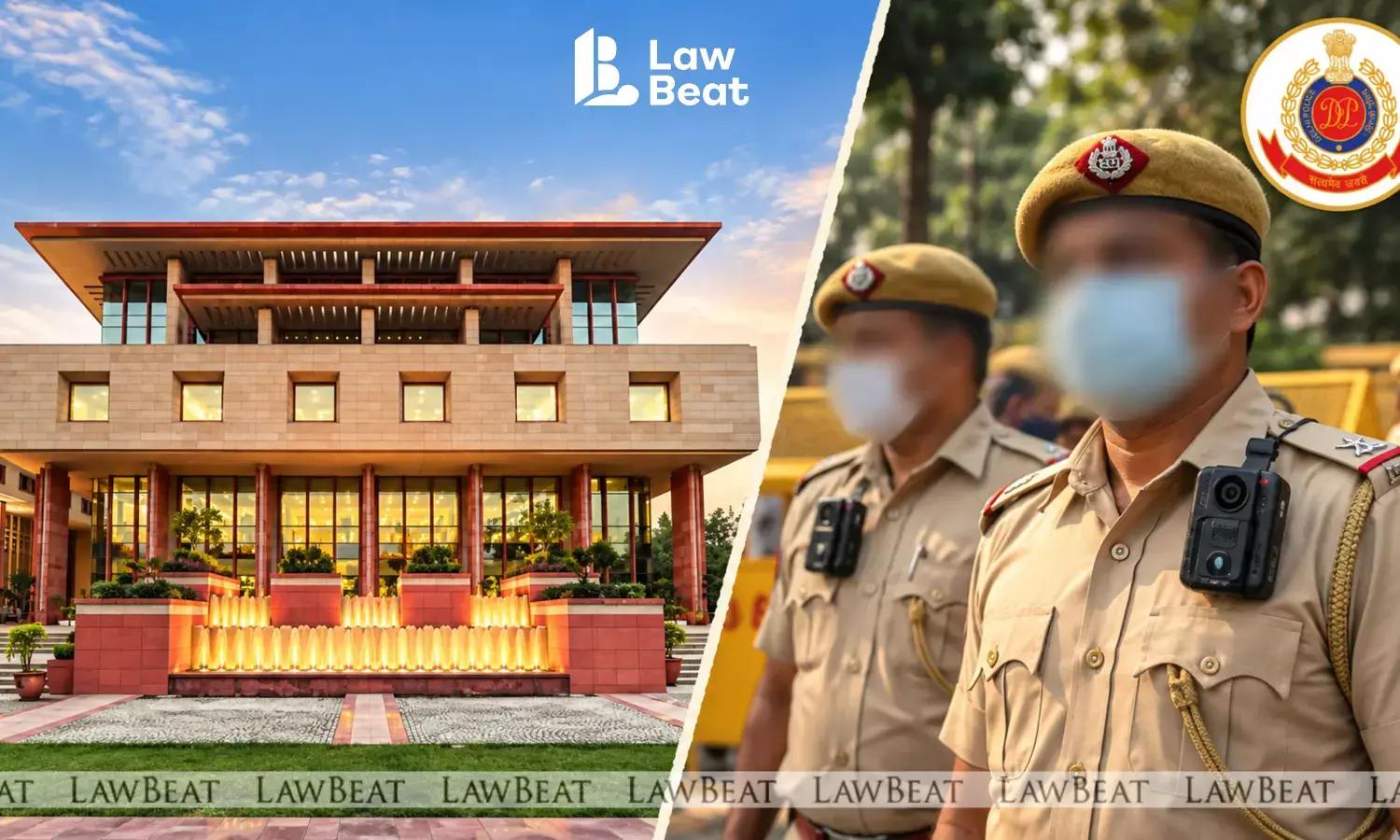
PIL before Delhi HC argued that body-worn cameras would provide an authenticated record of police conduct during protests, while ASG Chetan Sharma said existing standing orders already provide for videography and urged that the PIL be treated as a representation
The Delhi High Court has disposed of a Public Interest Litigation seeking a mandatory system for the use of body-worn cameras by police and Rapid Action Force (RAF) personnel deployed during protests, directing the Union Home Ministry to take a decision on framing a Standard Operating Procedure (SOP) for their operation and use within six months.
A Division Bench of Acting Chief Justice Nitin Wasudeo Sambre and Justice Sanjay Sharma passed the order after hearing Senior Advocate Akhil Sibal for the petitioner, Chahat Raghav, and Additional Solicitor General Chetan Sharma for the respondents.
The PIL sought a framework under which body-worn cameras would be systematically used during protests rather than being deployed sporadically when allegations of police misconduct arise.
Appearing for the petitioner, Sibal submitted that the PIL was not directed at any particular incident or allegation, but sought a mechanism to ensure accountability during protests where allegations of excessive use of force by police and violence by protesters frequently arise.
He said that body-worn cameras were already being used by various authorities, but their use by police during protests appeared to be “very sporadic” and there was no comprehensive procedure governing their deployment.
The senior counsel argued that protests often leave the court with competing allegations about who initiated violence and whether excessive force was used by police.
“We have the technology to, at least, fix some accountability for some of this.”
Sibal said relying on videos recorded by private individuals also raises questions concerning authenticity, selective recording and context.
According to him, body-worn cameras could provide a continuous and authenticated record of an officer's conduct, subject to appropriate safeguards concerning preservation and access.
“Rather than have this chaos with snapshots and snippets of circulating videos...there has to be some way for fixing that accountability post that incident " he said.
He submitted that the proposed system would benefit both police personnel and protesters. “They must always be used. It's for the protection of all concerned. Those who are policing, those who are being policed, it'll benefit the whole process" he submitted.
Court Questions Need For Judicial Direction
The Bench questioned why the Court should direct the authorities to legislate or formulate such a mechanism judicially. Sibal clarified that the petitioner was not necessarily seeking legislation and suggested that the Court could constitute a committee of stakeholders to formulate an appropriate procedure, which could thereafter be implemented by the authorities.
The Bench also questioned the petitioner about the existing legal framework governing videography.
Sibal referred to Section 105 of the Bharatiya Nagarik Suraksha Sanhita (BNSS), which mandates audio-video recording of the process of search and seizure, including preparation of the seizure list and obtaining signatures of witnesses.
He argued that the broader legislative trend towards recording police processes supported the need to consider body-worn cameras during protests.
He also relied upon a 2022 Delhi Police Standing Order concerning the policing of rallies, demonstrations
and processions. According to him, while the Standing Order contemplated videography, it provided for third-party videographers rather than cameras worn by the police personnel themselves.
Sibal: Existing Videography Is Not A Substitute For Body Cameras
Sibal pointed out that the Standing Order contemplated at least two videographers remaining on either side of a demonstration to record both the demonstrators and police response.
He argued, however, that this did not address the problem of capturing the conduct of individual officers from their own vantage point.
The Bench questioned how a body-worn camera would operate. Sibal explained that the camera would remain on throughout the relevant deployment, with a protocol governing when it could be switched off after the incident.
He submitted that such a system would prevent selective recording and allow the footage to be preserved with an appropriate chain of custody. “So it can't be selective. It becomes authenticated. It is preserved. It has a chain of custody.”
He also distinguished body-worn cameras from facial-recognition technology, saying the latter raises separate concerns relating to profiling, surveillance and privacy.
ASG Chetan Sharma: Existing SOPs Already Provide For Videography
ASG Chetan Sharma, appearing for the respondents, opposed the PIL being treated as requiring immediate judicial formulation of a new system.
He argued that the Supreme Court's decision in Mazdoor Kisan Shakti Sangathan v. Union of India had already resulted in directions concerning regulation and videography of demonstrations, while Delhi Police had also framed relevant Standing Orders.
Citing the Supreme Court's directions, Sharma submitted that existing guidelines already required protests and demonstrations to be videographed.
He also relied on the Supreme Court's decision in Balwansingh Chaufal v. State of Uttarakhand , submitting that the Delhi High Court's PIL Rules required a representation to be made to the concerned authorities before invoking the Court's jurisdiction.
Sharma suggested that the present PIL could itself be treated as such a representation. He also pointed out that Delhi Police had issued a tender for procurement of body-worn cameras and that such cameras were already being used by traffic police.
Court Notes Absence Of Standard SOP For Body-Worn Cameras
The Court's order records that the use of body-worn cameras by police personnel could be inferred not only from the tender issued for their procurement but also from their use by traffic police personnel.
At the same time, the Bench noted that a standard SOP specifically governing the operation and use of body-worn cameras appeared not to be in existence.
The Court observed that, given advancements in technology used for policing and crowd-management situations, there might not presently be a corresponding provision in the police manual or existing Standing Orders dealing specifically with the issue.
The Bench therefore accepted the submission on behalf of the respondents that the PIL could be treated as a representation and directed the respondents to consider the issue.
Decision On Body-Worn Camera SOP Within 6 Months
The Court ultimately directed: "The respondents are directed to communicate the decision taken on the aspect of framing of the SOP in the matter of operation and use of body-worn cameras within period of 6 months from today."
The Court clarified that if the petitioner remained aggrieved in future by any inaction or by the reasonableness of the terms of the SOP, liberty would be available to approach the Court afresh.
The PIL was accordingly disposed of.
Case title - MS CHAHAT RAGHAV v. UNION OF INDIA & ORS.
Next Story