
Delhi High Court Denies Bail to Alleged IM Operatives, Says Long Custody Not Enough Under UAPA
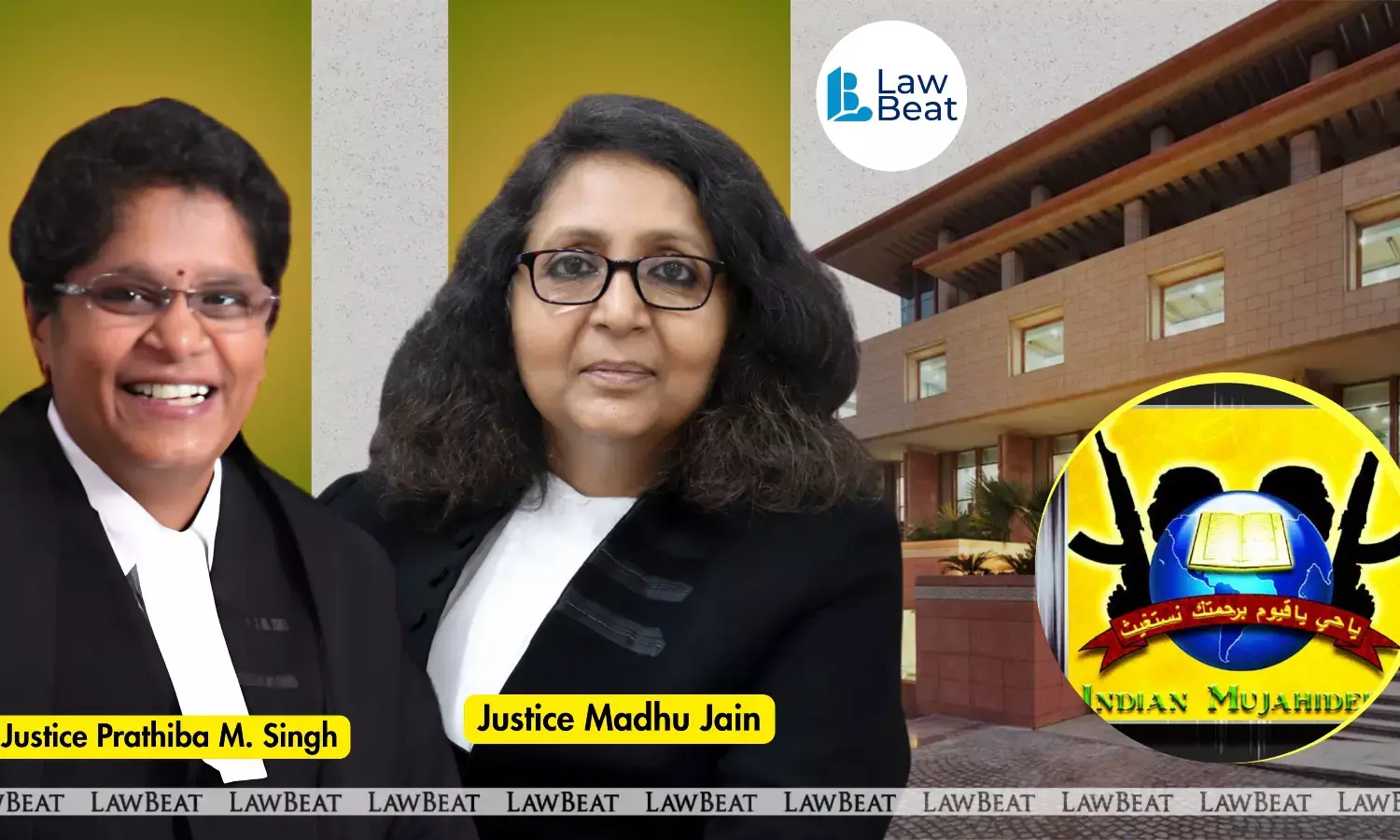
Delhi High Court refused bail to two accused allegedly linked to Indian Mujahideen, citing serious charges and strong evidence under UAPA.
The Delhi High Court has refused to grant bail to two accused allegedly involved in planning a terrorist attack in the national capital, holding that prolonged incarceration by itself cannot be a standalone ground for relief under the stringent provisions of the Unlawful Activities (Prevention) Act, 1967 (UAPA), particularly when the material on record indicates a continuing threat.
A Division Bench comprising Justice Prathiba M Singh and Justice Madhu Jain dismissed the appeals filed by Mohd. Saquib Ansari and Waqar Azhar, upholding the trial court’s decision to deny bail. The Court emphasised that under Section 43D(5) of the UAPA, bail can only be granted if the court is satisfied that the accusations are not prima facie true, a threshold that was not met in the present case.
“In the opinion of this Court, the prayer for parity would not be tenable inasmuch as the nature of the material, which was recovered from Mohd. Maroof, who has been released on bail by this Court and the present two Appellants is distinct and different. In case of the Appellants, substantial amount of damaging material such as chemicals, IEDs, electronic gadgets, etc. were recovered which would show that they were in the process of preparing for a terror attack in the country. The seizure and recovery of such explosives, electronic devices, capability of one of them of being trained to even making poison and trained for making bombs distinguishes the case of Mohd. Maroof from the Appellants”, the Court observed.
The Bench observed that while prolonged custody is a relevant factor, it cannot override the statutory restrictions imposed under anti-terror laws where there is credible material suggesting involvement in serious offences. It relied on judicial precedent, including the ruling in Gulfisha Fatima, to reiterate that courts must examine the nature of allegations, the role attributed to the accused, and the available evidence before granting bail in such cases.
The Court took note of several pieces of evidence cited by the prosecution, including the recovery of a pen drive allegedly containing extensive jihadi material.
This included Caliphate-related documents, speeches, and digital content referencing high-profile individuals such as the Prime Minister of India and the chief of the Rashtriya Swayamsevak Sangh.
The Bench observed that such material, along with electronic communications allegedly linking the accused to members of the banned outfit Indian Mujahideen operating from Pakistan, pointed towards a continuing security threat.
Further, the prosecution alleged that the accused were engaged in preparatory activities for terrorist acts, including bomb-making and attempts to create poison-based weapons. The Court noted that under Section 18 of the UAPA, even preparation for committing a terrorist act is punishable with severe penalties, including life imprisonment, thereby underscoring the seriousness of the allegations.
The case originates from an investigation into a Rajasthan-based module of the Indian Mujahideen, which was allegedly planning attacks in Delhi.
The accused were arrested in 2014 and were later convicted in separate proceedings in Rajasthan in 2021 for offences including waging war against the State and violations under the UAPA and the Explosive Substances Act. Although the Rajasthan High Court had suspended their sentences in those cases on grounds of prolonged incarceration, the Delhi High Court clarified that such orders were not determinative in the present matter.
Rejecting the plea of parity with a co-accused who had been granted bail earlier, the Bench held that the nature and extent of recoveries attributed to Ansari and Azhar, including explosives, chemicals, detonators, and digital evidence, clearly distinguished their case.
It emphasised that each bail application must be assessed on its own facts and the specific role of the accused.
The Court also referred to attendance records from Waqar Azhar’s engineering college in Jaipur, which allegedly showed prolonged absence during the relevant period, supporting the prosecution’s claim of his involvement in the alleged conspiracy.
Additionally, allegations that he attempted to prepare toxic substances using chemicals such as magnesium sulphate, acetone, and castor seeds were noted as part of the broader narrative of planned attacks.
Addressing the argument of prolonged detention, the Court categorically held that such a ground cannot dilute the rigours of Section 43D(5) of the UAPA. It observed that individuals associated with terrorist organisations may pose a continuing risk if released, and therefore, courts must exercise caution while considering bail.
“The mere fact of long incarceration cannot be sufficient in cases where there is prima facie material and a likelihood of continued involvement in terrorist activities,” the Bench observed, adding that the statutory framework requires a stricter standard of scrutiny.
Concluding that the accusations against the appellants were prima facie true and that the material on record indicated a continuing threat, the High Court upheld the trial court’s orders and dismissed the appeals. It reiterated that neither parity nor the duration of custody could justify a departure from the restrictive bail regime under the UAPA in the facts of the case.
Case Title: Mohd. Saquib Ansari v. State (NCT of Delhi)
Bench: Justice Prathiba M Singh and Justice Madhu Jain
Date of Judgement: 24.04.2026