
Delhi HC Denies Bail To Olympic Medalist Sushil Kumar In Sagar Dhankar Murder Case
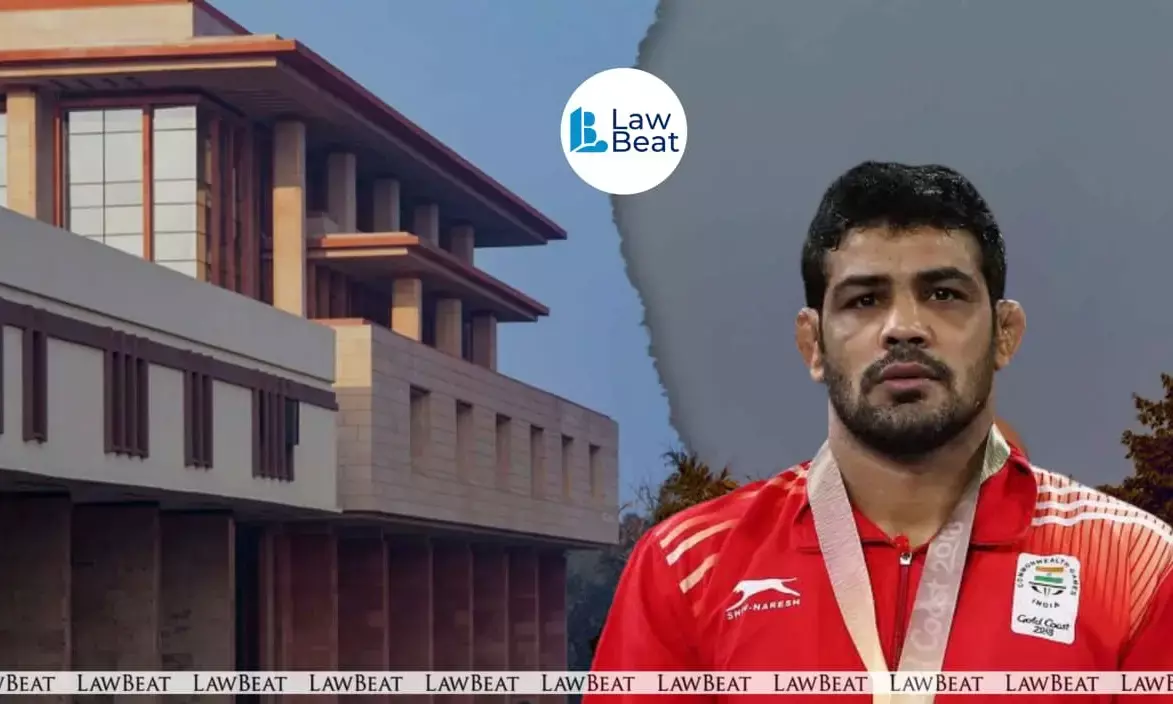
Delhi High Court refused fresh bail to wrestler Sushil Kumar in the Sagar Dhankhad murder case.
The Delhi High Court has dismissed two-time Olympic medallist Sushil Kumar’s fresh plea for regular bail in the Sagar Dhankhad murder case, holding that the circumstances relied upon by him did not constitute a genuine change in circumstances warranting reconsideration of the Supreme Court’s earlier decision cancelling his bail.
The bench of Justice Purushaindra Kumar Kaurav observed that the concerns which had weighed with the Supreme Court, including Kumar’s pre-arrest conduct, the gravity of the allegations and his societal standing and capacity to influence the trial, had not materially changed.
The case arises from the intervening night of May 4-5, 2021, when police received a PCR call regarding gunfire inside Delhi’s Chhatrasal Stadium. According to the prosecution, several persons, including Sagar Dhankhad, had been abducted and brought to the stadium, where they were allegedly assaulted by Kumar and his associates with lathis, dandas and hockey sticks.
Some accused were allegedly armed with firearms. Dhankhad subsequently succumbed to his injuries.
The investigation resulted in chargesheets against 23 accused persons for offences including murder, attempt to murder, kidnapping, rioting, criminal conspiracy and offences under the Arms Act. Charges were framed on October 15, 2022, and the trial is at the stage of prosecution evidence, with 222 witnesses cited.
Kumar had earlier secured regular bail from a coordinate Bench of the High Court in March 2025. The Bench had taken note of several material eyewitnesses and injured witnesses having turned hostile and the likelihood of the trial taking considerable time.
The Supreme Court, however, subsequently set aside that order in August 2025 and directed Kumar to surrender.
It took note of his alleged evasion of arrest, the gravity of the allegations, recovery of a loaded firearm and forensically untampered video evidence. It also considered his societal influence as a celebrated wrestler and Olympian and the pattern of witnesses turning hostile after his temporary release.
The Supreme Court had left it open to Kumar to seek bail afresh if there was a change in circumstances.
Kumar subsequently approached the Trial Court, which rejected his fresh bail plea in February 2026. Before the High Court, he argued that circumstances had since changed as all injured and public witnesses up to PW-42 had been examined and had not supported the prosecution or attributed any specific role to him.
He also relied on the testimony of Ashok Dhankhad, the deceased’s father and complainant, who had by then been examined. Kumar argued that this, coupled with his incarceration for more than five years, constituted the change in circumstances contemplated by the Supreme Court.
The State and the deceased’s father opposed the plea, disputing the claim that Ashok Dhankhad’s testimony was unsupportive of the prosecution. They argued that the testimony, read as a whole, corroborated the prosecution case and that its evidentiary value could only be determined by the Trial Court after appreciation of the entire evidence.
The High Court rejected Kumar’s contention that the complainant’s examination amounted to a material change in circumstances.
Referring to Supreme Court’s judgment in Kalyan Chandra Sarkar v. Rajesh Ranjan, the Court noted that while an accused can file a successive bail application, he must demonstrate a fresh ground. A subsequent court must examine the reasons for the earlier rejection or cancellation and identify the fresh circumstances justifying a different view.
The Court observed that the Supreme Court’s earlier decision was not based merely on the fact that certain witnesses remained to be examined. Rather, it was based on the broader concern arising from Kumar’s societal standing and the pattern of witnesses turning hostile following his temporary release.
"It cannot be treated as a change in circumstances sufficient to unlock the door that the Supreme Court closed" the High Court held.
The Court further declined to determine whether Ashok Dhankhad’s testimony supported or contradicted the prosecution case, observing that such appreciation of evidence was for the Trial Court at the stage of final adjudication.
On the ordinary parameters for bail, the High Court noted that 23 accused persons were facing trial and 222 prosecution witnesses had been cited, of whom 48 had been examined. It also noted the Trial Court’s report that individual cross-examination by the accused was principally responsible for prolonging the proceedings.
The Court acknowledged that "bail is ordinarily the rule and jail the exception", but held that the principle operates within the established parameters governing bail, particularly in a case involving an alleged premeditated and gruesome assault resulting in death, recovery of a firearm and video evidence.
Finding that the concerns earlier identified by the Supreme Court had not materially changed and that Kumar had failed to establish either a genuine change in circumstances or an independent case for bail, the High Court dismissed the application.
The Court clarified that its observations were confined to the bail proceedings and would not affect the Trial Court’s determination of the merits of the case.
Case Title: SUSHIL KUMAR v THE STATE GOVT. OF NCT OF DELHI