
Delhi HC Judge Initiates Contempt Against Kejriwal & AAP Leaders, Says Judiciary Cannot Be Bullied Through Social Media Campaigns
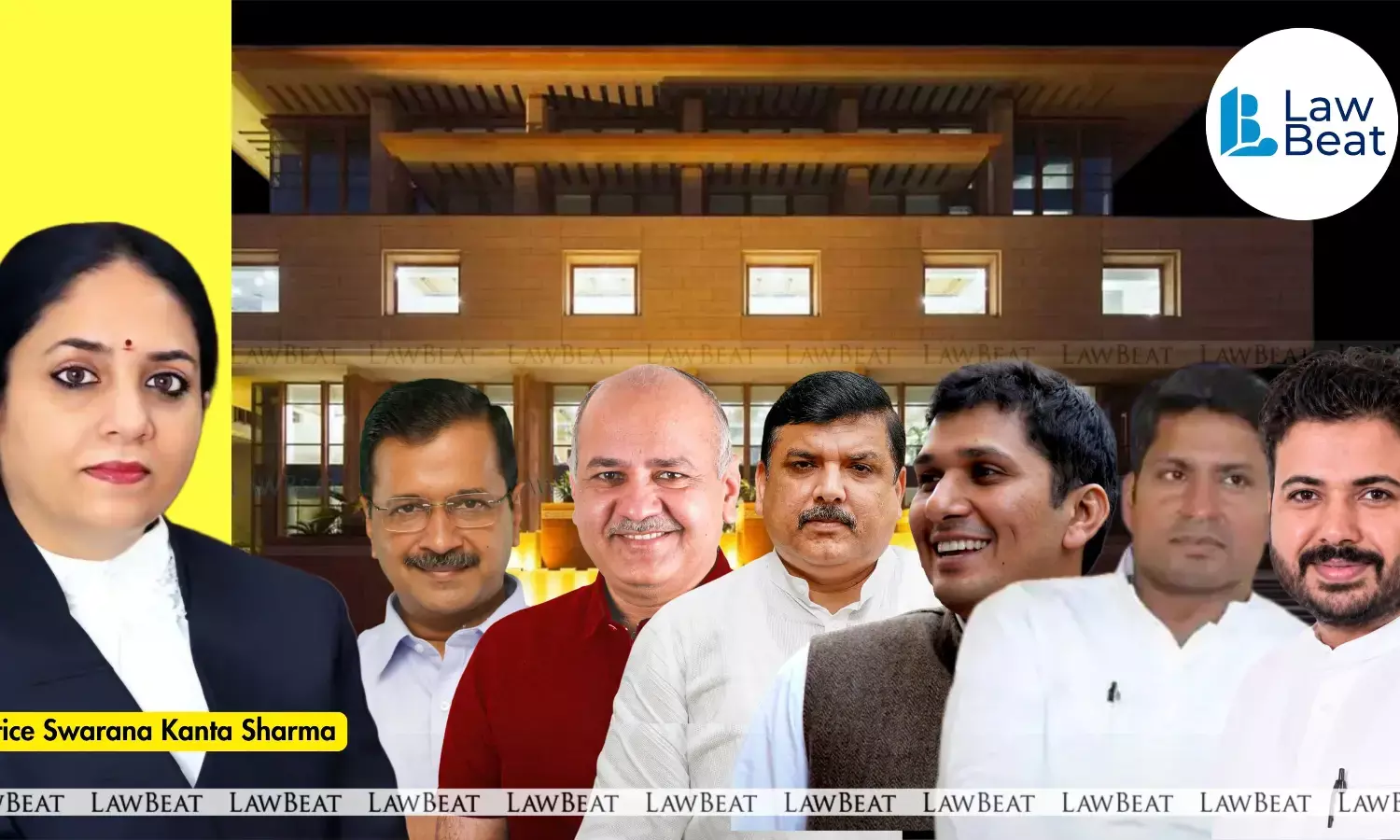
Justice Swarana Kanta Sharma initiated criminal contempt proceedings against Arvind Kejriwal and other AAP leaders over an alleged campaign targeting the judiciary in the excise policy case
The Delhi High Court judge Justice Swarana Kanta Sharma on Thursday initiated criminal contempt proceedings against AAP chief Arvind Kejriwal, senior party leaders Manish Sisodia, Sanjay Singh, Saurabh Bharadwaj, Vinay Mishra and Durgesh Pathak over what she described as a “coordinated campaign” to vilify and intimidate the judiciary in connection with the excise policy case.
Delivering a detailed order in open court, Justice Sharma said the alleged actions of the contemnors crossed the line between fair criticism and a direct attack on the institution of the judiciary. “When the institution is put on trial, it becomes the duty of the judge to ensure that courts are not governed by such allegations,” Justice Sharma observed at the very outset.
The judge said the controversy initially appeared to be limited to recusal applications and allegations of apprehension of bias. However, after passing orders in the matter, the Court came across what it described as a widespread social media campaign involving “selective videos,” “incomplete letters,” public boycott announcements and repeated allegations questioning the Court’s integrity and political neutrality.
“It was a coordinated social media campaign,” the Court remarked.
Justice Sharma repeatedly emphasised that the contempt proceedings were not being initiated due to personal hurt or anger. “These proceedings are not born in a day. The robe that I wear is not so fragile that a few criticisms will affect it,” she said.
At several points during the hearing, the judge spoke directly about the pressure judges face when targeted publicly after passing adverse judicial orders. “They wanted to intimidate me. Mujhe darana chahte the. I refuse to be intimidated,” Justice Sharma declared in open court.
The Court held that the conduct of the contemnors amounted to a “calculated attempt to scandalise the judiciary” and create a chilling effect on judges. “The message was clear: if a judge does not conform to political expectations, the judge will be vilified,” the Court observed while specifically referring to the alleged role of Arvind Kejriwal.
Justice Sharma noted that instead of challenging the judicial orders before the Supreme Court, Kejriwal and others allegedly chose to carry the dispute into the public sphere through videos, social media campaigns and public statements. “A lie spoken a thousand times does not become the truth,” she remarked.
The Court took serious exception to the circulation of a selectively edited video from a lecture delivered by Justice Sharma at a university event in Varanasi. According to the Court, references made to Lord Shiva and the cultural significance of Varanasi were falsely projected online as evidence of political affiliation.
“This video was edited, knowingly,” Justice Sharma observed, adding that even fact-check clarifications and statements issued by the concerned college were allegedly ignored while pushing the narrative online.
The Court also referred to public statements and boycott letters issued by Kejriwal and other AAP leaders, including allegations that “justice could not be expected” from the bench. Justice Sharma said such remarks were not merely criticism of judicial orders but attempts to lower public confidence in the judiciary.
“How did he assume authority to speak on behalf of citizens of this country?” the judge asked while referring to statements attributed to Kejriwal.
Justice Sharma held that the acts of Kejriwal, Sisodia, Sanjay Singh, Vinay Mishra and Saurabh Bharadwaj prima facie amounted to criminal contempt, observing that the alleged conduct was intended to “scandalise the judiciary and intimidate the judicial system.”
The Court said silence in such circumstances would have amounted to surrender. “My silence was being mistaken for weakness and surrender, which is not true,” Justice Sharma said.
The judge further stated that judges sometimes have to pay a “personal price” for standing firm and protecting institutional integrity. “When judicial silence is mistaken for weakness, this Court had to speak, for itself and for the institution,” she observed.
Justice Sharma clarified that the proceedings were not aimed at shielding judges from criticism. “Any ordinary citizen can criticise a judge or an order. That alone is not contempt. But there is a distinction between criticism and what the contemnors did,” the Court said.
Justice Sharma also announced that the excise policy case would now be placed before another bench, since a judge initiating contempt proceedings could not continue hearing the substantive matter.
“This is not recusal. This is judicial discipline,” the Court clarified.
Solicitor General Tushar Mehta, who appeared during the proceedings, strongly supported the Court’s stand and described the alleged conduct as a “calculated design” aimed at damaging judicial institutions.
“Mahatma Gandhi was never chargesheeted for framing a liquor policy, taking bribes or corruption; nor did he file recusal applications,” Mehta remarked sharply while criticising what he termed “theatrics.” He further warned that if such tactics became standard practice for litigants, it could seriously undermine judicial functioning.
Justice Sharma concluded the pronouncement by asserting that courts in India would continue to function fearlessly despite political pressure or public campaigns. “Justice in Bharat shall remain fearless and will guard its courts with all its might,” she said.
Today afternoon, the Court had witnessed the sharp development after Justice Swarana Kanta Sharma said she would initiate contempt proceedings over allegedly defamatory and vilifying content posted against her in connection with the excise policy case.
The matter came up during proceedings where the Court was also scheduled to hear the CBI’s challenge to the discharge of all accused in the case, including senior AAP leaders Arvind Kejriwal, Manish Sisodia and Durgesh Pathak, who have been boycotting the proceedings before the bench.
Case Title: CBI v. Kuldeep Singh & Ors.
Bench: Justice Swarana Kanta Sharma
Order Date: May 14, 2026