
“Few Days of Clash”: Sr Adv Chitale Urges Madhya Pradesh High Court for Practical Solution in Bhojshala Case
“Not a Property Dispute”: Sr Adv Chitale Chitale Flags Limited Clashes Before Madhya Pradesh High Court
The Madhya Pradesh High Court at Indore continued hearing today in the long-standing Bhojshala dispute. Senior Advocate A.K. Chitale, appearing for the petitioners in urged the Court to adopt a pragmatic, conflict-avoidance approach, emphasizing that the case was not a conventional property dispute but a matter requiring administrative sensitivity and social harmony.
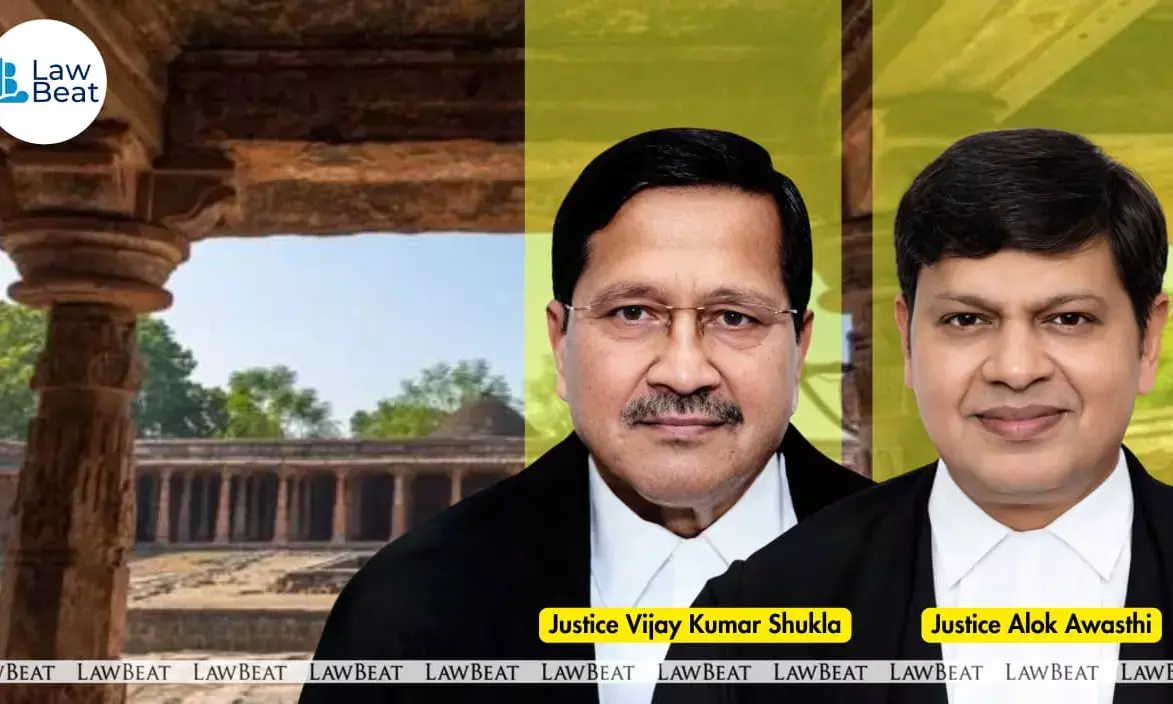
The matter, titled Antar Singh and 6 Others v. Secretary, Union of India and 5 Others, is being heard by a Division Bench of Justice Vijay Kumar Shukla and Justice Alok Awasthi along with other connected matters.
At the outset, Sr. Adv. Chitale took the Court through maps, archival records, and photographs forming part of the petition, drawing attention to what he described as the “square area with pillars” marked in the site plan. He clarified that this portion alone constitutes the “disputed area,” while the remaining premises fall outside the scope of adjudication.
Referring to an aerial image from the time the petition was filed, he pointed out that “the representation of the square below with pillars” indicates the precise location of contest, urging the Bench to confine its focus accordingly.
Tracing the historical background, Sr. Adv. Chitale submitted that for long periods, there was no communal friction at the site. He referred to legislative frameworks from 1904, later replaced in 1959, to suggest that “everything was fully appropriate” before intermittent tensions began surfacing. These tensions, he argued, were sporadic and often coincided with overlapping religious occasions, gradually escalating into administrative challenges.
Placing reliance on a series of documented interventions, including communications by Members of Parliament and even Chief Ministers, Sr. Adv. Chitale contended that multiple attempts had been made over decades to resolve the issue amicably. He also referred to orders of the Archaeological Survey of India (ASI), which permitted regulated access to both communities for worship at different times, stating that such arrangements had largely maintained equilibrium.
However, he highlighted that conflicts tend to arise during a limited number of days when religious events coincide. “Except these days, there was no communal tension,” he submitted, adding that the problem intensifies when festivals fall on the same day, leading to “face-to-face situations” between communities. He stressed that such instances, though few, require disproportionate deployment of police forces and administrative resources.
Sr. Adv. Chitale’s principal submission was that the Court should consider carving out a practical solution for these specific days. He proposed that on occasions of overlap, alternative locations within the vicinity could be designated for one of the communities, thereby preventing confrontation. “My petition is not for a property dispute… I am trying to avoid that,” he told the Bench, underscoring that the objective was conflict resolution rather than adjudication of competing ownership claims.
He further suggested the possibility of establishing a broader institutional mechanism, such as a commission or consultative body involving social workers and community representatives, to address similar disputes across the country. According to him, “bringing such matters to a head won’t serve any purpose,” and governance priorities should instead focus on larger public concerns.
Sr. Adv. Chitale also drew attention to the financial and administrative burden imposed by recurring tensions, noting that the entire city remains under heightened security for extended periods. He questioned the sustainability of such arrangements, especially when a limited, targeted intervention could mitigate the risk.
Responding to the submissions, the Bench observed that the dispute appears confined to “only three days or so” in a year when overlapping events create potential flashpoints. The Court noted that, barring these instances, the existing ASI-regulated schedule allowing Friday namaz and other designated days for Hindu prayer appears to function without difficulty.
As the hearing progressed, the Court permitted Sr. Adv. Chitale to continue his arguments at length, acknowledging the significance of the issues raised. The matter remains under consideration, with the Bench indicating that any resolution must balance legal rights with practical realities on the ground.
The matter will be heard again tomorrow (April 18, 2026).
Case Title: Hindu Front for Justice (Regd. Trust No. 976) Through its President Ms. Ranjana Agnihotri v. Union of India Ministry of Culture and other connected matters
Date of Hearing: April 17, 2026
Bench: Justice Vijay Kumar Shukla and Justice Alok Awasthi