
'Hinduism Is Inclusive, Abrahamic Religions Inherently Exclusive': Madras HC While Upholding FCRA Denial To Zen Trust
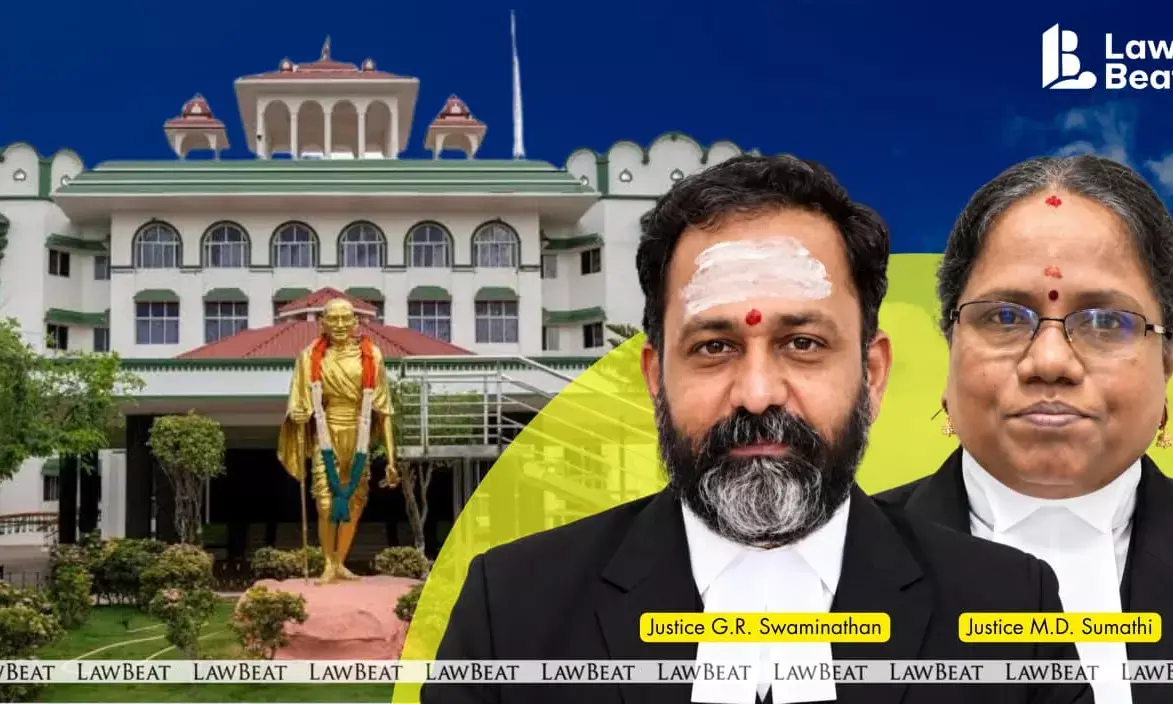
Observing that Hinduism is inclusive and the Abrahamic religions are inherently exclusive, the Madurai Bench of the Madras High Court on October 6 upheld the rejection of an application by Kanzeon Public Charitable Trust, which runs a Zen Meditation Centre in Kodaikanal, for registration under the Foreign Contribution (Regulation) Act, 2010 (FCRA).
A Division Bench of Justice G.R. Swaminathan and Justice M.D. Sumathi held that the Trust had failed to correctly disclose its nature as a religious organisation while seeking FCRA registration.
In the course of examining the Trust's claim that its activities could not be labelled religious, the Bench observed:
"Unlike Hinduism which is inclusive, the Abrahamic religions are inherently exclusive."
The Court further observed that devout Jews, Christians and Muslims believe that theirs is the "one true and complete revelation" because that is what their holy books say of themselves.
The observation came after the Court noted that the person who founded the Trust and was its “moving spirit” was an ordained Christian priest, and after examining material displayed on the Trust's website, including a motif depicting a Christian cross above a Buddha statue.
Trust Claimed Zen Meditation Was Not Religious
The Trust, founded in 2021 and registered under Sections 12AB and 80G of the Income Tax Act, had established a Zen Meditation Centre at Kodaikanal.
Its counsel argued that the Trust's activities could not be characterised as religious and relied upon earlier judgments concerning the distinction between religious activity and cultural or educational activities.
The Union Government defended the rejection, submitting that the Government's policy was to regulate the inflow of foreign funds that could be deployed for religious conversion or activities harmful to the country's secular fabric.
‘Zen Can Be No Exception’: Madras HC
The Court examined Rule 9 of the FCRA Rules, 2011 and Form FC-3A, which requires an applicant to disclose the nature of its organisation.
The form categorises organisations as religious, cultural, economic, educational or social, with further classifications for religious organisations.
The Bench noted that the Trust itself claimed to subscribe to Zen Buddhist philosophy.
While saying it was not for the Court to determine whether that claim was genuine or spurious, the Bench held that, on the Trust's own showing, it was a religious organisation.
The Court observed: "The authority rightly states that Zen Buddhism is a variant of Mahayana Buddhist School. Applying the same logic, every Buddhist school will come under the broad umbrella of Buddhism. Zen can be no exception."
Since the Trust's application did not correctly identify its nature as religious, the Court held that the rejection was justified.
'One Cannot Keep Any Card Up One’s Sleeve'
The Bench clarified that being a religious organisation did not, by itself, prevent the Trust from seeking FCRA registration.
It noted that Section 12 of the FCRA bars an unregistered religious organisation from accepting foreign contribution, but an organisation having a definite religious programme is entitled to apply for registration under Sections 11 and 12.
However, the applicant must make a complete disclosure. "But one has to make a clean breast of everything. One cannot keep any card up one’s sleeve. This is no game of hide and seek" the Court said.
The Court accordingly held that the Trust's failure to correctly disclose its religious character was sufficient to sustain the rejection.
Court Distinguishes Religious Activity From Indian Knowledge Systems
Importantly, the judgment also drew a distinction between a religious organisation and an institution engaged in education or preservation of Indian cultural and knowledge traditions.
The Bench observed that an organisation primarily engaged in systematic teaching of Vedanta, the Bhagavad Gita, the Upanishads, Yoga and allied Indian Knowledge Systems, through structured classes, residential courses, publications, research and preservation of manuscripts, could not be classified as a religious institution merely because it dealt with those subjects.
Such activities, the Court said, would fall under education or culture.
The Bench referred to the National Education Policy, 2020, which expressly recognises Indian Knowledge Systems within the educational curriculum and refers to philosophy and yoga among the fields in which such knowledge is to be taught.
The Court said the FCRA framework should operate in tandem with the NEP and cautioned that misclassification could have serious economic and funding consequences.
No Absolute Right To Receive Foreign Contributions
The Court further held that there is no vested or absolute right to receive foreign contribution. It said considerable leeway and discretion must be given to the authority while deciding applications under Sections 11 and 12 of the FCRA.
However, that discretion remains subject to judicial review where it is exercised perversely, relevant material is ignored, or there is non-application of mind.
In its final conclusions, the Bench held that an FCRA applicant must correctly disclose the nature of the organisation. It added that while organisations engaged in India's civilisational heritage may fall within the educational or cultural category, programmes involving worship and rituals would fall within the religious category.
The Court further held that religious organisations whose activities do not affect India's secular fabric and social amity may obtain FCRA registration, but organisations engaged in converting people from one religious faith to another would be denied registration.
The Court ultimately sustained the rejection of the Trust's FCRA application and dismissed the appeal, with no order as to costs.
Case Title - Kanzeon Public Charitable Trust v Union of India