
India Gate Air-Pollution Protest: Delhi Court Reserves Bail Order Of 7 Accused
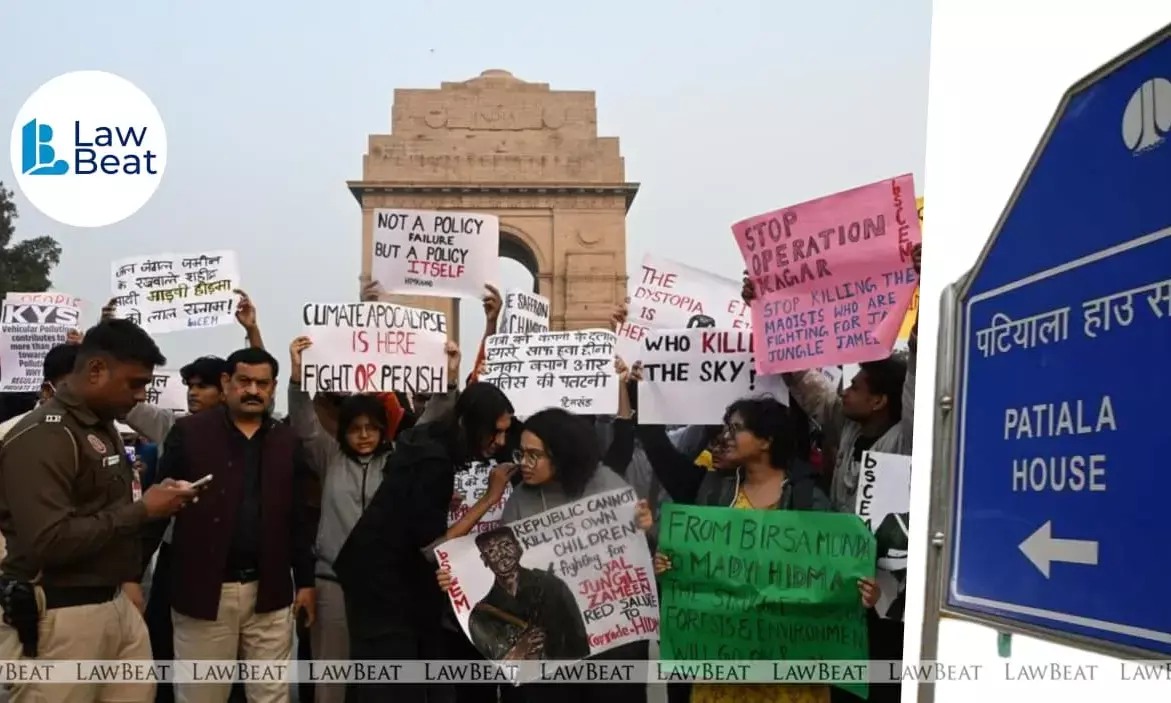
Delhi court granted bail to ten Kartavya Path protesters accused of raising pro-Hidma slogans while rejecting one bail plea over alleged Radical Students Union links
A Delhi Court on Tuesday reserved its order on the bail pleas of seven accused arrested in the Kartavya Path protest case, setting December 4 as the date for pronouncement.
The protest took place on November 23 near India Gate, where students affiliated with the Bhagat Singh Chhatra Ekta Manch (BSCEM) and environmental collective Himkhand demonstrated against the worsening air pollution in the capital. Police accused the protesters of raising provocative slogans and using pepper spray on personnel, injuring officers deployed to manage the crowd.
After hearing arguments from the investigating officer and defence counsels, Judicial Magistrate First Class (JMFC) Aridaman Singh Cheema of Patiala House Court reserved the order.
The Delhi Police had opposed bail and sought additional custodial interrogation, citing the need to probe alleged political slogans referencing slain Maoist commander Madvi Hidma, examine the protesters’ social media activity, and trace alleged funding sources. Police also claimed the students possessed expensive phones and noted that some had previously travelled to Hyderabad for a conference linked to the banned Radical Students’ Union.
Defence lawyers pushed back, stressing that the accused had varying degrees of involvement. One had no political background and did not know the others before the protest. Another, a meritorious student from a lower-middle-class family, posed no flight risk, they argued.
Addressing the accusation against a WhatsApp group admin, the counsel submitted that “there is no vicarious liability in criminal law,” and a group administrator cannot be held responsible for messages posted by others. Several lawyers emphasised that the protest was spontaneous and not coordinated by their clients, who were being held accountable for actions they did not commit.
The defence further questioned the police’s shifting stand on the pepper spray incident. “You can’t swim in two boats,” one lawyer said, highlighting alleged contradictions in the police responses. They also pointed out that the offences invoked carry maximum sentences below five years, triggering the safeguards under Arnesh Kumar that discourage unnecessary arrests.
In total, 23 protesters were arrested in two FIRs registered at Parliament Street and Kartavya Path police stations. Seventeen were held in the Parliament Street case involving a scuffle outside the station, while six were arrested in the Kartavya Path case linked to the pepper spray allegations. Fifteen of the protesters from the Parliament Street FIR were rearrested in the Kartavya Path case.
In the parallel Parliament Street case, JMFC Sahil Monga granted bail earlier: nine accused were released on November 28, and the remaining eight secured bail on Tuesday.
Bench: Judicial Magistrate First Class Aridaman Singh Cheema
[Inputs: PTI]