
Instagram Chats Alone Cannot Prove ‘Living In Adultery’: Allahabad High Court In Maintenance Case
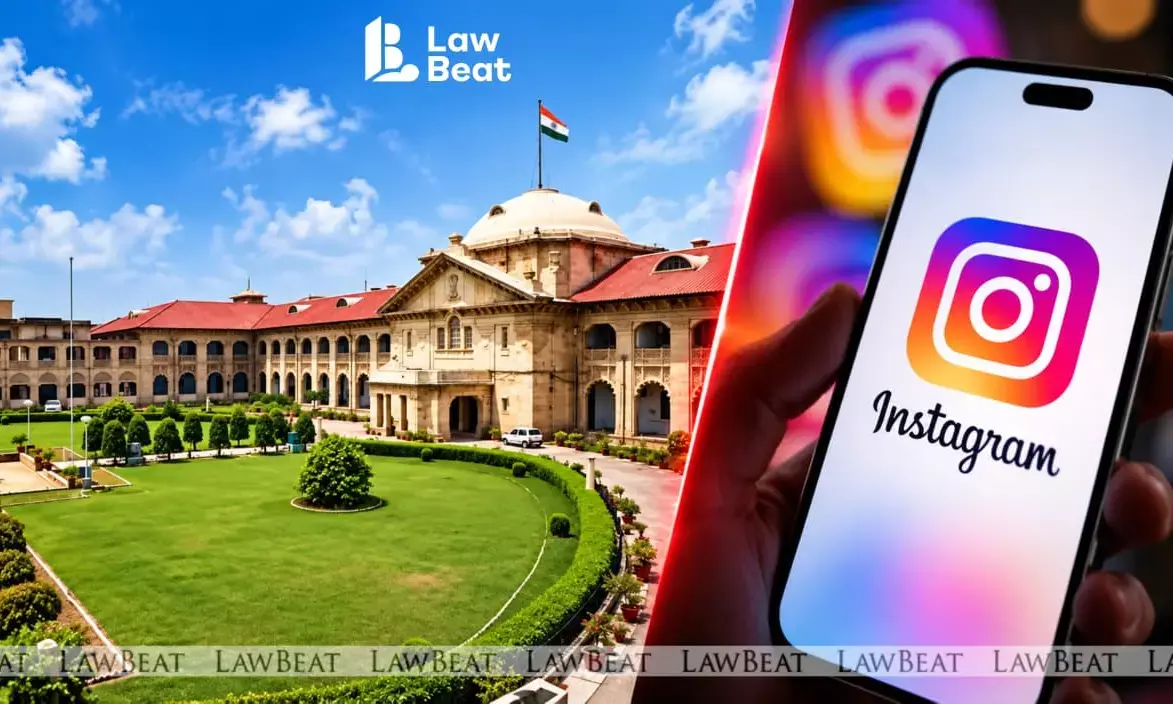
Allahabad High Court rejects Instagram chats as proof of adultery.
The Allahabad High Court recently dismissed a revision petition filed by a husband against the family court's order directing him to provide maintenance to his wife, after he claimed that she was "living in adultery".
The bench of Justice Jai Krishna Upadhyay refused to accept printouts of alleged Instagram chats between the man's wife and an advocate as proof of adultery.
The single-judge bench stressed that the admissibility of electronic evidence must be tested strictly at the anvil of Section 65B of the Indian Evidence Act, 1872, corresponding to Section 63 of the Bharatiya Sakshya Adhiniyam, 2023 (BSA). Since the Instagram chats produced by the husband were not supported by the mandatory statutory certification, court held that "it would be entirely incorrect in law to treat the electronic evidence as admissible".
Court further clarified that even if, for the sake of argument, the contents of the unverified chats were to be perused, mere text messages on a social media platform, without corroborative evidence of physical intimacy or cohabitation, were insufficient to legally establish that the wife was continuously "living in adultery".
Court stressed that the burden lay heavily upon the husband to prove a continuous adulterous lifestyle of his estranged wife, which he had failed to discharge.
What does "living in adultery" mean?
Court examined the statutory bar on maintenance applicable where a wife is "living in adultery". It observed that the expression "living in" denotes a continuous, ongoing and habitual course of adulterous conduct.
According to the court, the expression cannot be extended to cover a single, fleeting lapse, conversational interactions, professional associations or mere unsubstantiated suspicions.
Court said that a husband seeking to deny his wife maintenance on this ground must produce clear and cogent evidence which, on the face of it, establishes a continuous adulterous conduct.
Court also noted that maintenance proceedings are essentially civil in nature and are intended to prevent vagrancy and destitution. Referring to Supreme Court decisions including Dukhtar Jahan v. Mohd. Farooq and Rajnesh v. Neha, the court said maintenance provisions are social welfare measures and must be interpreted keeping their beneficent object in view.
It added that while the standard of proof in such proceedings is not the criminal standard of "beyond reasonable doubt", the burden of establishing a statutory disqualification from maintenance rests upon the person alleging it.
Why were the Instagram chats not enough?
The husband's allegation of adultery was primarily based on printouts of Instagram chats allegedly exchanged between his wife and an advocate. He argued that the conversations established an adulterous relationship and, consequently, disentitled her from claiming maintenance.
The high court, however, found that the chats were not accompanied by the mandatory statutory certification required for admitting electronic records as secondary evidence.
Relying on the Supreme Court's judgments in Anvar P.V. v. P.K. Basheer and Arjun Panditrao Khotkar v. Kailash Kushanrao Gorantyal, court reiterated that the statutory certification is a mandatory condition for the admissibility of secondary electronic evidence.
Court observed that the requirement assumes importance because of the inherent vulnerabilities associated with digital data and the need to establish its authenticity.
"Mere text messages on a social media platform", court observed, without corroborative evidence of physical intimacy or cohabitation, cannot establish that a wife is continuously living in adultery.
Maintenance order upheld
Court found that the family court had correctly evaluated the material placed before it and that its order did not suffer from any jurisdictional error, material irregularity or perversity warranting interference in revision.
The high court accordingly found no merit in the revision petition and dismissed it.
Case Title: X v. State of U.P. and Another
Bench: Justice Jai Krishna Upadhyay
Order Date: September 29, 2026