
Is ‘Reasonable Apprehension’ of Demolition After FIR Enough to Move Writ Court? Allahabad HC to Decide
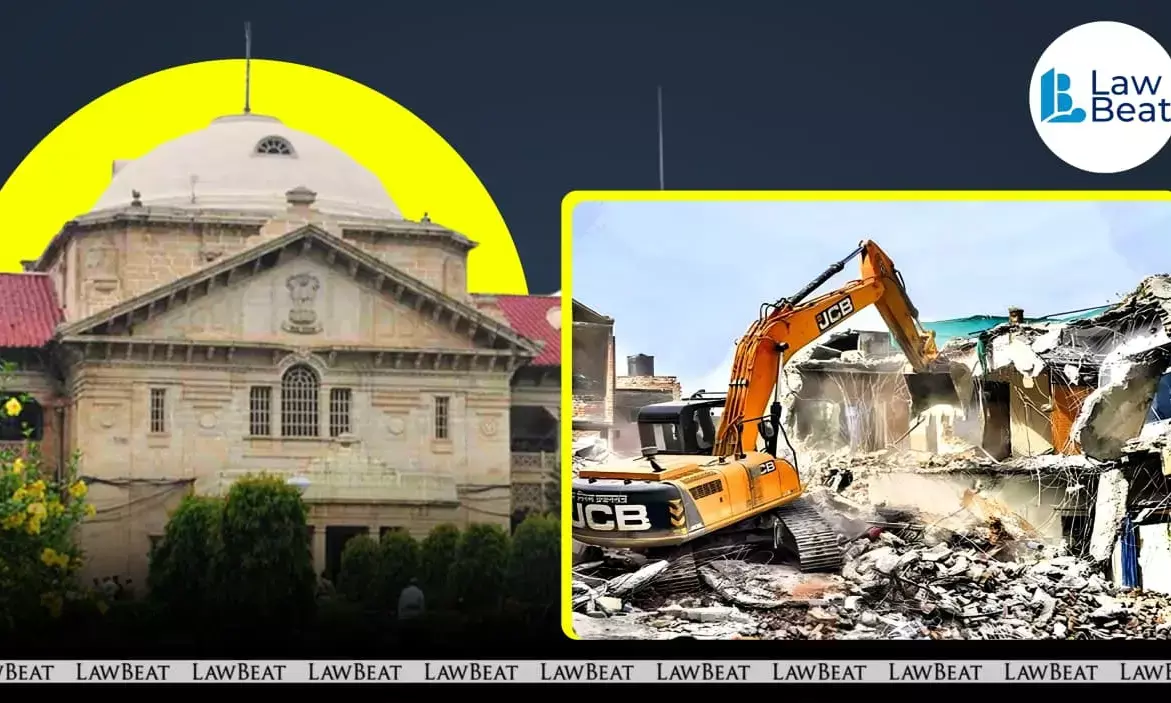
Allahabad High Court halts Hamirpur property demolition over criminal cases against non-accused relatives
The Allahabad High Court has raised serious constitutional questions over the growing practice of demolitions being initiated immediately after the registration of criminal cases, even against persons who are not accused, while hearing a writ petition filed by a family in Uttar Pradesh’s Hamirpur district.
The petition was filed by three members of a family, a son, his father, and his mother, residents of Bharua Sumerpur in Hamirpur. The petitioners approached the court alleging that their residential and commercial properties were being targeted by the authorities following the registration of an FIR against one of their relatives, despite none of them being named as accused in the case.
The FIR, registered in 2026, was lodged against one Aafan Khan, a close relative of the petitioners. The case was registered under Sections 64(1), 62/351(3), 61(2) of the BNS and Sections 67(A) of the IT Act, Section ¾ of the POCSO Act, and Section 3/5(1) of the U.P Prohibition of Unlawful Religious Conversion Act.
According to the petitioners, soon after the FIR was registered, a mob allegedly targeted their house, allegedly with police connivance.
Placing their grievance before the court, the family submitted that although none of them were accused in the criminal case, the authorities issued notices to the father, who owns the residential house where all three reside. They further claimed that a commercial property named “Indian Lodge,” registered in the name of the mother, had been sealed by the authorities. In addition, a saw mill, the licence of which stands in the father’s name and had been renewed in February 2025, was also sealed, though its subsequent renewal was pending at the time.
The core apprehension raised before the court was that the petitioners’ properties were likely to be demolished using mechanical means, prompting them to seek urgent judicial intervention to prevent any such action.
Opposing the plea, the State raised a preliminary objection, contending that the petition was premature as no cause of action had arisen. It was argued that the petitioners were required to first respond to the notices issued to them. The State further claimed that neither the residential house nor the lodge had been sealed. As regards the saw mill, the State alleged that it had been sealed due to the recovery of prohibited wood, and that the petitioners had not disclosed this fact in their pleadings.
During the hearing, the Additional Advocate General gave an oral assurance to the court that no demolition would be carried out without following the procedure established by law and without giving the petitioners an opportunity to present their case.
Taking note of the submissions, the division bench observed that it had repeatedly come across cases where demolition notices were issued immediately after the commission of an offence, followed by demolition after ostensible compliance with statutory requirements. Court noted that such actions continued despite clear directions of the Supreme Court of India prohibiting punitive demolitions of structures.
The bench underscored that the issue involved a larger constitutional balance between the State’s statutory powers and the fundamental rights of citizens under Articles 14 and 21 of the Constitution.
In this backdrop, court framed several questions of law, including:
(1) Is there non-compliance of the judgment of the Supreme Court in In Re: Directions in the Matter of Demolition of Structures (Writ C No. 295 of 2022 – (2025) 5 SCC 1) with specific reference to paragraphs 85 and 86 of that judgement?
(2) Does the authority to demolish justify the act of demolishing a structure, or is there a duty on the anvil of parens patriae upon the State, not to demolish a dwelling place in the absence of public need/purpose?
(3) Would steps taken in the direction of demolishing a structure immediately following the commission of an offence be a colourable exercise of executive discretion?
(4) How is the high court to balance the conflicting interests between the statutory authority of the State to demolish a structure and the fundamental right of the average citizen under Articles 21 and 14, to prevent it?
(5) Can "reasonable apprehension" of demolition be a cause of action for a citizen to approach this court and if 'yes', what is the bare minimum for this court to hold the existence of such "reasonable apprehension"?
Pending further hearing, the high court directed that any interim order already in force would continue. It also directed the police to provide protection to the life, limb, and property of the petitioners, ensuring their free ingress and egress.
The matter has been listed for further hearing on February 9, 2026.
The Supreme Court’s November 13, 2024 guidelines in In Re: Directions in the Matter of Demolition of Structures arose from a batch of writ petitions filed under Article 32 of the Constitution.
The petitions were filed by affected individuals and civil rights groups challenging demolition actions undertaken by state and municipal authorities in different parts of the country. Given the multiplicity of petitions raising common questions of law and constitutional significance, the Supreme Court clubbed the matters and treated them as a consolidated proceeding to examine the legality and limits of demolition powers exercised by state authorities.
After hearing the parties, the Court proceeded to lay down pan-India directions governing the exercise of demolition powers, emphasising that demolition of structures cannot be undertaken merely on the basis of criminal allegations against occupants or owners.
The Court underscored that such actions must strictly comply with due process requirements, including prior notice, a meaningful opportunity of hearing, and reasoned orders, and clarified that punitive demolition falls outside the permissible scope of executive authority.
Case Title: Faimuddeen And 2 Others vs. State Of U.P. And 7 Others
Order Date: January 21, 2026
Bench: Justices Atul Sreedharan and Siddharth Nandan