
'Judge Must Engage With the Bar, Not Sit Like a Sphinx': Madras High Court
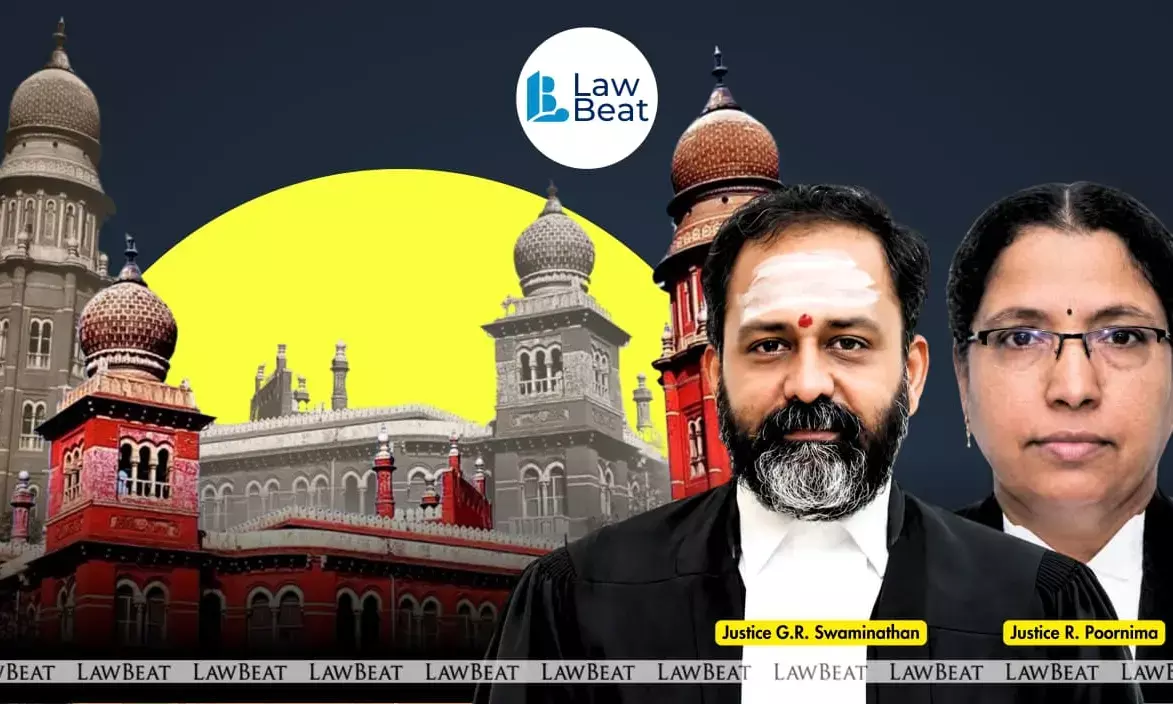
Madras High Court restores money recovery decree in suit.
A judge should not sit "like a sphinx" and spring adverse findings on litigants without first putting them on notice, the Madras High Court recently observed while reversing a trial court's decision that dismissed a money recovery suit despite the defendant neither filing a written statement nor cross-examining the plaintiff.
Allowing an appeal filed by Madurai resident P. Palanikumar, a division bench of Justice G.R. Swaminathan and Justice R. Poornima set aside a 2018 judgment of the IV Additional District Judge, Madurai, and decreed recovery of Rs. 31.54 lakh in favour of the plaintiff.
The dispute arose from a claim that Palanikumar had advanced Rs. 25 lakh to R. Selvi in June 2015. According to the plaintiff, Selvi executed a promissory note agreeing to repay the amount with 12 per cent annual interest and also deposited the original title deed of her property as security. After issuing a legal notice and receiving a reply, the plaintiff approached the civil court seeking recovery of the amount.
The trial court, however, dismissed the suit on the ground that the plaintiff had failed to prove his financial capacity to advance such a large amount, the mode of payment, and the execution of the promissory note.
Why did the High Court fault the trial court?
The bench noted that the defendant had neither filed a written statement nor cross-examined the plaintiff. While a defendant who has not filed a written statement cannot adduce evidence because evidence must be founded on pleadings, such a defendant can still participate in proceedings by cross-examining the plaintiff's witnesses, court said. In this case, that opportunity was not utilised.
The judges held that if the trial court entertained doubts about the plaintiff's financial capacity, it ought to have directly questioned him using its powers under Section 165 of the Indian Evidence Act (corresponding to Section 168 of Bhartiya Sakshya Adhiniyam, 2023).
"The Judge should not sit like a sphinx. He must engage in a dialogue with the Bar. He must pose questions to the witness to disabuse his mind of lingering suspicions," the bench observed.
Court further said that litigants cannot be taken by surprise and that if a judgment is to rest on an adverse factor, the concerned party must first be put on notice. Since no such exercise was undertaken, the finding that the plaintiff lacked the financial wherewithal was "perverse" and based on no evidence, it held.
What did the court say about the promissory note?
The high court found that the defendant's own reply notice did not deny receipt of money. Instead, she claimed that the plaintiff was merely acting on behalf of another individual, Santhanakrishnan. The bench said this amounted to an admission that money had been received, with the dispute being only about its source.
Invoking the rule of non-traverse under Order VIII Rule 5 of the Code of Civil Procedure, court held that allegations not specifically denied must be treated as admitted. Since the defendant never filed a written statement, the plaintiff's claim regarding the loan and execution of the promissory note stood deemed admitted.
Court also relied on the statutory presumption under Section 118 of the Negotiable Instruments Act, which presumes consideration for a promissory note unless proved otherwise. Since the defendant failed to rebut that presumption, the trial court was wrong in refusing relief, it held.
Does a cash loan above Rs.20,000 become unenforceable?
Rejecting another basis on which the plaintiff's claim had been doubted, the bench clarified that although advancing Rs. 25 lakh in cash may violate Section 269SS of the Income Tax Act, such a violation does not make the transaction illegal or void.
Court said tax authorities remain free to initiate proceedings for any breach of the Income Tax Act, but such a violation does not prevent a lender from recovering the money through civil proceedings.
The bench also attached significance to the fact that the plaintiff was in possession of the defendant's original title documents, a circumstance that remained unexplained by the defendant. Holding the trial court's approach to be "utterly unsatisfactory" and its reasons "clearly unsustainable", the high court allowed the appeal and decreed the suit in full.
Case Title: P. Palanikumar v. R. Selvi
Judgment Date: June 4, 2026
Bench: Justice G.R. Swaminathan and Justice R. Poornima