
Judicial Review Limited In Policy Matters: MP High Court On Mukhyamantri Ladli Behna Yojana
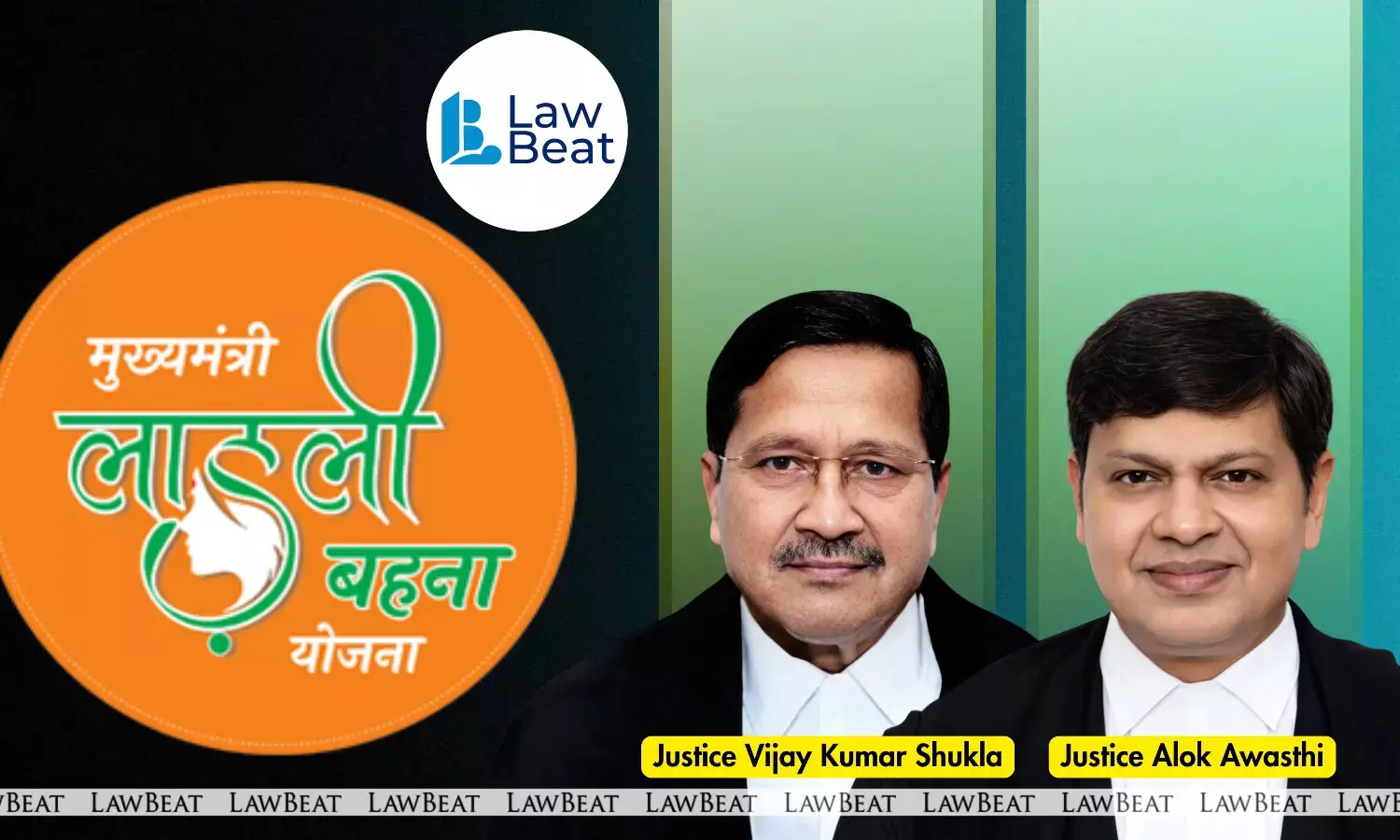
MP High Court Refuses To Interfere With Ladli Behna Yojana Policy, Dismisses PIL
The Madhya Pradesh High Court has declined to interfere with the implementation of the Mukhyamantri Ladli Behna Yojana, 2023, holding that decisions relating to eligibility, age limits and closure of registrations fall squarely within the executive domain of the State Government and cannot ordinarily be examined in a public interest litigation.
A Division Bench comprising Justice Vijay Kumar Shukla and Justice Alok Awasthi dismissed a writ petition filed in the nature of pro bono publico under Article 226 of the Constitution of India, challenging what was described as “illegal, arbitrary and discriminatory implementation” of the scheme.
The petition was filed by Paras Saklecha. Shri Vibhor Khandelwal appeared for the petitioner, while Shri Sudeep Bhargava, Deputy Advocate General, along with Shri Pradyumna Kibe, Government Advocate, represented the State.
The Mukhyamantri Ladli Behna Yojana was introduced on March 1, 2023 with the stated objective of women empowerment by improving health and nutrition, promoting economic independence and strengthening women’s role in family decision-making. Under Clause 6.1 of the policy, eligible women domiciled in Madhya Pradesh were to receive Rs.1,000 per month directly in their bank accounts. The amount was later increased administratively to Rs.1,250 per month.
As per Clause 3 of the policy, the eligibility criteria required that a beneficiary be a domiciled married woman, including widows, divorced and abandoned women, between the ages of 23 and 60 years. By an order dated July 19, 2023, the minimum age was reduced from 23 to 21 years, thereby extending benefits to women aged between 21 and 60 years.
The petitioner contended that the State’s decision to stop fresh registrations under the scheme with effect from August 20, 2023 was arbitrary and discriminatory, especially when the policy was of a continuing nature and had over 1.26 crore beneficiaries. It was argued that denial of benefits to similarly placed women amounted to hostile discrimination and violated Article 14 of the Constitution. The fixation of the minimum age of 21 years and maximum age of 60 years was also challenged as unreasonable.
The court, however, was not persuaded. Addressing the scope of judicial review over policy decisions, the bench referred to settled Supreme Court precedents holding that courts do not sit in appeal over the wisdom of economic or executive policies. Judicial review, the bench emphasised, is confined to examining legality and constitutionality, not desirability.
The court observed that the present case did not fall within the recognised grounds for interference with policy decisions. It recorded that the policy in question was not statutory but an executive policy of the State Government.
Rejecting the challenge to the closure of fresh registrations, the Bench held that “in a policy decision, it is for the State to decide the date of implementation and its continuation.” The fixation of a commencement date and closure date was described as being “within the domain of the State”.
On the challenge to the age criteria, the court found no arbitrariness. It held that prescription of minimum and maximum age limits for entitlement under a welfare scheme is “absolutely within the domain of the State Government,” and considering the nature of the scheme, no constitutional infirmity was made out.
The court also declined to entertain the argument regarding enhancement of the monetary benefit, observing that the petitioner was admittedly not an aspirant or beneficiary under the scheme and such issues could not be examined in a PIL.
Concluding that no case was made out for judicial interference, the bench held that it did not find any ground to entertain the public interest litigation and dismissed the petition without costs.
Case Title: Paras Saklecha v. State of Madhya Pradesh Through Chief Secretary and Others
Date of Order: February 10, 2026
Bench: Justice Vijay Kumar Shukla and Justice Alok Awasthi