
Karthigai Deepam Row: Dargah Tells Madras HC It Was Not Properly Heard in Hindu Devotee’s Plea
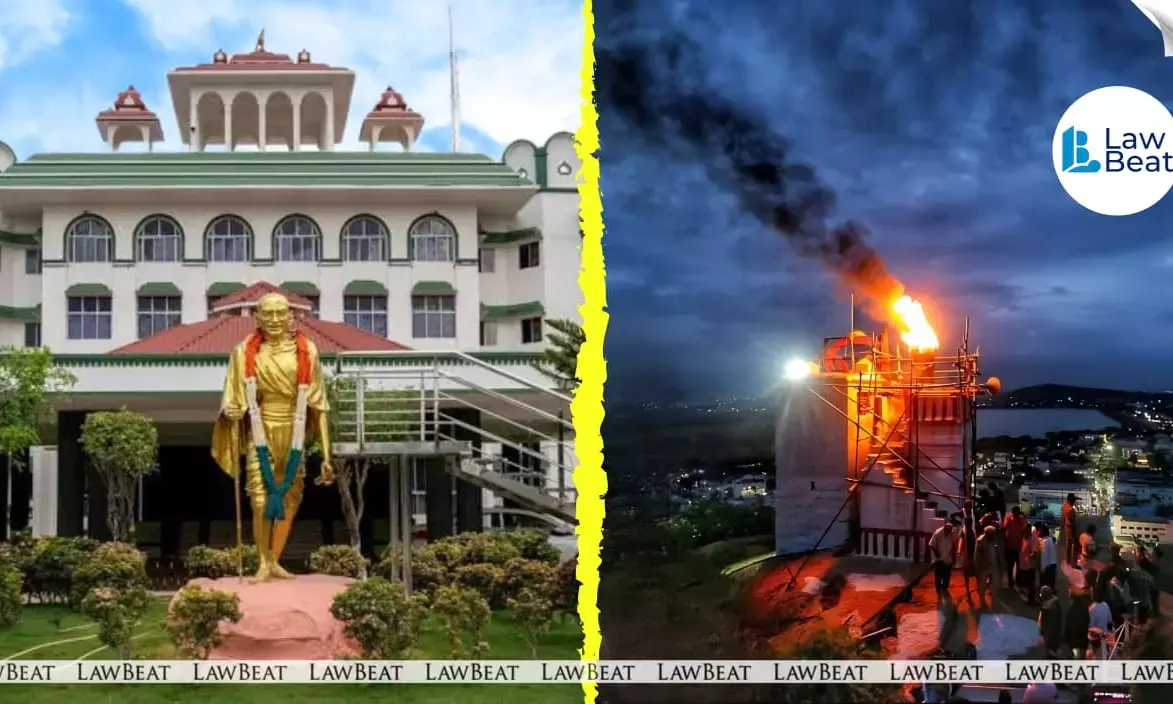
Madras High Court Division Bench hears Temple and Dargah arguments challenging single judge's Deepathoon lamp lighting order, stressing procedural flaws
The Madras High Court on Monday heard appeals filed by the Arulmigu Subramanian Swamy Temple, Thirupparankundram, and the State government of Tamil Nadu, challenging a single judge order of December 1 that permitted lighting of a sacred lamp during the Karthigai Deepam festival atop an ancient pillar (deepathoon) on Thiruparankundram Hill.
During the hearing, Senior Advocate T. Mohan, representing the Hazarath Suitan Sikkandar Badhusha Avuliya Dargah, which is also situated at the Thirupparankundram Hill, alleged that the PIL leading to the order was fast-tracked in violation of procedural safeguards and without affording it a fair hearing.
Sr Adv. Mohan submitted before the division bench of Justices G Jayachandran and K K Ramakrishnan that the context in which the PIL was filed and decided was critical, as the dargah was not initially made a party to the proceedings despite being directly affected by the outcome. He told the division bench that the dargah was impleaded only at a later stage, after key proceedings had already taken place.
He further contended that the writ petition was rushed through in violation of established writ rules. He argued that respondents are ordinarily entitled to eight weeks to file counter affidavits, but in the present case, only three days were granted, leaving no real opportunity to respond.
He further submitted that he was effectively shut out of the hearing process. Mohan told the court that he was disconnected from the virtual hearing and that the single judge proceeded with the matter after stating that he would not wait, even though the dargah was an affected party that ought to have been heard first.
Mohan further alleged that even before he was heard, newspaper reports suggested that the lamp would be lit once orders were passed, and submitted that the judgment was handled in a summary manner that “deconstructed the law”.
Challenging the maintainability of the PIL itself, Mohan argued that public interest litigation requires a real and tangible legal interest, not a sentimental or ideological one. He cautioned that without clear limits, courts risk being flooded with busybodies and interlopers seeking to exercise rights they never possessed.
During the hearing, the division bench repeatedly cautioned counsel to confine their submissions to the sustainability of the single judge’s judgment, clarifying that it was not concerned with events preceding or following the filing of the case.
Supporting concerns over the manner in which the PIL was entertained, Senior Advocate A.K. Sriram, appearing for another appellant, assailed the single judge’s approach in setting aside the executive officer’s order without examining its merits. He submitted that the trust board, a necessary stakeholder, was never made a party to the proceedings, rendering the exercise procedurally flawed.
Sriram further argued that characterising the hilltop lamp-lighting as a “Tamil tradition” could not, by itself, form a valid legal basis for invoking writ jurisdiction. He submitted that questions relating to religious usage and practice ought to follow the statutory route, and not be adjudicated through a PIL that bypassed established procedures.
Adding to the State’s perspective, Senior Advocate N. Jothi, appearing for the Joint Commissioner of the Hindu Religious and Charitable Endowments (HR&CE) Department, defended the department’s regulatory role and flagged concerns over public order. He submitted that under the Tamil Nadu Temple Entry Authorisation Act, 1947, trustees have statutory powers, subject to State control, to regulate temple administration and ensure orderly observance of religious practices.
Jothi also warned that entertaining such PILs without clear limits could open the floodgates for similar claims and recurring litigation, potentially disturbing public order. He told the court that public authorities had already been put to great difficulty due to the actions of a few individuals, who, according to him, triggered the controversy and caused law-and-order problems at the site.
The hearing is scheduled to resume after the lunch break.
Case Title: The Executive Officer, Arulmigu Subramanian Swamy Temple, Thirupparankundram, Madurai vs. Rama Ravikumar and Others with connected matters
Hearing Date: December 15, 2025
Bench: Justices G Jayachandran and K K Ramakrishnan