
Karthigai Deepam Row: Madras High Court Summons TN Chief Secretary, ADGP to Explain Repeated Defiance of Court Orders
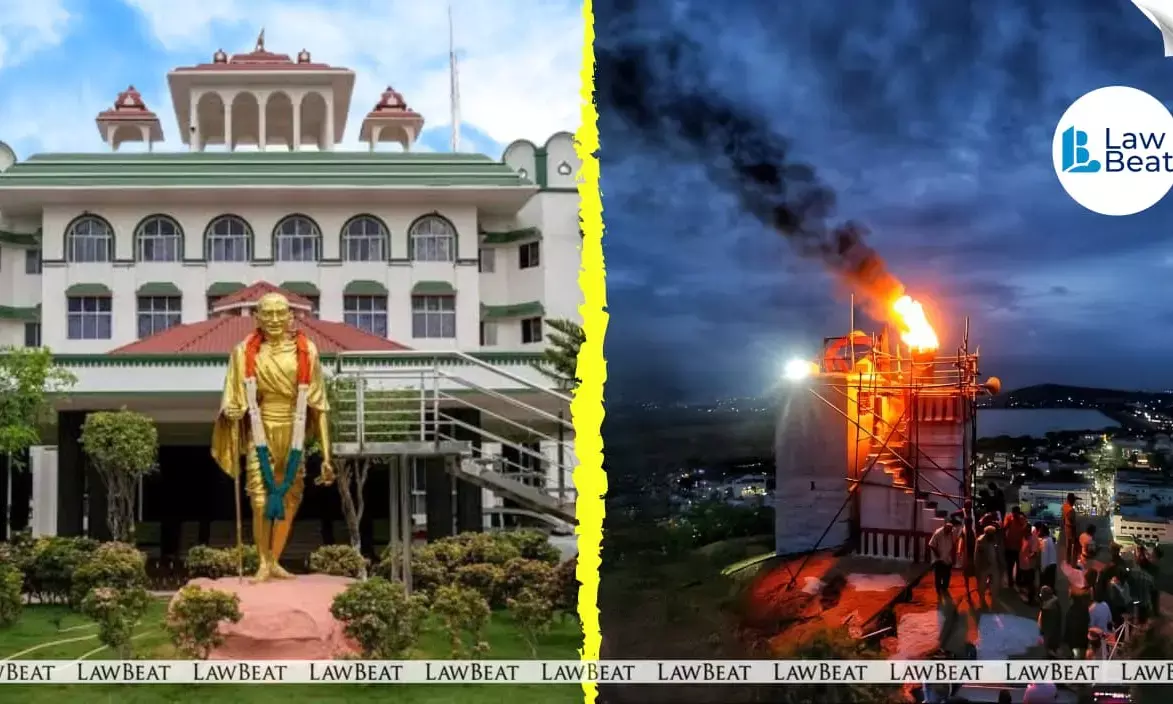
Madras High Court seeks explanation from TN Chief Secretary and Police over repeated non-compliance with its order allowing the annual Karthigai Deepam to be lit atop Thiruparankundram Hill, specifically at the ancient stone pillar called Deepathoon
The Madras High Court on December 9, 2025, directed the Chief Secretary of Tamil Nadu and the Additional Director General of Police, Law and Order, to appear before it on December 17 through video conference to explain why district-level officials repeatedly failed to enforce judicial orders relating to religious processions and rituals, including the court-ordered lighting of the Karthigai Deepam at Thirupparankundram.
The bench of Justice G.R. Swaminathan also impleaded the Union Home Secretary to seek possible central inputs at a later stage.
Court issued the direction while hearing a contempt petition filed after the district administration and police allegedly defied court orders in the matter. The court had on December 1 directed the Arulmigu Subramania Swamy Temple at Thirupparankundram to light the Karthigai Deepam at the traditional “Deepathoon” site and instructed the local police to ensure compliance. However, when the temple management refused, the petitioner was permitted to climb the hill and light the lamp under CISF protection. The CISF contingent was stopped by the Commissioner of Police and more than 200 personnel, who physically prevented them and the petitioner from proceeding.
Police officials cited a prohibitory order issued by the District Collector on December 3 under Section 163 of the Bharatiya Nagarik Suraksha Sanhita (BNSS), 2023. The high court later held that the Collector’s order had been issued to overreach its earlier directions and quashed it on December 4. The Division Bench had also dismissed a State appeal (LPA(MD) No. 8 of 2025) challenging the contempt-related directions. Despite this, the police again prevented the petitioner and his associates from performing the ritual, prompting the court to implead Deputy Commissioner A.G. Inigo Divyan as a contemnor.
A report submitted by the CISF Deputy Commandant on December 9 confirmed that the State police had blocked CISF personnel from carrying out the high court’s order. The police reportedly claimed the order lacked the judge’s signature and invoked the now-quashed prohibitory order.
Justice Swaminathan observed that while officials on December 3 had at least attempted to justify their conduct using the Collector’s order, the refusal to obey the court’s directions on December 4, after the ban was quashed, had no possible defence.
Court rejected the State’s plea for adjournment on the ground that writ appeals were scheduled before a Division Bench and that an SLP had been filed before the Supreme Court. It noted that the SLP was defective and that no interim order had been obtained either from the Division Bench or the Supreme Court. In such circumstances, the operative judicial directions continued to bind the district administration.
Justice Swaminathan also referred to two recent cases in Kanyakumari and Dindigul districts involving religious-site conflicts, in which district administrations allegedly failed to enforce high court orders, including directions to restore a Murugan statue at “Mayiladum Parai” and to permit Karthigai Deepam celebrations at “Mandu Kovil". These instances, court said, revealed a “definite pattern” of non-compliance that could not be attributed merely to mistaken judgment.
Court emphasised that State officials are bound to enforce judicial orders and cannot rely on oral instructions or illegal directives from superiors to justify non-compliance. It observed that repeated defiance may amount to willful disobedience, attracting contempt consequences.
Calling for systemic accountability rather than isolated explanations, court insisted that the highest officials of the State clarify whether they intend to issue guidance or circulars ensuring that district administrations comply with court orders without hesitation.
The matter will be taken up on December 17 for further directions.
The controversy has long revolved around a customary shift. For more than a century, the lamp was traditionally lit at a “Deepa Mandapam” near the Uchi Pillaiyar Temple on the hill which is a lower, widely accepted spot. But this year, petitioners sought the ancient Deepathoon on the hill as the site for lighting, arguing that ritual tradition and temple ownership supported their claim.
The Hill includes the Arulmighu Subramaniya Swamy Temple and a nearby dargah, and has been at the centre of a simmering dispute over religious rights and access.
Notably, on December 9, Dravida Munnetra Kazhagam (DMK) led a delegation of INDIA bloc Members of Parliament to Lok Sabha Speaker Om Birla to submit an impeachment notice seeking removal of Madras High Court judge Justice G R Swaminathan. They alleged alleged that Justice Swaminathan’s conduct undermines confidence in judicial impartiality and transparency. They also accused him of extending undue favour to a senior advocate and lawyers belonging to a particular community and claimed that some of his verdicts are coloured by political ideology, contrary to the secular scheme of the Constitution.
Case Title: Rama.Ravikumar vs. K.J.Praveenkumar IAS and Others
Order Date: December 9, 2025
Bench: Justice G R Swaminathan