
Lucknow Fire Incident: Allahabad High Court Directs UP Govt to Frame SOP on Fire Safety, Fix Accountability for Lapses
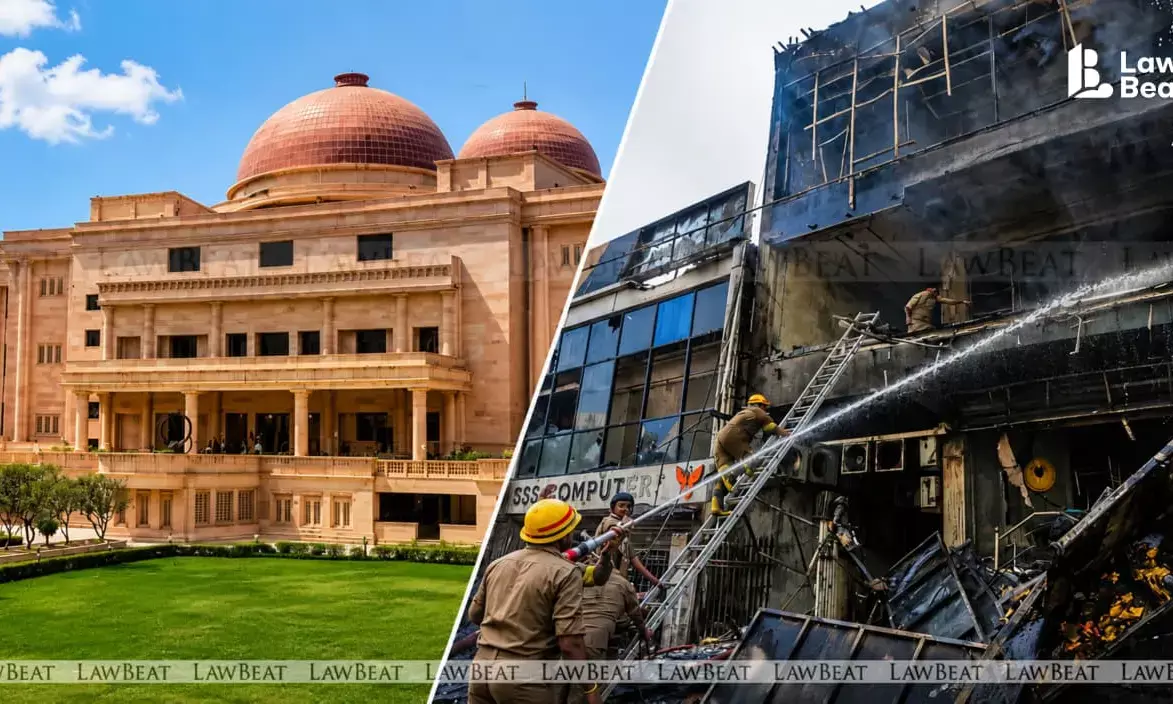
Allahabad High Court hears PIL over Lucknow fire incident and safety lapses.
Observing that repeated fire tragedies expose a "sorry state of affairs" and reflect the failure of existing enforcement mechanisms, the Allahabad High Court has directed the Uttar Pradesh government to formulate a Standard Operating Procedure (SOP) to prevent such incidents, ensure compliance with building by-laws and fire safety norms, and fix accountability of erring officials.
A bench of Justice Rajan Roy and Justice Manjive Shukla was hearing a public interest litigation filed by Advocate Shivendu Pandey following the June fire at a Housing and Animation Centre in Aliganj, Lucknow, in which 15 young persons lost their lives.
The petitioner appeared in person. Additional Advocate General Anuj Kudesia represented the Lucknow Development Authority, while Manish Jauhari appeared for the power authorities.
Court noted that the Aliganj incident was not the first such tragedy. It referred to the Levana Hotel fire case and other pending PILs relating to similar incidents, observing that although authorities and courts respond immediately after disasters, "the promptness which was reflected immediately after the incident, dies," allowing fresh incidents to occur.
Why did the court question the Aliganj building approvals?
Court found serious lapses in the approvals granted to the building.
During the hearing, Additional Advocate General Anuj Kudesia informed the bench that the building had been sanctioned only for residential purposes, but a commercial building had been constructed and commercial activities were being carried on there.
He further stated that although a demolition order had been passed in May 2016 against unauthorised basement construction, it was withdrawn less than two months later. Even after the withdrawal, construction remained contrary to the sanctioned plan. When asked why illegal construction was not stopped or action taken under the U.P. Urban Planning and Development Act, 1973, counsel candidly informed the court that no action had been taken.
The bench observed that had timely action been taken, "loss of lives would have been prevented".
How did a residential building get a commercial electricity connection?
The bench also questioned the role of electricity authorities.
Counsel for the Power Corporation informed the court that the premises initially received a 2 KV residential electricity connection in 2016 but was later granted a 20 KV commercial connection after an NOC issued by the Director, Electrical Safety.
Court questioned how a building sanctioned only for residential use could subsequently receive approval for commercial electricity. It observed that had proper scrutiny been undertaken at that stage, "this unfortunate incident... would not have occurred."
Should the exemption from fire safety certificates be revisited?
Court also examined the legal framework governing fire safety.
It was informed that under Section 26 of the U.P. Fire and Emergency Services Act, 2022, multi-storey buildings below 15 metres are exempt from obtaining fire safety certificates. The bench observed that the Aliganj tragedy itself showed that this exemption appeared "unreasonable, prima facie," and said all relevant provisions should be revisited by the State Government.
The judges further questioned whether an occupancy certificate, contemplated under the same provision, had ever been issued in respect of the building and, if so, on what basis.
Court also expressed dissatisfaction over the State's response after the incident. Although it was informed that a Special Investigation Team had been constituted, the State counsel could not explain its composition or terms of reference. He only informed the court that a high-level committee meeting had been held on June 23, 2026, but the minutes were not available.
The bench also questioned the absence of a uniform compensation policy. Noting that families of the deceased had received Rs 12 lakh each, it observed that compensation awarded by the State varies widely across different incidents, sometimes reaching Rs 50 lakh or Rs 25 lakh, and asked what objective criteria govern such decisions.
Directing the petitioner to implead senior officials from the Housing, Energy and Power departments, court ordered all official respondents to file separate counter affidavits.
It further directed the State Government to prepare an SOP to ensure compliance with building by-laws and fire safety norms and to fix responsibility on officers and employees for lapses. Advocate Rakesh Kumar of the Oudh Bar Association was permitted to assist the court as amicus curiae.
The matter will next be heard on August 4, 2026.
Case Title: Shivendu Pandey v. State of U.P. through Additional Chief Secretary/Principal Secretary, Home Department, Lucknow and 11 Others
Order Date: July 2, 2026
Bench: Justice Rajan Roy and Justice Manjive Shukla