
Madras HC Upholds Thengalai Sect’s Exclusive Worship Rights at Kancheepuram Temple
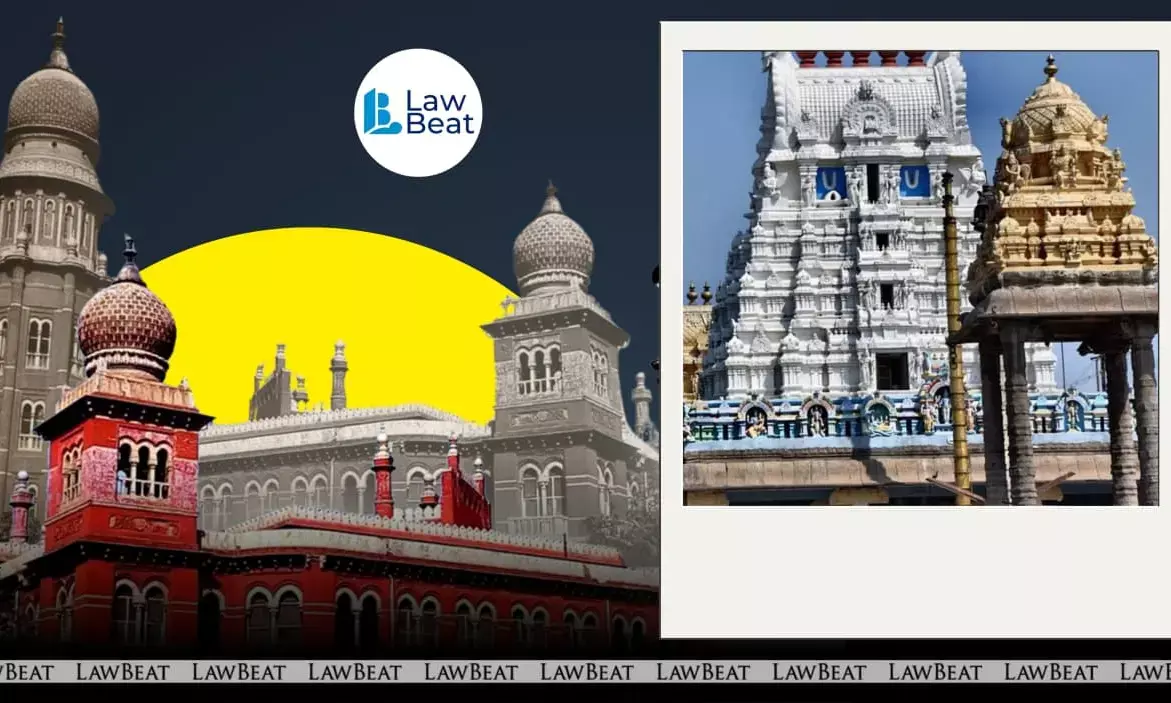
Madras High Court re-affirms Thengalai sect's exclusive rights over temple ceremonies at Sri Devarajaswamy Temple
The Madras High Court has reaffirmed that only the Thengalai sect’s mantram, prabandham and Vazhi Thirunamam may be rendered during puja and processions at Sri Devarajaswamy Temple, Kancheepuram. Court directed the Executive Trustee to enforce this mandate strictly in line with the century-old decrees and to seek police assistance whenever required, with the police directed to provide immediate protection on request.
Reiterating the long-standing legal position, a division bench of Justice R. Suresh Kumar and Justice S. Sounthar held that the Adhyapaka Mirasi in the temple is an exclusive office vested in the Thengalai sect’s residents of Kancheepuram, entitling them alone to commence the worship with the recitation of “Sri Sailesa Dayapatram,” to lead the rendition of the Nalayira Divya Prabandham, and to conclude with the Thengalai Vazhi Thirunamam in front of the deity.
Members of the Vadagalai sect, the court emphasised, may join the recitation only as ordinary worshippers by repeating what the Mirasi office-holders render and cannot introduce their own mantrams, separate goshti, or Desika Prabandham during the ceremonial worship or procession.
The bench noted that these rights were not new creations but had been conclusively settled through multiple decisions of the High Court, particularly the judgments of 1882, 1915, 1939 and 1969, all of which declared that the ceremonial worship in the temple is to be conducted solely in accordance with the Thengalai Mirasi system.
Court observed that these judgments were delivered in representative suits and are binding on all members of both sects. It also held that the abolition of hereditary servants under the 1971 amendment to the Hindu Religious and Charitable Endowments Act had no impact on the Mirasi right, since the right is not an individual hereditary emolument but an office vested in a body of persons, namely, all Thengalai residents of Kancheepuram.
The bench rejected the Vadagalai contention that the earlier decrees were unconstitutional on the ground that they pre-dated the Constitution and allegedly violated Articles 25 and 26. Judicial decrees, the court said, cannot be challenged in collateral proceedings as violating fundamental rights.
The right asserted by the Vadagalai sect to recite their own mantrams or Desika Prabandham during the temple’s puja service stood on a different footing from their general right to worship, court opined. The Mirasi office, court held, is protected under the denominational rights in Article 26 and cannot be overridden by an individual assertion of Article 25. The decrees restraining the Vadagalai sect from reciting their separate mantrams therefore do not infringe their constitutional rights.
Court also rejected the argument that the decrees had become unenforceable due to limitation. A decree for injunction need not be executed unless violated, the bench noted, and under the present Limitation Act such injunction decrees are not subject to any limitation period for enforcement. Each act of interference constitutes a fresh violation.
It further observed that the Vadagalai challenge to the Executive Trustee’s 14 May 2022 notice through which the trustee attempted to enforce the decrees was, in essence, an impermissible attempt to question the validity of the decrees themselves through a writ petition.
Finding no merit in the Vadagalai petitions, court dismissed the 2018 plea, which sought a direction for the recitation of the Desika Prabandham during the 750th birth anniversary of Vedanta Desika, and the 2022 plea, which sought to quash the trustee’s 2022 notice reiterating that only Thengalai mantrams and prabandhams may be rendered during the puja. The bench held that the trustee’s notice was entirely consistent with the binding judicial decrees.
Court further allowed the pleas filed by members of the Thengalai sect, setting aside the interim order of the single judge that had permitted both sects to separately render their initial and concluding mantrams during the puja service. The bench said such an arrangement was inconsistent with the binding decrees and could not be sustained.
On the contempt plea filed against the Executive Trustee for allegedly permitting Vadagalai recitations during the 2018 festival, court held that wilful disobedience was not established. It noted that the trustee had, in fact, largely adhered to the pattern mandated by the decrees and that subsequent disputes had emerged owing to fresh litigation and law-and-order concerns.
With these findings, court closed the contempt petition, dismissed the Vadagalai writ petitions, allowed the writ appeals filed by the Thengalai sect, and directed the Executive Trustee and the police to ensure faithful implementation of the decrees governing ceremonial worship at Sri Devarajaswamy Temple.
The team appearing for the Thengalai sect was led by a team of Senior Counsels Mr. Vijay Narayan, Mrs. Hema Sampath, Mr. V. Srinivasa Raghavan, Mr. A.K. Sriram, Mr. P.V. Balasubramaniam and Mr. K.B.S. Rajan who were assisted by counsels Mr. M.V. Swaroop, Mr. R Palaniandavan, CMS INDUSLAW Partner Varuni Mohan, Senior Associate Harsh Gupta and Associate Priyanka Kannan.
Senior counsel G. Rajagopalan, Counsel R.P. Palaniandavan and Varuni Mohan appeared for the Vadagalai petitioners and appellants.
The State and HR&CE Department were represented by Special Government Pleader N.R.R. Arun Natarajan, assisted by Government Advocate K. Karthikeyan, while the police was represented by Additional Public Prosecutor R. Muniyapparaj. The Executive Trustee was represented by standing counsel R. Bharanidharan.
Case Title: P.B.Rajahamsam vs. S.Narayanan and Others with connected matters
Judgment Date: November 28, 2025
Bench: Justice R. Suresh Kumar and Justice S. Sounthar