
Mere Demand Of Bribe Is An Offence: Madhya Pradesh High Court Refuses To Quash FIR Against Doctor
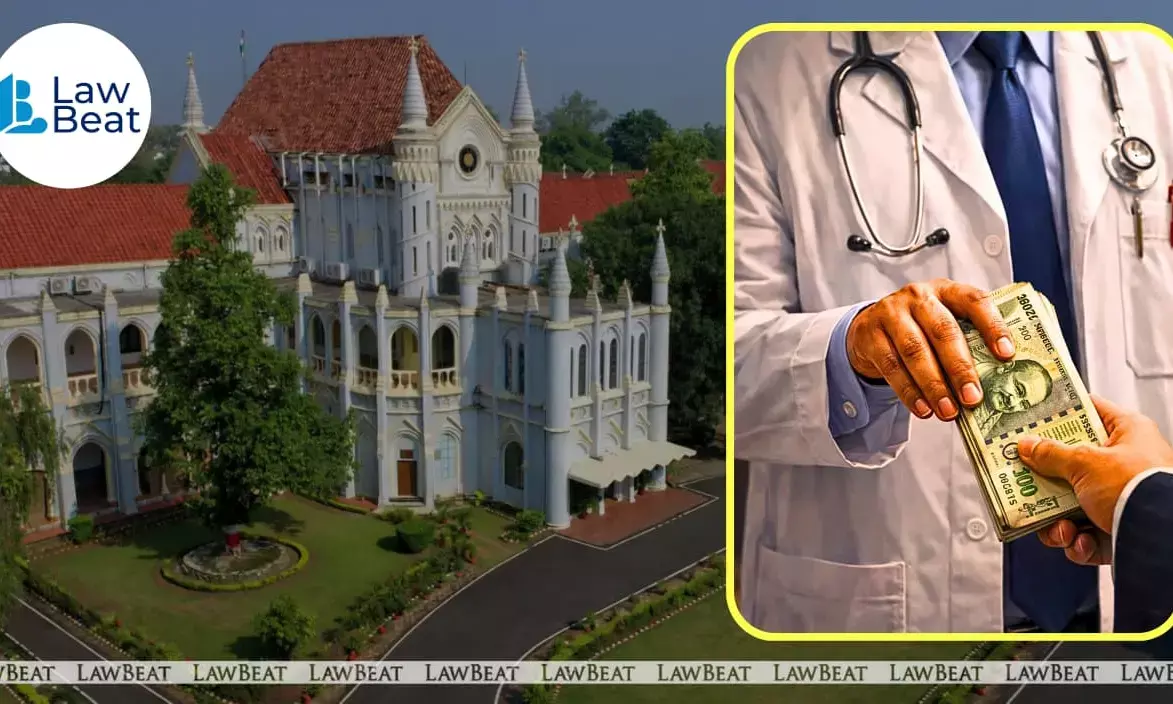
No Relief in Corruption Case: MP High Court Says Asking for Bribe Itself Punishable
The Madhya Pradesh High Court has refused to quash a corruption case against a public health official, holding that even a mere demand for illegal gratification is sufficient to attract the rigours of the Prevention of Corruption Act, particularly after its 2018 amendment.
The Division Bench of Justice Vivek Agarwal and Justice Avanindra Kumar Singh dismissed a writ petition filed by Dr. Ankit Tripathi, an Incharge Block Medical Officer, who had challenged the FIR registered against him under Section 7 of the Act.
The case arose from allegations that the petitioner demanded a bribe from a complainant who was running an Aadhaar Card Preparation Centre within the premises of a Community Health Centre in Khargapur. According to the prosecution, the demand was made in exchange for permission to continue operating the centre. A complaint was subsequently lodged, and recordings were made to substantiate the allegations. The FIR covered a period between August 26 and August 29, 2025.
Appearing for the petitioner, Advocate Raunak Yadav argued that the FIR deserved to be quashed in light of a recent Supreme Court ruling. He also raised objections regarding the complainant’s locus and pointed to a delay of about one month in lodging the FIR. Additionally, it was suggested that the Lokayukt was considering closing the case, a claim strongly disputed by the respondent’s counsel, Advocate Abhishek Shrivastava.
Rejecting these submissions, the High Court undertook a detailed examination of Section 7 of the Prevention of Corruption Act as amended in 2018. The Bench emphasized that the provision now clearly criminalises not only the acceptance but even the mere attempt or demand for an “undue advantage” by a public servant. Quoting the statutory framework, the Court noted that the offence is complete even if the public duty is not ultimately performed improperly.
The Court relied on the explanation appended to Section 7, observing, “the obtaining, accepting, or the attempting to obtain an undue advantage shall itself constitute an offence even if the performance of a public duty by public servant, is not or has not been improper.” This interpretation was further reinforced through an illustration provided in the statute, where even asking for money to expedite routine work amounts to an offence.
Addressing the issue of locus, the Bench held that the law does not require the complainant to be directly and formally connected to the benefit sought. Referring to the statutory explanation, the Court clarified that it is immaterial whether the undue advantage is sought directly or through a third party. Thus, even if the Aadhaar centre was not officially in the complainant’s name, the complaint would still be maintainable.
On the question of delay, the Court found that a one-month gap in lodging the FIR was not fatal to the prosecution’s case. It observed that delay becomes significant only when it hampers the collection of evidence to such an extent that a fair trial becomes impossible. In the present case, no such prejudice was demonstrated.
Importantly, the Bench distinguished the Supreme Court judgment cited by the petitioner, noting that it pertained to a pre-amendment context. The High Court underscored that the 2018 amendment had materially altered the legal position by expanding the scope of culpability. In this regard, it also relied on an earlier precedent to reiterate that “a mere demand or solicitation by a public servant amounts to the commission of this offence.”
Concluding that no grounds were made out for interference at the preliminary stage, the Court stated that “no indulgence is called for to quash the FIR at this stage,” and dismissed the petition.
Case Title: Dr. Ankit Tripathi v. The State of Madhya Pradesh and Others
Date of Order: March 25, 2026
Bench: Justice Vivek Agarwal and Justice Avanindra Kumar Singh