
MP High Court Flags Non-Existent SC Judgment In State’s Reply, Says Pleadings Were Blindly Drafted With AI
“No Such Judgment Exists”: MP High Court Pulls Up State for Citing a Fake Case in Its Reply
The Madhya Pradesh High Court has set aside the dismissal of a police officer who was removed from service a day after a woman cleaner complained against him, holding that the seriousness of an allegation cannot be used as a shortcut to bypass a departmental inquiry. The Court also took strong exception to the State’s reply, which relied on a Supreme Court judgment that does not exist.
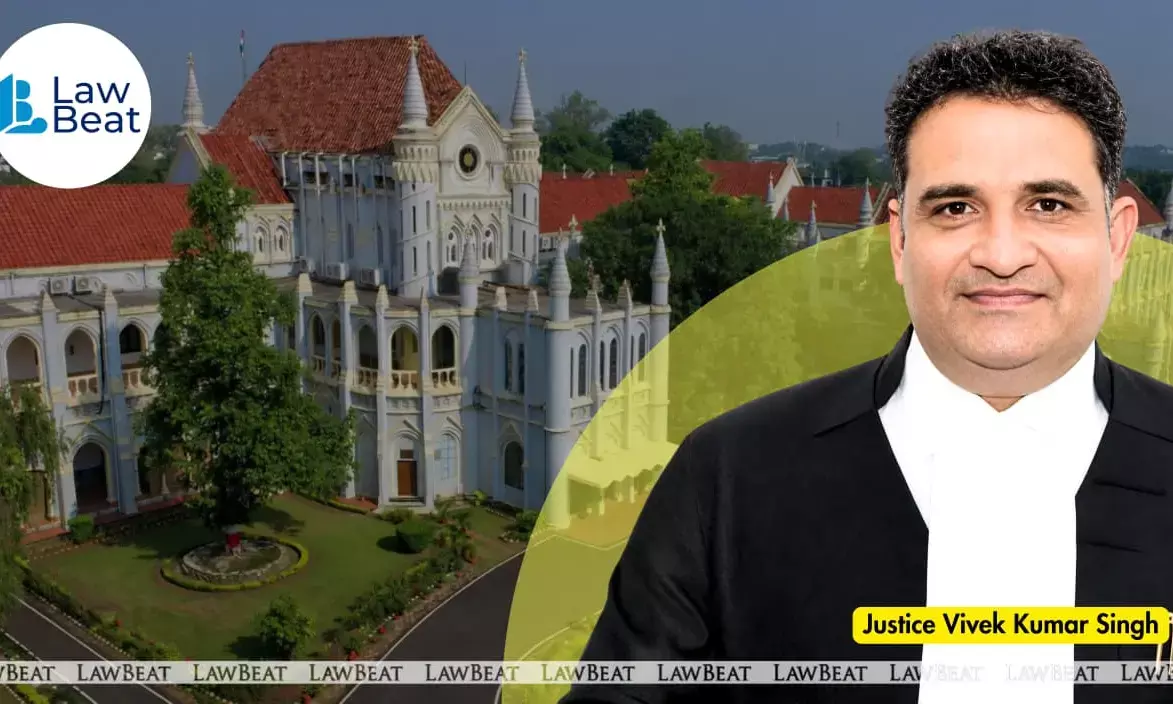
Allowing the petition filed by Piyush Mani Tiwari, Justice Vivek Kumar Singh of the Jabalpur bench quashed the dismissal order dated 27 May 2024 and the appellate order dated 22 July 2024, and directed that he be reinstated forthwith.
Tiwari joined the Madhya Pradesh Police as a Constable in 1992. In May 2024, he was an Acting Sub-Inspector at the State Situation Room, Special Branch, Police Headquarters, Bhopal. On 26 May 2024, a private woman cleaner deployed there complained that he had behaved indecently with her. He was suspended the same day.
On 27 May 2024, without a show-cause notice, a charge-sheet or any inquiry, he was dismissed under Article 311(2)(b) of the Constitution, which allows an inquiry to be skipped when it is “not reasonably practicable” to hold one.
Appearing for the petitioner, Advocate Nityanand Mishra argued that the entire process was short-circuited within 24 hours, without charges, without an Internal Complaints Committee under the Sexual Harassment of Women at Workplace Act, 2013, and without reasons explaining why an inquiry was impractical. Government Advocate Swati Aseem George defended the action for the State, citing the sensitive nature of the complaint, public trust in the police and a likelihood of witness intimidation.
Recording reasons is a constitutional duty
The Court turned to the Constitution Bench ruling in Union of India v. Tulsiram Patel, which holds that recording reasons in writing for dispensing with an inquiry is “a constitutional obligation”, and that such reasons cannot be vague.
Justice Singh found that the dismissal order “has not assigned a single reason” to show why an inquiry was impracticable. It only repeated the constitutional language and said the reasons were recorded separately. When the Court asked the State on 26 March 2026 to produce that record, “no contemporaneous record or separate note of reasons supported by objective material has been produced by the respondents.”
The State’s later justifications fared no better. On witness intimidation, the Court found “not a shred of material on record” to show that the petitioner ever threatened or intimidated the complainant or any witness. On the argument that the matter was too sensitive, it said the alleged gravity of the misconduct “is a ground to hold a prompt inquiry in accordance with law, not a license to dispense with constitutional due process.”
The bench added that once the petitioner had been suspended, “there was no impediment whatsoever” in serving a charge-sheet and holding a regular inquiry.
Fake citation in the State’s reply
The Court also criticised how the State’s return was drafted. The respondents had relied on State of Andhra Pradesh v. S.S. Mohammad Nisar. The Court noted that no such judgment exists, and that the citation actually belongs to Sidhartha Vashisht @ Manu Sharma v. State (NCT of Delhi), a case on suspension of sentence.
Observing that the respondents had “blindly resorted to the use of Artificial Intelligence tools to draft their pleadings”, the Court said, “Pleadings filed before a Constitutional Court are solemn documents.” It expected the Advocate General’s office to ensure every citation is verified before it is placed on record.
The State remains free to start a regular departmental inquiry under the Madhya Pradesh Civil Services (Classification, Control and Appeal) Rules, 1966, after giving Tiwari a hearing. Back wages will depend on its outcome. The Court expressed no opinion on the merits of the allegations. A copy of the order has been sent to the Principal Secretary, Law, and the Advocate General.
Case Title: Piyush Mani Tiwari vs. The State of Madhya Pradesh and Others
Order Date: November 17, 2026
Bench: Justice Vivek Kumar Singh