
MP High Court: Officer Who Only Failed to Report Bribery Can't Get Bribe-Taker's Punishment
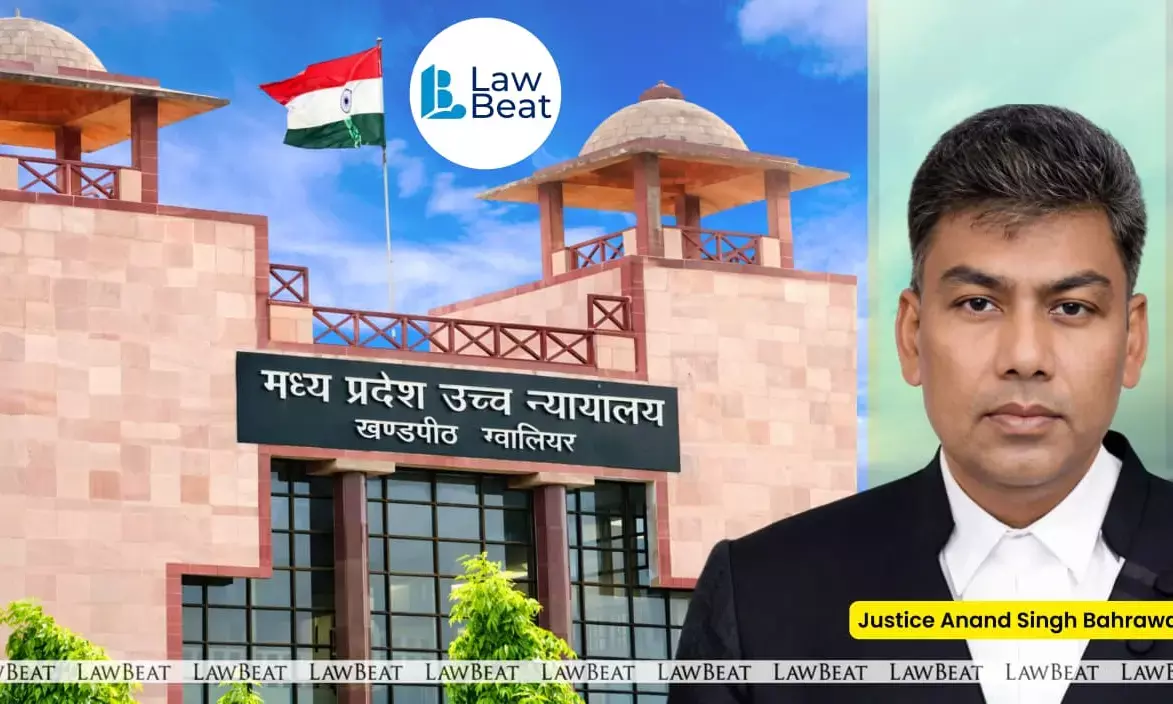
Same Penalty for Different Roles Violates Equality, Rules MP High Court
The Madhya Pradesh High Court's Gwalior Bench has held that a police official cannot be handed the same departmental punishment as a colleague who was found guilty of far more serious misconduct, quashing a penalty imposed on an Assistant Sub-Inspector who was accused merely of failing to inform his superiors about a bribery incident he did not himself commit.
Justice Anand Singh Bahrawat was hearing a writ petition filed by Brahm Kishore Dixit, posted as Assistant Sub-Inspector at Police Line, Gwalior, challenging the punishment of withholding one annual increment with cumulative effect, along with the appellate and mercy petition orders that upheld it.
The case arose after a complaint published in the local newspaper Daily Sandhya Sudarshan Express led to Dixit and two other officials being placed under suspension in October 2018. A charge-sheet issued in December 2018 alleged that Dixit had cooperated with Sub-Inspector Kripa Shankar Awasthi in an illegal act, failed to report the incident to senior officers, and acted in violation of Para 64(4) of the Police Regulations.
During the departmental enquiry, the Enquiry Officer found the serious allegations of bribery and misconduct proved only against Awasthi. As for Dixit, the only charge found proved was that he had failed to inform his superior officers about the incident. Despite this clear distinction, the disciplinary authority imposed the identical punishment on both officers.
Advocate Raghvendra Dixit, appearing for the petitioner, argued that the disciplinary authority had disagreed with the Enquiry Officer's findings without recording reasons or following the procedure under Rule 15(2) of the Madhya Pradesh Civil Services (Classification, Control and Appeal) Rules, 1966, and that no fresh show-cause notice was issued before the punishment. He contended the punishment was disproportionate and violated natural justice, and that the appellate authorities had mechanically affirmed it through non-speaking orders.
Appearing for the State, advocate B.M. Patel defended the enquiry as procedurally sound, arguing that the punishment had been "rightly imposed" and the appeal and mercy petition "rightly dismissed after due consideration."
The Court, after examining the record, found that the disciplinary authority had indeed differed from the Enquiry Officer's findings without following the mandatory procedure under Rule 15(2), and that no opportunity had been given to Dixit to explain the proposed disagreement before punishment was imposed.
Relying on the Supreme Court's ruling in Rajendra Yadav v. State of Madhya Pradesh, the Bench observed that the doctrine of equality applies even among persons found guilty in a joint enquiry, and that parity among co-delinquents must be maintained while imposing punishment. It also drew on a similar Karnataka High Court ruling and the Supreme Court's decisions in Administrator, UT of Dadra and Nagar Haveli v. Gulabhia M. Lad and Lucknow Kshetriya Gramin Bank v. Rajendra Singh to hold that punishment in a joint enquiry must reflect each delinquent's actual role and gravity of proven misconduct.
The Court noted, "A person having a lesser role cannot be subjected to the same or a harsher punishment than the person whose role and misconduct were more serious." It further held that the punishment imposed upon Dixit "cannot be sustained" and that the matter "deserves to be reconsidered by the competent authority in accordance with law."
While reaffirming that courts under Article 226 do not ordinarily interfere with punishment in disciplinary matters, the Bench held interference was warranted here since the authority had failed to consider an important circumstance and the punishment was disproportionate.
Allowing the petition in part, the Court quashed the punishment order dated November 28, 2019, along with the subsequent appeal and mercy petition orders, and remitted the matter to the Disciplinary Authority to pass a fresh, reasoned order within two months, after giving Dixit a hearing. The Court directed that any punishment imposed must "necessarily be lesser" than that awarded to Awasthi, while clarifying that it had expressed no opinion on the exact quantum, which remains for the Disciplinary Authority to decide.
Case Title: Brahm Kishore Dixit vs. The State of Madhya Pradesh and Others
Date of Order: September 1, 2026
Bench: Justice Anand Singh Bahrawat