
'MPs Can Head State Govt': Allahabad HC Rejects PIL Against CM Yogi Adityanath, Deputy CM Keshav Maurya
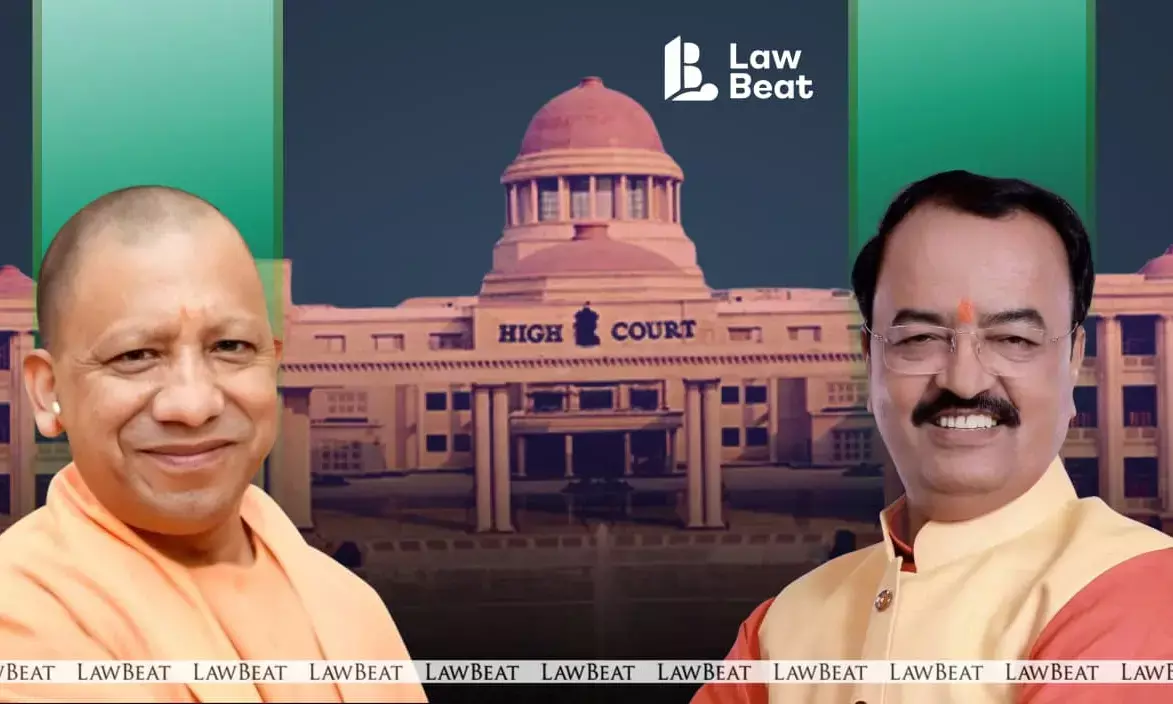
Allahabad High Court division bench dismisses challenge to 2017 Chief Minister, Deputy Chief Minister appointment
The Allahabad High Court on December 16, 2025, dismissed a public interest litigation challenging the appointment of Uttar Pradesh Chief Minister Yogi Adityanath and Deputy Chief Minister Keshav Prasad Maurya in March 2017, holding that there is no constitutional bar on a sitting Member of Parliament being appointed to head a state government.
A division bench of Justices Rajan Roy and Rajeev Bharti held that the Constitution does not prohibit a Member of Parliament from taking oath as chief minister or deputy chief minister, and that such an appointment does not violate the doctrine of separation of powers or any implied constitutional restriction. The court also upheld the validity of Section 3(a) of the Parliament (Prevention of Disqualification) Act, 1959.
The petition, filed by Sanjay Sharma in 2017, had questioned the legality of the appointments made on March 19, 2017, when both appointees were Members of Parliament and had not yet resigned from their Lok Sabha seats. The petitioner argued that holding the office of chief minister or deputy chief minister while continuing as a Member of Parliament amounted to holding two constitutional posts, violated constitutional morality, and placed an unwarranted burden on the public exchequer.
By the time the matter was finally decided, both leaders had completed their term in 2020 and were subsequently reappointed in 2022 following fresh elections. The court noted that the later appointments were not under challenge and that the reliefs seeking quo warranto and declaration of vacancy of Lok Sabha seats had become infructuous.
The bench confined itself to examining whether the 2017 appointments were unconstitutional and whether Section 3(a) of the 1959 Act, which excludes ministers from the category of “office of profit” for the purposes of parliamentary disqualification, was invalid.
Rejecting the petitioner’s arguments, court observed that there is “nothing in the Constitution” which bars a Member of Parliament from being appointed as chief minister or deputy chief minister of a state. It noted that Article 164(4) of the Constitution expressly permits a person who is not a member of the state legislature to be appointed as a minister, subject to the condition that such person gets elected within six months.
The bench also rejected the contention that a Member of Parliament holds a constitutional office or an office of profit under the government. It held that Members of Parliament are elected representatives and do not function at the pleasure of the government. Merely drawing salary and allowances does not create an employer-employee relationship between legislators and the government, court said, relying on Supreme Court precedent.
Court found the argument based on separation of powers to be fundamentally flawed, noting that every minister is ultimately required to be a member of the legislature. Accepting the petitioner’s reasoning would mean that no legislator could ever be appointed a minister, which would run contrary to the constitutional scheme.
On the challenge to Section 3(a) of the Parliament (Prevention of Disqualification) Act, 1959, court held that Article 102 of the Constitution itself permits Parliament to declare that certain offices shall not disqualify their holders from being Members of Parliament. It also pointed out that the Explanation to Article 102 clearly states that a person shall not be deemed to hold an office of profit merely because he is a minister of the Union or a state.
In view of this explicit constitutional provision, the bench held that the exclusion of ministers, including chief ministers and deputy chief ministers, from disqualification under the 1959 Act was constitutionally permissible. Since the Explanation to Article 102 had not been challenged, court said the attack on Section 3(a) of the Act was untenable.
Finding no merit in any of the surviving prayers, the high court dismissed the public interest litigation and declined to grant any of the reliefs sought by the petitioner.
Case Title: Sanjay Sharma vs. Union of India Thru Secretary of Ministry personnel and Ors.
Judgment Date: December 16, 2025
Bench: Justices Rajan Roy and Rajeev Bharti