
Non-Hindus Displaying Religious Markers Cannot Enter Even Premises Of Agamic Temples In TN: Madras High Court
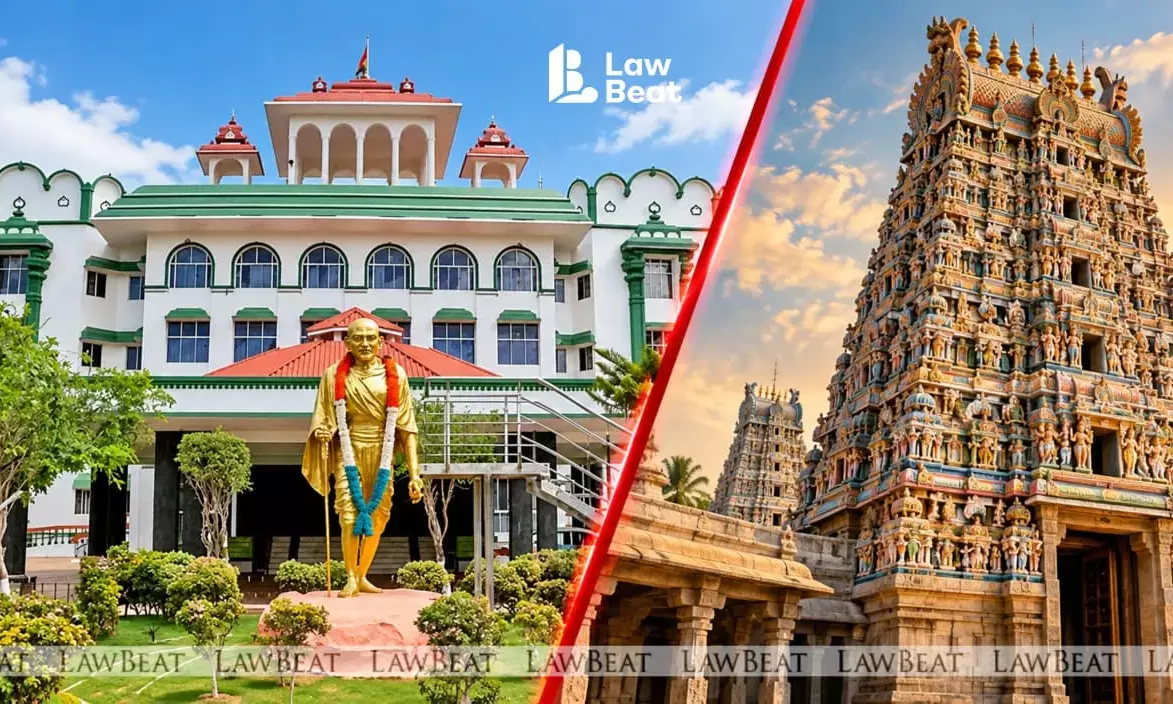
Madras High Court clarifies conditions for entering Agamic temples.
The Madras High Court has held that non-Hindus who display religious markers and do not affirm reverence for the concerned deity cannot be permitted to enter even the premises of Agamic temples in Tamil Nadu.
"If such entry is permitted, it would defile the sanctity of the temple," said the bench of Justice G.R. Swaminathan and Justice P. Murugan.
Court referred to the decision in D. Senthilkumar Vs. Government of Tamil Nadu (2024), wherein the bench of Justice S. Srimathy had issued a direction that if any non-Hindu claims to visit a particular deity in a temple, then the temple authorities shall obtain an undertaking from the said person that he/she has faith in the deity and he/she would follow the customs and practices of the Hindu religion and also abide by the temple customs, and on such undertaking the said non-Hindu may be allowed to visit the temple.
The present bench held that trustees of Agamic temples are entitled to insist that non-Hindus who do not furnish such an undertaking should not be permitted to cross the flag-pole (Kodimaram).
Court took note of the political sycophancy and the use of temple visits for political optics. Referring to instances of political leaders entering temples along with their supporters, it observed that temple customs could not be compromised for such displays.
"We know of one political leader who is a fundamentalist subscribing to a non-Hindu faith. But he would make it a point to visit the temple and also prominently display the religious mark on his forehead. This was to play to the gallery. The vote value of such a display is obvious, the bench observed.
"'Chamchagiri' is endemic to our political culture," the bench remarked, adding that "usages and customs of temple cannot kneel down before such display of Chamchagiri and optics".
The bench, however, highlighted the instance of Tamil Nadu Chief Minister Joseph Vijay, whom it described as a Christian by faith, worshipping Goddess Meenakshi after signing an undertaking. It observed that he was not asked to convert to Hinduism but was only required to affirm his reverence for the deity.
"This is what we call as an inclusive approach," said the bench.
Court passed the directions while allowing a writ petition filed by Thangam Venkatesh, who sought directions to the Tamil Nadu Hindu Religious and Charitable Endowments (HR&CE) Department to enforce the Tamil Nadu Temple Entry Authorisation Act, 1947, and relevant provisions of the HR&CE Act, 1959.
The petitioner had approached the court seeking an enquiry into alleged violations of the statutory provisions and the formation of enquiry committees to prevent individuals bearing religious symbols of other faiths and non-adherents from entering restricted temple sanctums and mandapams.
At the outset, the bench noted that the question of whether non-Hindus could enter Agamic temple precincts had already been considered by two single judges of the high court in 1972 and 2024. However, in view of recent developments, it considered it necessary to make an authoritative pronouncement on the issue.
In 1972, Justice T. Ramaprasada Rao had struck down Rule 4A of the Temple Entry Authorisation Rules, which permitted non-Hindus to enter temple premises, holding that the provision was beyond the scope of the parent legislation.
The bench endorsed the conclusion in that judgment, observing that the purpose of the 1947 Act was to remove restrictions imposed on certain classes of Hindus and extend temple-entry rights to all sections of the Hindu community.
It also referred to a 2024 judgment by Justice S. Srimathy in D. Senthilkumar v. Government of Tamil Nadu, which directed temple authorities not to permit non-Hindus who did not believe in Hinduism.
The present bench went a step further by holding that non-Hindus displaying religious markers and not subscribing to reverence for the concerned deity could not be allowed even into the temple premises.
The judges also distinguished between restrictions imposed on Hindus on the basis of caste and those applicable to non-Hindus. Referring to historical Agamic injunctions that prevented certain communities from entering particular areas of temples, the bench said such restrictions could not override constitutional principles.
"Constitution ranks paramount and such regressive theological injunctions have to necessarily give way," it observed, adding that these restrictions would continue to apply to non-Hindus who did not sign the undertaking.
The bench also relied on Section 10 and Sections 24(3) and 24(4) of the HR&CE Act. It noted that Section 10 requires persons holding offices under the department to profess the Hindu religion, while Section 24(3) requires departmental officers to have due regard to the religious practices and usages of the institutions. Section 24(4), it noted, does not authorise a non-Hindu to enter the premises covered by the provision.
The judges also referred to the Supreme Court's decisions in Venkataramana Devaru v. State of Mysore and Seshammal v. State of Tamil Nadu, among other precedents, while examining the relationship between temple customs, religious practices and constitutional protections.
The judges described an undertaking-based approach as inclusive, clarifying that a non-Hindu was not required to convert to Hinduism to enter a temple but only to affirm reverence for the deity.
Court accordingly allowed the writ petition and made no order as to costs.
Case Title: Thangam Venkatesh v. State of Tamil Nadu & Ors.
Judgment Date: October 23, 2026
Bench: Justice G.R. Swaminathan and Justice P. Murugan