
Same “Lame” Reasons Every Year: Madras HC Clears RSS Route Marches At 128 Locations, Raps Tamil Nadu Police
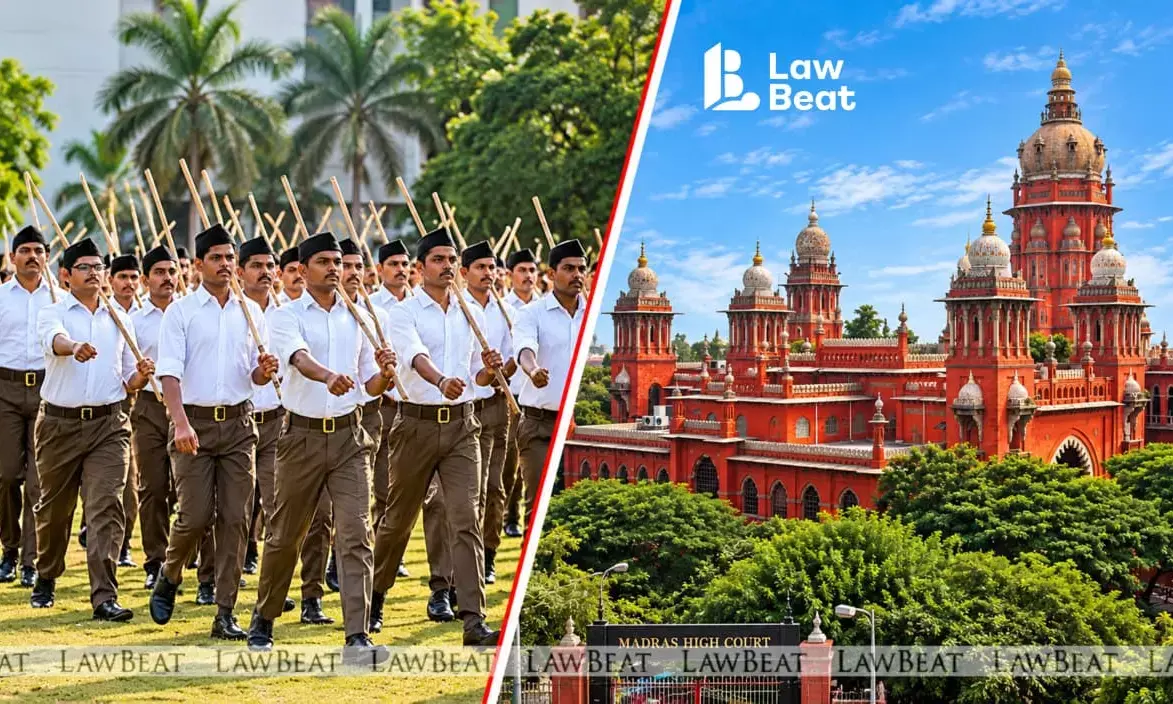
RSS Route Marches Cleared Across 128 Tamil Nadu Locations for October 25 and November 1, Madras High Court Records
The Madras High Court on Friday permitted Rashtriya Swayamsevak Sangh (RSS) route marches across 128 locations in Tamil Nadu on October 25 and November 1, and directed the police to finalise timings, routes and venues by Monday, October 19.
Justice V Lakshminarayanan, dictating his order in court, recorded that Advocate General Vijay Narayan had obtained instructions and stated that the processions could go ahead on both dates, subject to modifications the police may suggest in districts where many marches are planned. The dates, the Court said, are frozen.
The Court once again criticised the police for rejecting applications on grounds that courts had already turned down. “They have not come up with any novel reasons for rejection. They have consistently given the very reasons which this Court found as lame,” it observed.
The petition was filed by the RSS state secretary, who applied to the Director General of Police on October 3 for marches between 3 pm and 7 pm, followed by public meetings, with volunteers in uniform led by a music band. Local applications were rejected citing restricted routes, places of worship of other communities, a statue of a rationalist leader, traffic congestion, unstated participant numbers, loudspeakers and law and order concerns.
The Court traced the long history of the dispute. It recalled that conditions were laid down for the marches in September 2022, that a Division Bench restored that order after it was modified in review, and that the Supreme Court dismissed the State’s appeal on April 11, 2023. Another batch of petitions was allowed on October 16, 2023, with the Court holding that roads are secular and belong to all people regardless of religion, caste or creed.
The Supreme Court later asked the High Court to frame guidelines to avoid needless litigation. Despite this, the judge noted, the State kept refusing permission, and an earlier order had called the saga a case of “Vikram and Betal” with no conclusion. The guidelines, framed in 2024, were meant to stop the police from troubling the court with novel and fanciful reasons.
The judge also reminded that the right to form an association under Article 19(1)(b) can be restricted only by a law made by the State or Parliament, and that the Tamil Nadu Police Act cannot be used to snuff out the RSS’s right to march.
Orally, the judge told both sides it was a “shame” they were back before the court, remarking that preventing the RSS from marching only promoted it indirectly. He also cautioned that following police advice “may land you in jail”.
The Court asked the RSS to apply early next year, since organisers know when Vijayadashami falls, and urged the police to call them and clarify doubts rather than reject applications. Applications, it said, should be processed for approval, not hunted for defects.
The Court compared the misuse of the guidelines to using a “scalpel” not to operate but to kill the patient.
The petitioner’s list of routes, meeting places, organisers and participant numbers will be annexed to the order so it cannot be altered later, and the RSS has filed an affidavit undertaking strict compliance with the High Court’s conditions. Numbers of participants and public attending meetings must be specified, the Court said.
Both sides broadly agreed that districts planning many marches, such as Kanyakumari and Coimbatore, could split them between the two dates, with local officers meeting organisers to settle details.
Senior Advocate NL Rajah appeared for the petitioner on behalf of advocate V Chandrasekaran. The State was represented by Advocate General Vijay Narayan, assisted by State Public Prosecutor John Sathyan and APP Arun Anbumani.
Background
On Thursday, the Madras High Court had expressed anguish over the Tamil Nadu Police citing mosques along routes and minority unease as grounds to deny permission, observing that such reasons had been rejected in earlier orders.
It noted that the RSS had sought permission at 128 locations while the police were willing to allow marches at only 58 of them. The Court found that neither the RSS nor the State had fully followed the 2024 guidelines, and, in the same order, directed the RSS to file an affidavit with routes, participant numbers and local organisers.
The marches, originally proposed for Sunday, October 18, were deferred to October 25 for the northern districts and November 1 for the southern districts. “Don’t give Muslims a bad name,” the judge had remarked while asking whether anyone from the Muslim community had actually objected to the proposed processions.
Case Title: V.G. Jagadeesan v. The State Rep. By, The Chief Secretary and Others
Date of Hearing: October 16, 2026
Bench: Justice V Lakshminarayanan