
SG Tushar Mehta Defends NEET Protest Surveillance Before Delhi High Court; Says Videography Essential For Law And Order
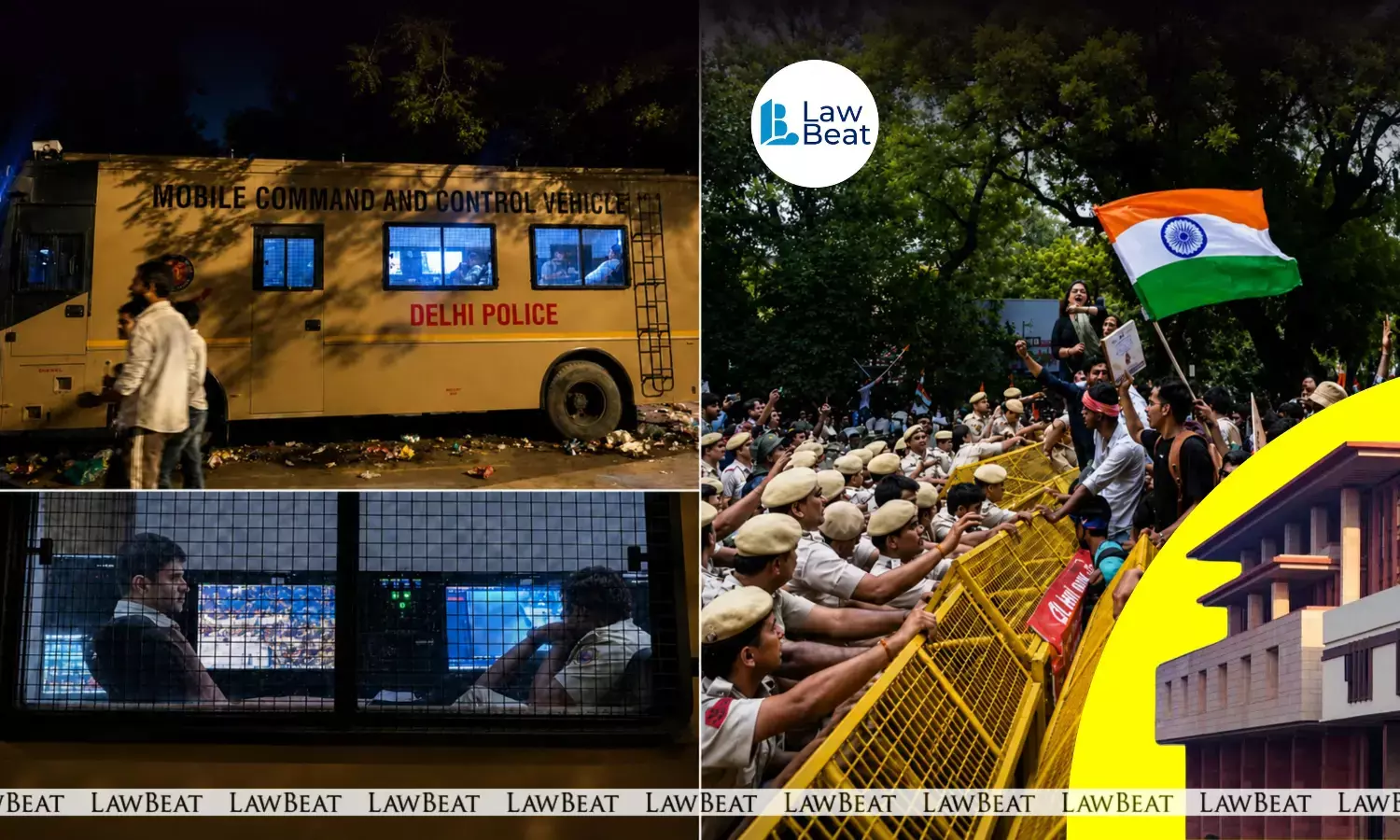
Delhi High Court heard a PIL challenging alleged police surveillance of student protesters at Jantar Mantar and deferred the matter to July 27 after hearing extensive arguments on privacy and public order
The Delhi High Court on Friday heard a public interest litigation (PIL) challenging the alleged continuous surveillance of student protesters at Jantar Mantar by the Delhi Police, with the petitioner arguing that indiscriminate videography and facial recognition violated the fundamental right to privacy guaranteed under the Constitution.
The Bench of Chief Justice Devendra Kumar Upadhyaya and Justice Tejas Karia however, noted that two petitions raising substantially similar issues were already pending before the Court and questioned the filing of multiple petitions on the same subject.
The Bench ultimately deferred the matter to July 27, observing that it first needed to "make up its mind" after hearing the competing submissions.
At the outset, Senior Advocate Nandita Rao, appearing for the petitioner, relied on the Supreme Court's judgment in Justice K.S. Puttaswamy v. Union of India to contend that the right to privacy extends even to individuals participating in public protests. She submitted that any State restriction on privacy must satisfy the constitutional tests of legality, legitimate State purpose and proportionality.
The Bench responded that there was no dispute over the legal position laid down in Puttaswamy but pointed out that similar issues had already been raised in two pending petitions listed for hearing on September 24. It suggested that the petitioner either seek impleadment in those proceedings or have the present matter heard alongside them.
Rao, however, argued that the present petition raised distinct concerns. She submitted that it had been filed even before the police action of July 20 and specifically challenged the alleged surveillance of young students, including girl students aged between 16 and 20 years.
She further referred to media reports alleging the deployment of live facial recognition technology at protest sites, warning that an 80% facial match could wrongly implicate individuals in criminal proceedings.
Senior Advocate Gopal Sankaranarayanan, who had appeared in the earlier petitions, supported Rao's submissions and told the Court that the present challenge raised issues that had not been argued previously.
Opposing the plea, Solicitor General Tushar Mehta raised a preliminary objection and argued that videography of protests was a long-standing law enforcement practice carried out pursuant to the Supreme Court's directions in the Ramlila Maidan case and the Standing Orders issued thereafter.
Mehta submitted that every protest at designated sites is videographed and that organisers themselves undertake to comply with the applicable Standing Orders. He argued that claiming a right to privacy in a public protest was "ironic", particularly when protesters themselves routinely recorded videos, gave interviews and encouraged social media documentation of demonstrations.
While acknowledging that privacy is a fundamental right, the Solicitor General maintained that the State is entitled to take necessary measures where there exists a legitimate public interest, including maintaining law and order and identifying offenders if any untoward incident occurs during a protest.
According to Mehta, videography serves precisely that purpose and cannot, by itself, be treated as an unconstitutional invasion of privacy.
Rebutting the submissions, Rao contended that the challenge was not to videography per se but to the absence of statutory safeguards governing collection, storage and use of such data. She argued that unlike journalists or private individuals, the State possesses coercive powers, making the absence of safeguards particularly concerning. Referring to the Standing Operating Procedure (SOP), Rao questioned where the recorded footage was stored, how it was protected and what mechanisms existed to prevent misuse.
Drawing a parallel with telephone interception laws, she submitted that surveillance measures affecting fundamental rights must be backed by clear legal procedures and institutional safeguards. Rao also cautioned that indiscriminate recording of protesters could criminalise democratic dissent, alleging that private conversations might later be selectively edited or relied upon in criminal proceedings.
Responding, Mehta urged the Court to hear the matter on Monday, remarking that the proceedings were only serving to "flare up the issue" and assuring the Bench that he would refrain from making sarcastic remarks.
Accepting the request, Chief Justice Upadhyaya observed that the Court would first need to consider the issues raised before taking a view. As counsels could not conclude their submissions, the High Court directed that the matter be listed for further hearing on July 27.
Case Title: Ms. Aishe Ghosh v. Union of India & Anr.
Bench: Chief Justice Devendra Kumar Upadhyaya and Justice Tejas Karia
Hearing Date: July 24, 2026