
Teacher Absenteeism in Primary Schools: Allahabad HC Directs UP Govt to Frame Strict Attendance Policy In 3 Months
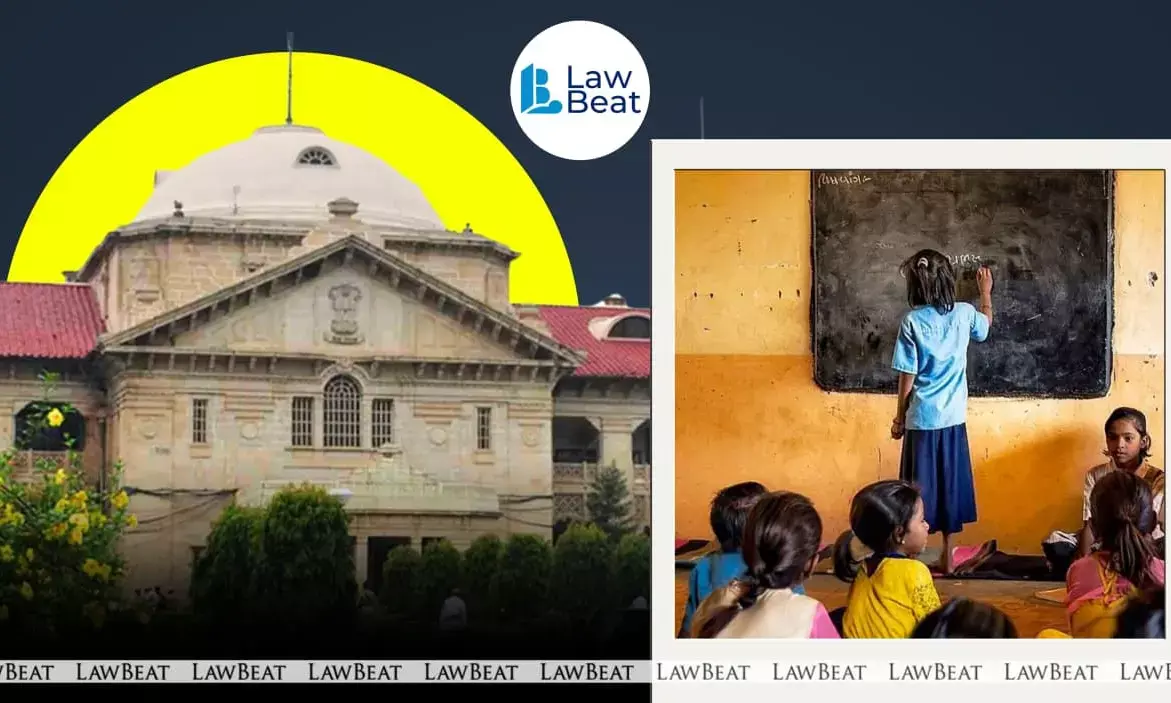
Allahabad High Court directs UP government to take policy decision to enforce teacher attendance in governemnt schools
The Allahabad High Court recently refused to interfere with the suspension of two primary school teachers accused of remaining absent during school inspections, while directing the Uttar Pradesh government to urgently frame and implement a policy to ensure regular teacher attendance in government schools.
Disposing of two connected writ petitions filed by Indra Devi and Smt. Leena Singh Chauhan, Justice Padia held that, without examining the merits of the suspension orders at this stage, the larger concern of ensuring uninterrupted education to children could not be ignored.
Court directed the disciplinary authorities to complete the proceedings against the teachers within two months and issued a separate mandamus to the state’s basic education department to take a policy decision on enforcing teacher attendance within three months.
"In case teachers will not attend the institution within time, it will frustrate the mandate of the Act, 2009 and the children will be deprived off from this fundamental rights guaranteed under Article 21-A of the Constitution of India," said the bench of Justice Prakash Padia.
The teachers had approached the high court challenging suspension orders dated August 30, 2025 and July 11, 2025, passed by the respective district basic education officers after inspections allegedly found them absent from their institutions during working hours. Since both petitions raised similar questions, court heard them together and passed a common order.
At the outset, the bench recalled another single judge bench's earlier observations made on October 16, when it had flagged that it was being “flooded” with cases relating to attendance and non-attendance of teachers in primary schools. Court had then underlined that the absence of teachers frustrates the very object of the Right of Children to Free and Compulsory Education Act, 2009, which guarantees free and compulsory education to children between six and fourteen years as a fundamental right under Article 21A of the Constitution.
The bench noted that the state had already issued government orders providing for digital attendance and had also constituted district-level and block-level task forces to monitor school functioning. However, court observed that these mechanisms were not effectively working on the ground, resulting in repeated complaints and litigation.
During the present hearing, the chief standing counsel placed before the court instructions dated November 28, 2025, stating that a high-level committee had been constituted under the chairmanship of the chief secretary. Meetings were held on October 30 and November 13, 2025, and further deliberations took place on November 27, 2025, to prepare a considered proposal for ensuring attendance of teachers and non-teaching staff in primary and upper primary schools, including through digital means.
Taking note of these developments, court recorded the state’s submission that a policy decision was already under consideration for implementing an effective digital attendance system. At the same time, the court emphasised the pivotal role played by teachers, especially at the primary level, in shaping young minds and laying the foundation of a child’s personality.
Referring extensively to Indian constitutional ethos, ancient texts and a long line of Supreme Court judgments, the court reiterated that teachers occupy a revered position in Indian society and that any dilution of their sense of duty has far-reaching consequences not just for students but for society at large.
Referring to verses from the Brahmanda Purana, court noted that the guru is equated with the divine trinity itself, symbolising the creator, preserver and destroyer of ignorance, and is regarded as “Parama Shiva in human form”.
The judge also revisited the Gurukula tradition, where education was imparted through close personal instruction, with students living for years under the guidance of their guru. Court recalled how the Upanishads, particularly the Mundaka Upanishad, emphasised complete surrender before a learned guru as a prerequisite for attaining knowledge, not merely of worldly subjects but of higher truths. Teachers, court observed, were not confined to spiritual instruction alone but taught diverse disciplines, ranging from archery and statecraft to economics and performing arts.
The bench observed that while many teachers continue to treat teaching as a pious obligation, persistent absenteeism by some undermines both equality among teachers and the fundamental right of children to education.
Court also noted that primary school teachers are often the first point of formal education for children in rural and economically weaker sections, and irregular attendance directly deprives such children of their constitutional entitlement. In this background, the bench held that it would not be appropriate to quash the suspension orders at this stage.
However, balancing individual service rights with public interest, court directed the disciplinary authorities to conclude the pending proceedings against the petitioners most expeditiously and positively within two months from the date of receipt of a certified copy of the order.
In addition, court issued a mandamus to the special secretary, basic education, Uttar Pradesh, to take a policy decision and all necessary steps to ensure the presence of teachers in schools within time, directing that the exercise be completed within three months from the date of the order.
Case Title: Indra Devi vs State of UP and 2 Others
Order Date: December 2, 2025
Bench: Justice Prakash Padia