
Temple On Encroached Government Land Not Immune from Eviction: Madras High Court Dismisses Plea
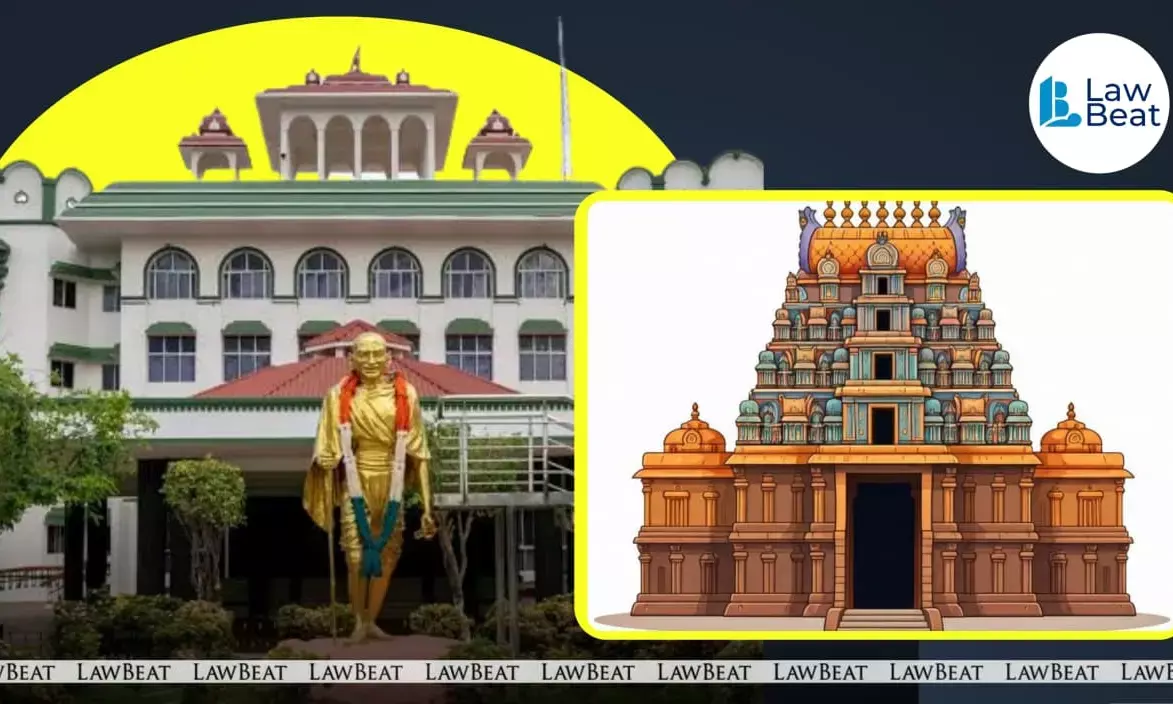
The Madras High Court, Madurai Bench, orders removal of temple encroaching on government water body bund
The Madurai Bench of the Madras High Court has held that a temple constructed on encroached government land does not acquire immunity from eviction merely because it is a place of worship, and dismissed a writ petition challenging the removal notice issued by municipal authorities.
Court found that the petitioner had encroached upon land classified as “Orruni Poramboke Road”, situated on the bund of a water body and used as a public pathway, and had put up a non-residential temple structure without permission.
The writ petition was filed by N. Kumar, who claimed to be the Managing Trustee of Sri Arulmighu Raajakaliamman Temple in Ramanathapuram district. He challenged a final notice dated 27.01.2026 issued under Section 128 of the Tamil Nadu Local Bodies Act, 1998, seeking removal of the alleged encroachment.
The dispute stemmed from an earlier notice dated 29.11.2025 issued by the Commissioner of Ramanathapuram Municipality directing removal of the structure within seven days. Kumar had challenged that notice in a previous writ petition, which was dismissed on 11.12.2025. Court had then recorded that no representation had been made by the petitioner justifying continued possession and that the time granted in the notice had already expired.
Following the dismissal, the petitioner issued a legal notice stating that he intended to file an appeal or review and requested the authorities not to take coercive steps. He also submitted a representation seeking grant of patta in respect of the land, relying on a government order of 2025, which provides for regularisation of certain residential encroachments. The authorities rejected the request on the ground that he had failed to produce title documents or building approval.
A second eviction notice dated 30.12.2025 and thereafter a final notice dated 27.01.2026 were issued, prompting the present writ petition.
Before the court, the petitioner contended that the temple had been in existence for several decades and that he had constructed the present structure in 1991 at his own expense. He submitted that daily poojas and festivals were being conducted and that the building had been assessed to tax and provided with electricity service. He argued that the eviction notice violated Articles 14, 25, 26 and 300-A of the Constitution and that his application for patta was pending consideration.
The state opposed the plea, submitting that the structure stood on the bund of a water body used as a public pathway and had been constructed without permission. It argued that tax assessment or electricity connection would not confer any legal right over government land. It further contended that the government order referred by the petitioner was a one-time measure applicable only to residential encroachments on unobjectionable government poramboke lands and could not apply to a non-residential temple structure on objectionable land.
The bench agreed with the State’s submissions. It held that the government order relied upon by the petitioner was not applicable, as the structure was non-residential and situated on a water body bund obstructing a pathway. Court observed that no patta could be granted in respect of such land and that even if a representation had been made, it was liable to be ignored.
Rejecting the argument based on the Places of Worship (Special Provisions) Act, 1991, court clarified that the Act was intended to maintain the religious character of places of worship as they existed on 15 August 1947 and did not protect structures put up by encroaching upon government land.
Finding no merit in the challenge to the eviction notice, court dismissed the writ petition and closed the connected miscellaneous petition, with no order as to costs.
Case Title: N.Kumar vs. The District Collector, Ramanathapuram District and Others
Order Date: February 6, 2026
Bench: Dr Justice G. Jayachandran and Justice K.K. Ramakrishnan