
Why Was YouTuber Ajeet Bharti Denied Anticipatory Bail In The SC/ST Act Case?
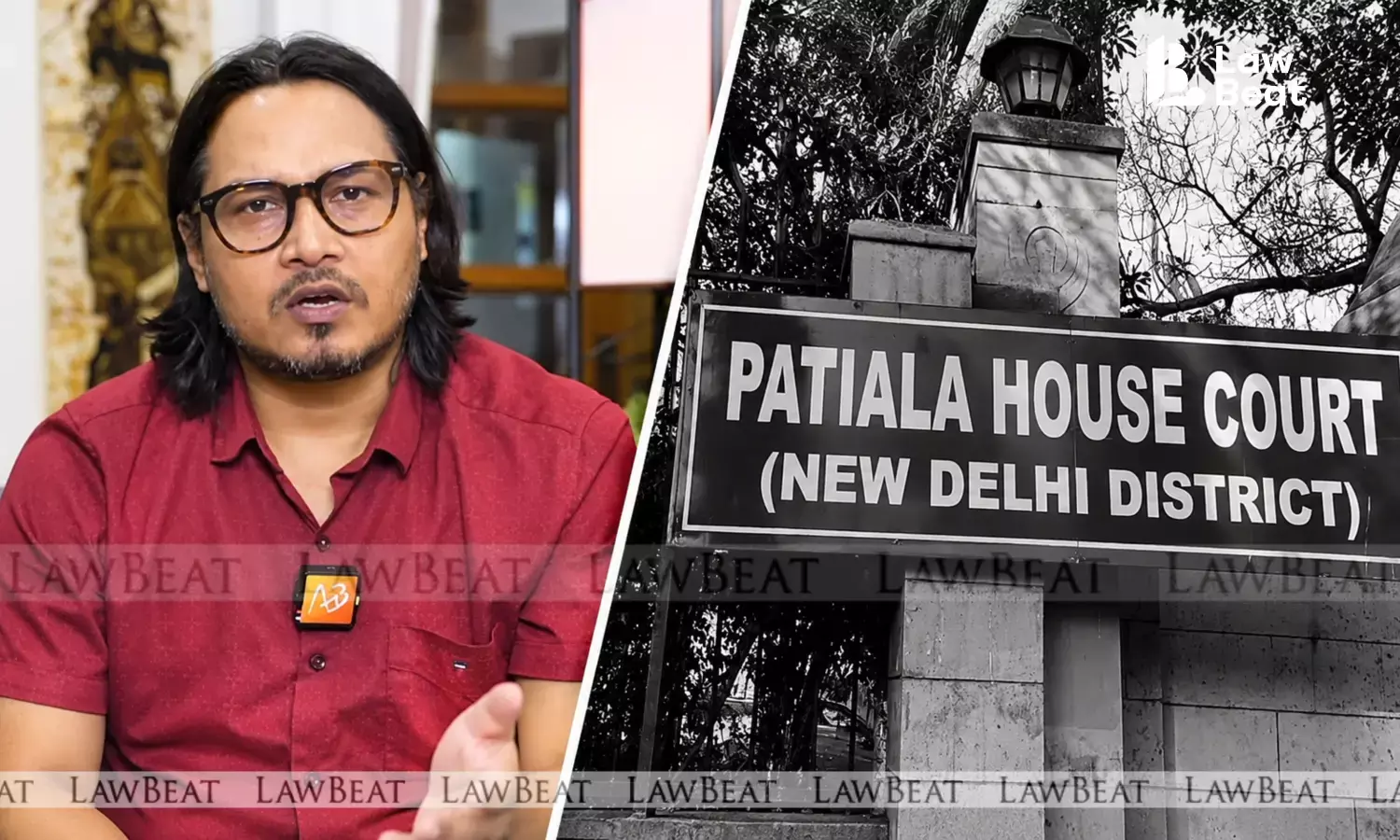
Delhi court denies YouTuber Ajeet Bharti anticipatory bail, holding his remarks on MP Chandra Shekhar Azad prima facie attract the SC/ST Act's Section 18 bar
An Additional Sessions Judge in Delhi has answered that question by dismissing YouTuber Ajeet Bharti's anticipatory bail application, holding that his on-air remarks about Nagina MP Chandra Shekhar Azad's "marriageability" prima facie disclosed the ingredients of an offence under the Scheduled Castes and the Scheduled Tribes (Prevention of Atrocities) Act, 1989; thereby triggering the statutory bar on anticipatory bail under Section 18 of the Act.
ASJ Saurabh Partap Singh Laler, passed the order on September 7 in Bail Application No. 2114 of 2026, arising out of FIR No. 0030/2026 dated August 23, 2026, registered at Police Station North Avenue.
The FIR
The FIR was registered on a written complaint by the Delhi State President of a registered political outfit, who was not personally present at any physical occurrence; the FIR records the place of occurrence "on social media."
It alleges that Bharti, through his verified account on X (@ajeetbharti) and on YouTube, published an episode of his self-titled programme on August 22, 2026 at about 22:11 hrs, which had garnered approximately 23,100 views by the date of the complaint. The episode was alleged to contain statements "casteist, derogatory and humiliating towards persons of the Scheduled Caste community," towards Chandra Shekhar Azad, and towards Dr. B.R. Ambedkar, along with statements "alleged to be sexually degrading and intimidatory."
The FIR invoked Sections 3(2)(va)/3(1)(r)/3(1)(s)/3(1)(u)/3(1)(v)/3(1)(w) of the SC/ST Act, Section 67 of the Information Technology Act, 2000, and Section 196(1)(c)/351(3) of the Bharatiya Nyaya Sanhita, 2023.
The Context of the remarks
The order records that the impugned portion arose in the course of Bharti's response to a comment by a user, "@Singhden," who had suggested that Bharti "arrange his sister's marriage" to the named Member of Parliament, "upon which reservation would end."
In response, per the transcript annexed by the applicant himself, Bharti is recorded to have stated, in substance, that if the commentator had arranged his own sister's marriage to a person of the "Dom" caste, or his mother's marriage to a person of the "Chamar" caste, the comparison might hold; that his sister was already married and he would not have her married to the named MP; that marriage required regard to several things, and it was "not that [a person] is a Chamar and an MP, [and] therefore a marriage should be arranged"; and that the MP would first have to "make himself worthy" to seek the hand of a woman from a "Savarna" (upper-caste) family.
The order notes this was "followed by further remarks, of an explicitly sexual character, concerning the commentator's (@Singhden) sister and mother, which this Court does not consider it necessary or appropriate to reproduce."
Applicant's Submissions
Advocate Jai Anant Dehadrai for Bharti argued that no offence under Section 3(1)(r)/(s) was prima facie disclosed since the complainant was not personally present, insulted, or intimidated, and no identified member of the Scheduled Caste/Scheduled Tribe community was shown to have been insulted "within public view," relying on Hitesh Verma v. State of Uttarakhand.
He also submitted that the impugned passage was "a rhetorical hypothetical addressed to the commentator, not a statement concerning any identified, real woman," and that the bar under Sections 18/18A of the SC/ST Act was "confined to offences 'under this Act'" and did not extend to the separately alleged IT Act and BNS offences merely because they were clubbed in the same FIR.
Reliance was placed principally on Shajan Skaria v. State of Kerala, for the proposition that the Section 18 bar applies only where a prima facie case under the 1989 Act is independently made out, along with Arnesh Kumar v. State of Bihar, Satender Kumar Antil v. CBI, and Sushila Aggarwal v. State (NCT of Delhi).
However, the State opposed the plea, arguing "the video makes out a clear case of offence under SC/ST (POA) Act, 1989," consistent with the approach taken by the Supreme Court in Shajan Skaria.
Court's Reasoning
The Court first clarified the threshold nature of its inquiry: "This is not an exercise in appreciating evidence or determining guilt, but a threshold enquiry to ascertain whether the statutory bar under Sections 18/18A even arises for consideration."
On what Section 3(1)(r) requires, the Court held: "Every insult to a person who happens to belong to a Scheduled Caste is not, without more, an offence under this provision; the insult must be shown, prima facie, to be on the ground of, or laced with reference to, the victim's caste, and general or generic abuse does not attract the provision merely because the recipient happens to belong to a Scheduled Caste."
On whether the "public view" requirement could be satisfied by an online broadcast, the Court observed: "Given that the impugned episode is stated to have garnered upwards of 23,000 views on a publicly accessible platform, this Court, for the limited and prima facie purpose of this application, is not persuaded that the 'public view' ingredient can be treated as plainly absent; the question is not, however, conclusively settled on the material available and remains open for fuller consideration at trial."
Distinguishing the applicant's principal precedent, the Court noted that in Shajan Skaria, the impugned video "contained no reference to caste at all, so that no ingredient of Section 3(1)(r) was found to be prima facie disclosed." By contrast, it held that the material in the present case showed "the impugned passage to proceed by an express, repeated invocation of caste names, not as a stray or quarrelsome aside but as the organising device of the applicant's response."
The Court reasoned further: "This is not generic invective of the kind held in Ramesh Chandra Vaishya (supra) to fall short of the statutory threshold; being an insult of the 'idiot/fool/thief' variety unconnected to caste, nor is it a stray use of a caste word of the kind considered insufficient in Vegraj Singh (supra). It is language that invokes caste hierarchy and marriageability directly, touching the very notion identified in Shajan Skaria (paragraph 62) as the paradigm of 'intent to humiliate' under Section 3(1)(r): caste-based notions of purity and the assumed superiority of 'upper' over 'lower' castes in matters of alliance and lineage."
The order adds: "The assertion that the said MP should make himself worthy of marrying an upper caste girl, is a specific reference to cast and humiliating as to why a person fit to be married to anyone in SC / ST community has to be something extra / something more / worthy of marrying a girl in upper cast." (reproduced verbatim from the order, including as-written wording)
The Court accordingly concluded: "On a prima facie reading, and without in any manner adjudicating upon its truth, correctness, or the full context in which it was said, which the applicant remains at liberty to place before the Investigating Agency and the Trial Court; this Court is of the view that the ingredients of Section 3(1)(r) of the Act, 1989 are prima facie disclosed."
Having found the threshold bar attracted on Section 3(1)(r) alone, the Court held it unnecessary to separately examine the remaining sub-clauses invoked in the FIR, and clarified that "since the application fails at this threshold stage, the ordinary triple-test enquiry into flight risk, tampering with evidence and influencing witnesses... does not arise for consideration."
On the applicant's argument that the IT Act and BNS offences stood independently of the SC/ST Act bar, the Court declined to sever them at this stage, noting "these offences are alleged to arise from the same recording and the same course of conduct, and that no separately severable transaction is disclosed."
The Court held: "This Court finds that the ingredients of an offence under Section 3(1)(r) of the Scheduled Castes and the Scheduled Tribes (Prevention of Atrocities) Act, 1989 are prima facie disclosed on the material on record, and that the bar under Section 18 of the Act, 1989 accordingly precludes the grant of anticipatory bail to the applicant." The application was accordingly dismissed.
The Court clarified that its observations "shall not be construed as an opinion on the merits of the case," that the Trial Court "shall not be influenced by any observation made herein," and that "nothing stated hereinabove shall preclude the applicant from renewing his prayer, or from seeking such other remedy as may be available in law, should circumstances change."
Case Title: State of Delhi v. Ajeet Bharti
Bench: ASJ Saurabh Pratap Singh Laler
Order Date: September 7, 2026