
Article 21 Includes Right to Speedy and Fair Investigation: Supreme Court Faults High Court for Not Intervening
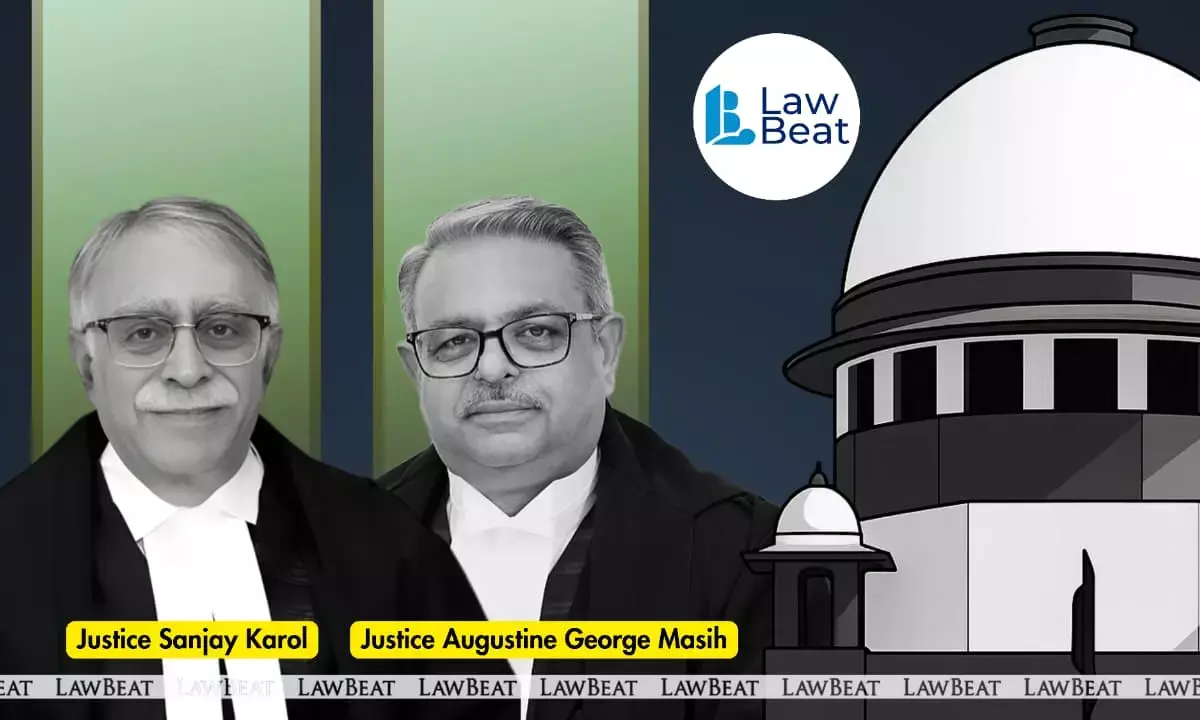
Supreme Court questions two-decade delay in criminal investigation.
The Supreme Court has said that the right to a speedy and fair investigation is an intrinsic facet of the right to life and personal liberty guaranteed under the Constitution, and constitutional courts cannot remain mute spectators when cases involving prolonged investigations are brought before them.
Emphasising that "justice delayed is justice denied", a Bench of Justices Sanjay Karol and Augustine George Masih expressed serious concern over a criminal complaint that has remained under investigation for nearly two decades without reaching any meaningful conclusion.
"Nearly two decades have passed since the initiation of the complaint by the original complainant. However, it is a matter of serious concern that despite the lapse of such an inordinate period of time the investigation is yet to reach any meaningful conclusion," the Bench observed.
Court also took a dim view of the loss of case records during the course of the investigation.
The observations came while allowing an appeal against a June 26, 2025 judgment of the Gujarat High Court, which had dismissed a writ petition seeking a direction to the police to file a charge sheet in a criminal complaint lodged in September 2007.
Why did the Supreme Court intervene in the prolonged investigation case?
Court noted that a bare perusal of the record showed that the original complainant had been running from pillar to post for the filing of a charge sheet, but to no avail.
According to the case records, the appellants' father had filed a complaint before the Judicial Magistrate First Class (JMFC), Bhiloda, against four persons under various provisions of the Indian Penal Code, including criminal conspiracy, cheating, criminal breach of trust and forgery.
He alleged that a property in Bhiloda village, which he had purchased in 1975, was fraudulently transferred while he was on Haj pilgrimage in 2002. According to the complaint, the accused forged his signatures and prepared a fake partition deed and sale deed in relation to the property.
In 2014, the police submitted a C-summary report before the JMFC. The report was rejected and further investigation was ordered, to be completed within 60 days.
How did the loss of case records affect the investigation?
In 2017, while hearing an application moved by the complainant, the Gujarat High Court directed that an investigation report be prepared within six weeks. The high court also recorded that some material collected during the investigation had gone missing from the custody of the concerned police station.
The same year, a Forensic Science Laboratory (FSL) report concluded that the disputed signatures had not been authored by the complainant and that the documents appeared to be forged. Following the report, the JMFC directed the police to take further action and continue the investigation.
Despite these developments, the investigation remained incomplete, prompting the complainant to seek directions for its completion.
"At the outset, in the considered view of this Court, the high court ought to have taken note of the inordinate delay in filing of the charge sheet and intervened in the matter at hand," the Supreme Court said.
Referring to its decision in Robert Lalchungnunga Chongthu v. State of Bihar (2025), the Bench reiterated that the right to a speedy trial is intrinsically linked to Article 21 of the Constitution.
Court further observed, "This court is of the view that it is incumbent upon constitutional courts to not remain mute spectators, when such prolonged investigations are brought to its notice. Therefore, in such peculiar circumstances, the High Court ought to have exercised its extraordinary jurisdiction to intervene in the present matter".
What explanation did the State give for the delay?
Appearing for the State, counsel submitted that material seized during the investigation had been sent for forensic examination, which confirmed that the complainant had not signed the disputed documents.
It was further submitted that a detailed report along with original case papers had been sent to the JMFC through Police Station Bhiloda. However, the material was allegedly misplaced during transit and never reached the JMFC. Following this, the Gujarat High Court ordered a reinvestigation in 2017.
The State also informed the Court that the original records remained untraceable during the reinvestigation. Disciplinary proceedings were initiated against the officer concerned and action was taken in accordance with law.
According to the State, the absence of the original records and the inability to trace all relevant witnesses prevented the investigation from being taken to its logical conclusion.
The Supreme Court, however, was not convinced.
"We find that from the order of the high court ordering re-investigation, nearly a decade has passed. Even in the case that during the investigation the police were not able to trace the relevant witnesses, ordinarily an appropriate report seeking closure should have been filed before the JMFC. We find no reason from the record, as to why the complaint and investigation have remained pending till date," the Bench said.
What directions has the Supreme Court issued?
Court observed that incidents involving the loss of records during an active investigation must be treated with utmost seriousness.
"Such incidents strike at the very core of the criminal justice system, rendering bonafide complaints inactionable," the Bench said.
In the interest of justice, Court directed the State of Gujarat and Police Station Bhiloda to conclude the investigation within six weeks and file an appropriate report before the JMFC, containing all available investigative material or details regarding the absence of such material.
Court also directed the State government to file an affidavit detailing the action taken against the officer responsible for the loss of records, the current stage of the proceedings against him, and whether those proceedings have been taken to their logical conclusion.
Further, the State has been asked to explain why, despite directions from the JMFC to continue the investigation after the records were lost, the magistrate was not informed about the inability to reconstruct the records or trace witnesses. The State has also been directed to file a compliance report regarding completion of the investigation.
Case Title: Sahil Abdulsattar Mansuri & Ors Vs Safimahamad Fafirbhai Mansuri & Ors
Bench: Justices Sanjay Karol and Augustine George Masih
Date of Judgment: June 4, 2026