
Article 226: Supreme Court Explains When High Courts Can Interfere With Disciplinary Inquiry Findings
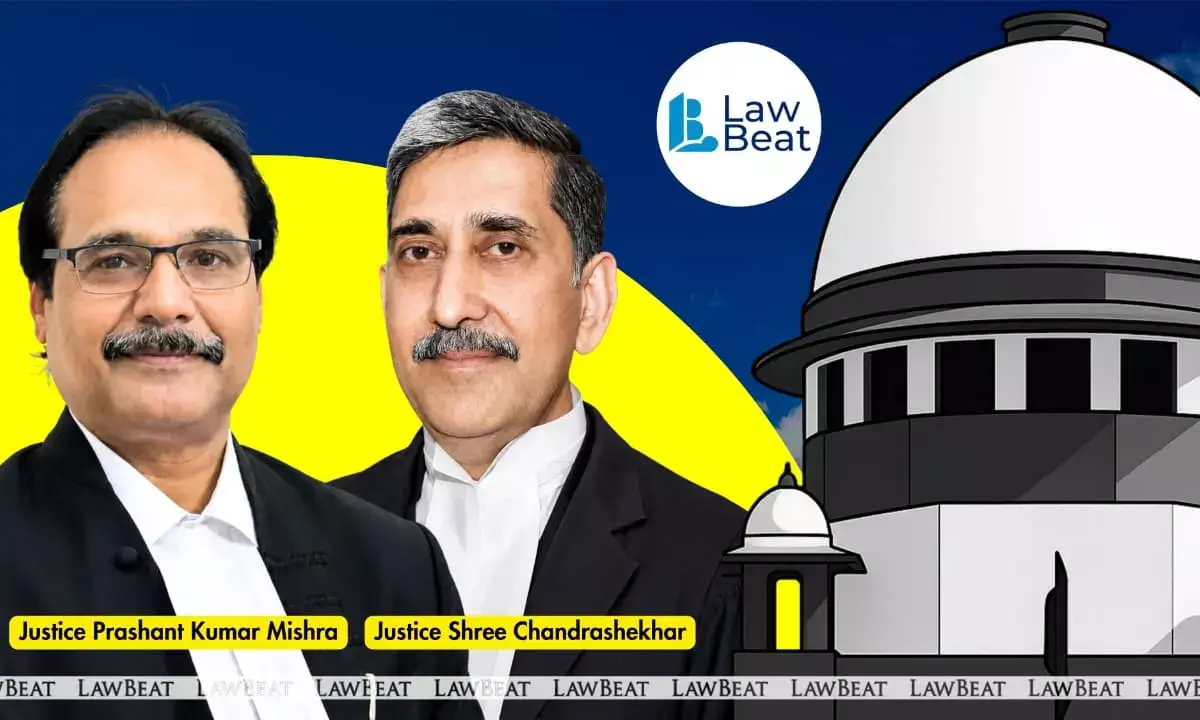
Supreme Court clarifies scope of writ of certiorari.
The Supreme Court has held that a decision based on clear ignorance or disregard of the law, or one containing a manifest error apparent on the face of the record, can be challenged through a writ of certiorari.
A Bench of Justices Prashant Kumar Mishra and Shree Chandrashekhar said such a writ can be issued to correct errors of jurisdiction or where an inferior court or tribunal acts illegally, improperly or in breach of natural justice.
When can a writ court interfere with findings in a disciplinary inquiry?
Court clarified that findings of fact recorded by an inferior court or tribunal ordinarily cannot be reopened unless they are based on no evidence. Such a finding, the Court said, constitutes an error of law apparent on the face of the record.
The Bench further explained that a finding can be considered perverse without requiring the writ court to re-appraise the evidence. This can happen where there is no concrete evidence to support the charge of misconduct, or where the conclusion reached in a domestic inquiry defies logic and is one that no reasonable person could have arrived at.
"Plainly speaking, if a decision on the face of it is found to be based on conjectures and surmises or where a decision is rendered by raising such inferences in law which are impermissible, the writ court is not denuded of its power to interfere in the matter and remedy the injustice meted out to the Government servant," the Bench said.
Dealing with an appeal filed by R Saravanan, Court said a finding recorded by an inquiry officer without any supporting evidence can be challenged in a certiorari proceeding.
It said this is not a case of re-appreciating evidence, but of recording a finding contrary to the material available on record. Such an issue, the Court said, is a pure question of law and is amenable to writ jurisdiction.
Court also reiterated that certiorari may be granted where a statutory authority acts without or beyond its jurisdiction, breaches natural justice, acts contrary to applicable rules, considers irrelevant facts, omits relevant facts, or takes a decision that is hit by the Wednesbury principle of unreasonableness.
The Wednesbury principle of unreasonableness means that a court can interfere with a decision of a public authority if it is so unreasonable that no reasonable authority would have taken it. It does not allow courts to interfere merely because they disagree with a decision. Instead, interference is justified when the decision is irrational, arbitrary, or unreasonable to such an extent that it cannot be legally sustained.
The appeal before the Supreme Court was filed by Saravanan, who was the Deputy Registrar of Periyar University and was aggrieved by a judgment of the Madras High Court's division bench, which had restored the punishment of his removal from service.
Saravanan had been accused of amassing wealth disproportionate to his known sources of income. He contended that a one-man commission constituted in his case had no authority to frame charges, as it had only been constituted to verify facts. He argued that the inquiry conducted by the commission was therefore without authority of law and that the order removing him from service was void.
The writ court had examined the report of the one-man commission and found that its findings were not supported by any material on record.
The Supreme Court noted that an appellate court should ordinarily not interfere with the judgment of the court of first instance unless a clear mistake affecting the outcome of the case is found.
It said a Letters Patent Bench should ordinarily be slow in interfering with the discretion exercised by a writ court under Article 226 of the Constitution. While such a Bench exercises the same jurisdiction as the single judge, it must give due weight to the writ court's decision where discretion has been exercised on relevant considerations.
A Letters Patent Bench is a division bench of a high court that hears appeals against decisions passed by a single judge of the same high court, where such an appeal is permitted under the Letters Patent governing that high court.
Court said interference is justified only when the findings are demonstrably erroneous and the mistake is glaring on the face of the record.
"There must exist cogent grounds and such grounds are not projected on some minor mistake in the judgment under challenge. The Letters Patent Bench is not entitled to interfere with the decision of writ Court on mere showing of some error of fact or in law," the Bench said.
Court added that where a writ court's decision under Article 226 furthers justice, equity and good conscience and is not against public policy, a Letters Patent Bench cannot exercise its appellate jurisdiction merely to interfere with that decision.
"Simply put, the Letters Patent Bench can not interfere with the decision rendered by the writ court which is otherwise just and reasonable," the Bench said.
Examining the Madras High Court division bench's judgment, the Supreme Court found that the writ court's well-reasoned decision had been interfered with without any cogent or justifiable reason.
The Bench noted that the division bench had reversed the writ court's findings on the ground that the material on record supported the findings in the inquiry report. However, in doing so, it had re-appreciated the entire material produced during the domestic inquiry, which the Supreme Court said was a matter for the Inquiry Officer or departmental authority to examine.
The division bench, the Court said, had relied on conjectures to conclude that Saravanan had a vested interest in the matter, misused his official position, and manipulated and secured affiliation for a college run by his wife.
Court also noted that, contrary to the settled legal position that the person making an allegation must lead evidence, the division bench had drawn an adverse inference against Saravanan because he had not produced title documents that could establish ownership of a house property.
It further noted that the division bench had concluded that Saravanan possessed assets disproportionate to his known income because he was paying monthly instalments towards a house loan and a Santro car while earning Rs 29,175 per month.
The Supreme Court held that the division bench had exercised its jurisdiction under Clause 15 of the Letters Patent in circumstances where there was no ground for such interference.
Allowing the appeal, Court set aside the Madras High Court division bench's August 29, 2019 judgment and restored the decision of the writ court.
Case Title: R Saravanan Vs Periyar University Rep By Its Registrar
Bench: Justices Prashant Kumar Mishra and Shree Chandrashekhar
Date of Judgment: October 16, 2026