
Dismissal From Service Reserved Only For Gravest Misconduct: Supreme Court
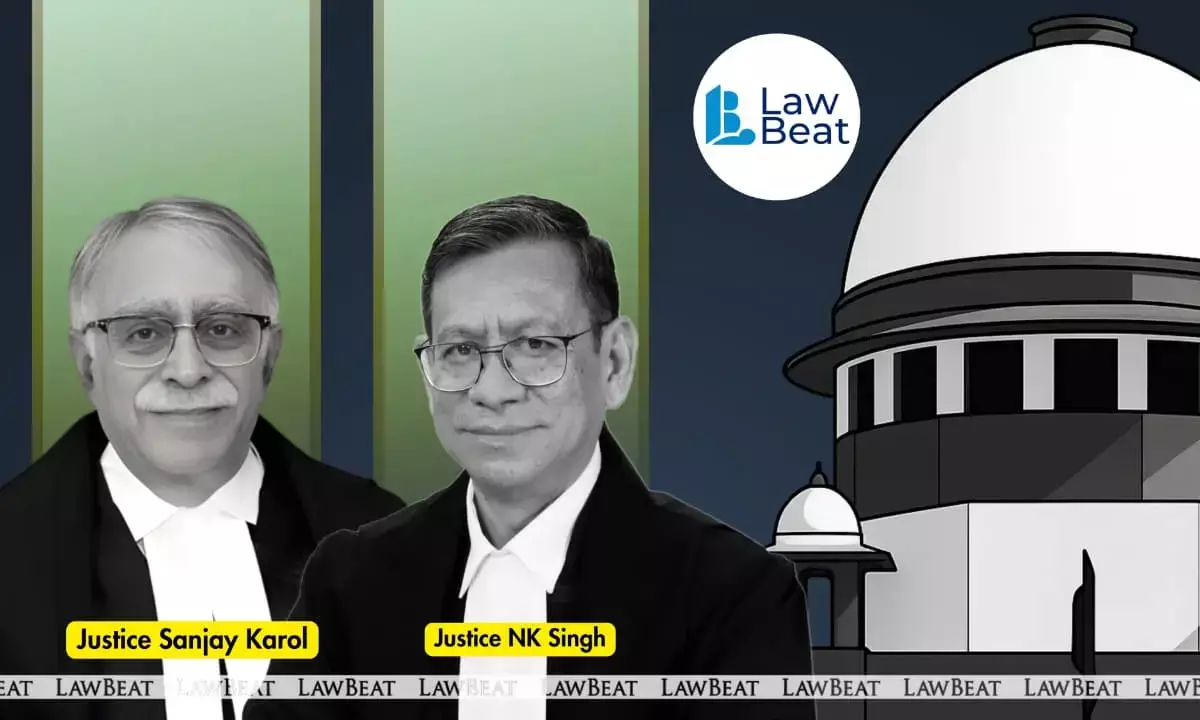
Supreme Court says dismissal should be reserved for only the gravest misconduct.
The Supreme Court has held that dismissal from service must remain reserved for cases where the misconduct is of the most serious nature and where considerations of sympathy or other mitigating factors would be undesirable and inappropriate.
Court said that even where service regulations prescribe dismissal as one of the permissible punishments for misconduct, the disciplinary authority is not relieved of its duty to consider all relevant factors before deciding whether the facts truly warrant the most extreme penalty.
A Bench of Justices Sanjay Karol and N Kotiswar Singh upheld the finding of misconduct against the appellant, Surekha Domaji Bele, but set aside the dismissal order after finding it to be both procedurally and substantively flawed.
"Dismissal from service is the severest form of penalty which can be inflicted on a delinquent employee in service jurisprudence," the Bench observed.
Also Read| Suppressing Higher Qualification to Get Government Job Justifies Dismissal: Supreme Court
It noted that dismissal has consequences beyond the immediate loss of employment. It permanently stains an employee's service record and may seriously affect future employment prospects, particularly in public employment, statutory bodies, public sector undertakings and other regulated establishments where service records and antecedents are relevant.
"The mere fact that a proved act falls within the broad category of 'misconduct' under the Regulations does not mean that dismissal must follow as a matter of course," Court said.
When is dismissal from service justified?
Answering this, Court said dismissal is ordinarily justified only where the misconduct is so grave that the employee's continuance becomes wholly incompatible with discipline, trust or the functioning of the institution.
According to the Bench, cases involving corruption, illegal gratification, moral turpitude, misappropriation, acts causing substantial financial loss to the employer, or conduct demonstrating complete unfitness for continued service stand on a different footing.
However, where the misconduct does not involve corruption, moral turpitude, financial misappropriation or proven loss to the employer, and where the employee has rendered long service with an otherwise clean record, the disciplinary authority must carefully consider whether a lesser punishment would sufficiently meet the ends of justice.
Also Read| Article 311(2) Explained: Supreme Court Says No Dismissal Without Inquiry Unless Backed by Material
Court also clarified that where service rules prescribe distinct penalties, the disciplinary authority cannot combine separate substantive penalties for the same misconduct unless the rules expressly permit such a course. Any punishment must therefore conform to the penalties prescribed under the applicable regulations.
What was the dispute before the Supreme Court?
The case arose from disciplinary proceedings initiated against the appellant, a Lower Division Clerk with the Maharashtra State Electricity Distribution Company Limited (MSEDCL).
She was accused of indiscipline, insubordination, disobedience of superior officers, tampering with official documents and negligence.
The disciplinary proceedings culminated in an order dated July 12, 2017, dismissing her from service. The authority also directed that her suspension period be treated as punishment. The dismissal was subsequently upheld by the Labour Court, the Industrial Court and the Bombay High Court.
Why did the Supreme Court interfere with the punishment?
Court found no error in the concurrent finding that the Executive Engineer was competent to pass the dismissal order, even though the appellant had been appointed by the Superintendent Engineer.
It also held that the absence of a fresh notice after the Labour Court's de novo findings did not prejudice the appellant on the question of guilt or misconduct, as she had participated in the proceedings before both the Labour Court and the Industrial Court.
However, the Bench held that once the matter had been remanded, the disciplinary authority was required to independently apply its mind to the surviving findings and reconsider the question of punishment.
Also Read| Disciplinary Action Need Not Be Approved by Appointing Authority Unless Rules Mandate: SC
Court noted that the earlier show-cause notice issued in 2008 had exhausted its purpose and could not be relied upon after the remand. A fresh show-cause notice proposing the punishment was therefore necessary before imposing any penalty.
"While the finding of misconduct remains undisturbed, the matter deserves to be remitted to the competent authority for fresh consideration as regards the quantum of punishment by issuing a fresh show-cause notice. The appellant shall be given an opportunity to place her explanation as regards the punishment. The competent authority shall thereafter pass a reasoned order about the punishment proposed to be imposed on the appellant," the Bench directed.
Court further held that the penalty of dismissal was wholly disproportionate to the misconduct proved.
It observed that, before imposing the severest punishment, the disciplinary authority had failed to consider relevant factors such as the nature and gravity of the misconduct, the appellant's long service, past record, age, the absence of financial loss to the employer, the absence of dishonesty, and the possibility of imposing a lesser punishment.
The Bench accordingly directed the competent authority to reconsider the quantum of punishment, while specifically considering a penalty other than dismissal from service. A fresh reasoned order must be passed within eight weeks after issuing a proper show-cause notice.
Court also directed that for the period from March 3, 2007 to July 12, 2017, the appellant shall be treated as entitled to subsistence allowance. It clarified that this amount must be paid irrespective of the punishment eventually imposed.
Finally, the Supreme Court set aside the Bombay High Court's 2024 orders dismissing the appellant's writ petition and review petition.
Case Title: Surekha Domaji Bele Vs Executive Engineer, Testing Division, MSEDCL
Bench: Justices Sanjay Karol and N Kotiswar Singh
Date of Judgment: June 11, 2026