
Fleeing Scene, Hiding Death Cannot Prove Murder Without Homicidal Act: Supreme Court Acquits 2 Men
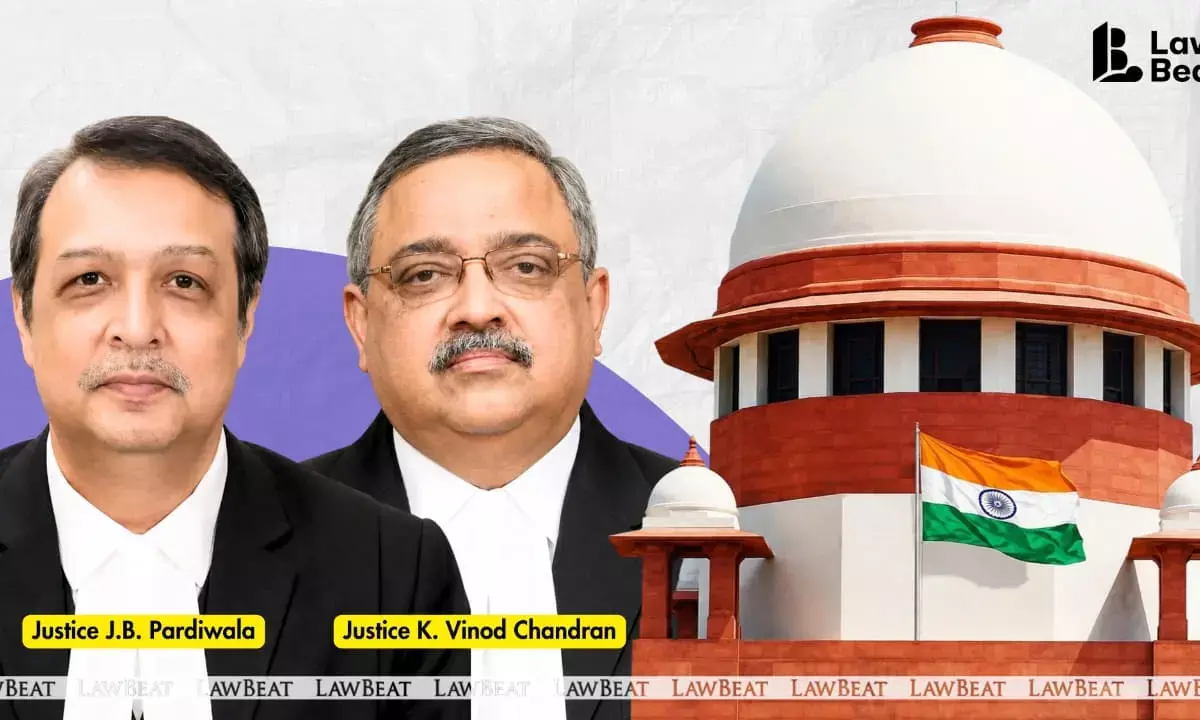
Supreme Court says post-incident conduct alone cannot establish murder.
The Supreme Court has held that reprehensible conduct by an accused after an incident, such as fleeing the spot, failing to report it or attempting to conceal it, cannot by itself establish a premeditated murder under Section 300 of the Indian Penal Code (IPC) [corresponding to Section 101 of the Bharatiya Nyaya Sanhita (BNS) ], unless there is underlying evidence of a homicidal act.
Court made the observation while acquitting two men who were convicted of murdering their friend, who was found drowned in a river in Gujarat in July 2006. The accused had taken the deceased to the river on the pretext of going to Ankleshwar to play volleyball.
A Bench of Justices J B Pardiwala and K Vinod Chandran also noted an unexplained delay of nearly four months in lodging the FIR and found that the evidence was more consistent with accidental drowning than homicide.
What evidence established that the death was homicidal?
Court found that there was no medical evidence to establish that the deceased had been murdered before being drowned.
The appellants, Taher Vajiyuddin Rangwala and another, maintained that they had gone swimming with the deceased and that he accidentally drowned. They said they fled in panic after seeing him drown and later went to watch a movie.
Villagers subsequently gathered at the riverbank and searched for the deceased. His clothes and other belongings were found on the bank and his body was recovered the next day. The post-mortem report stated that he had died of "asphyxia due to drowning".
The post-mortem report recorded three injuries: a contused lacerated wound on the frontal bone above the left eyebrow, an abrasion between the left eye and left ear, and an abrasion on the right mid-clavicular region.
The injuries were not grievous. The doctor who conducted the post-mortem stated in cross-examination that they could have been caused while the deceased was bathing in the river or while his body was being dragged by the current and came into contact with a hard substance, such as a sharp-edged stone.
The prosecution, however, alleged that the deceased had been struck with a soda bottle, fragments of which were allegedly found at the scene. The court noted that the alleged broken soda bottle containing blood stains was never sent for forensic examination.
"A reading of the post-mortem report, juxtaposed with the testimony of the Doctor who conducted the postmortem, cannot lead to a finding that the death was homicidal," the Bench said.
Court noted there was nothing to show that the deceased had been hit on the head, rendered unconscious and then deliberately drowned, as alleged by the prosecution. On the contrary, the medical evidence supported the defence version of accidental drowning.
Four-month delay and doubtful motive weakened prosecution case
The Supreme Court also found the delay in registering the FIR significant.
The FIR was registered only on November 3, 2006, nearly four months after the incident. Court noted that even after the accused had confessed to being present at the river and the deceased's body had been recovered, no allegations were levelled against them until the First Information Statement was recorded.
The prosecution had relied on motive, the last-seen-together theory, the presence of the accused near the scene, the alleged homicidal nature of the death, their silence and their conduct, including an alleged lie to the deceased's sister.
The alleged motive was that the deceased was in a relationship with first accused's sister, which allegedly continued after her marriage and enraged the first accused. The second accused was also said to have quarrelled with the deceased a few days earlier over a cricket match.
The Bench, however, found the motive doubtful. It pointed out that despite the alleged hostility, the deceased's family had allowed him to accompany the accused when they took him from his home.
The testimonies of the deceased's brother and sister, in fact, indicated that the deceased and the accused shared a friendly relationship, Court observed. It therefore found that the alleged motive appeared to have been introduced as an afterthought.
Accused's conduct after drowning could not prove murder
Court also rejected the argument that the accused's conduct after the incident established their guilt.
It noted that the riverbank where the accused and deceased had been drinking was not a secluded place and was frequented by people. The bench found it unlikely that the accused would have chosen such a place in broad daylight for a premeditated murder of their friend.
The last-seen theory and the presence of the accused near the scene were admitted, but Court said these circumstances were equally consistent with their defence that the deceased had accidentally drowned.
The accused's failure to rescue the deceased, fleeing the spot, going to a movie and not informing his family were undoubtedly reprehensible. However, Court held that such conduct could not be treated as an incriminating circumstance proving murder when the underlying evidence did not establish a homicidal death.
Court also rejected the high court's presumption that a person who had witnessed his friend drowning would not go to watch a movie or return empty soda bottles to the shop from which they had been purchased.
The Bench said human behaviour, particularly in the face of adversity, cannot be predicted in such a manner.
"The human mind, as has often been held by this court, is at the same time fickle, manipulative and imaginative and the actions, the result of a deprived or a foolish mindset, especially in the face of adversities, which cannot be predicted," it said.
The Supreme Court held that the hypothesis of accidental drowning was more plausible than homicide and accordingly set aside the orders of the trial court and high court.
The two accused, who had been convicted under Sections 302, 34 and 201 read with Section 120B of the IPC [(corresponding to Sections 103, 3(5), 238 and 61 of the BNS, respectively)] and sentenced to life imprisonment, were acquitted.
Case Title: Taher Vajiyuddin Rangwala & Anr Vs The State of Gujarat
Bench: Justices J B Pardiwala and K Vinod Chandran
Date of Judgment: August 13, 2026