
Supreme Court Directs All States To Enforce GPS Trackers And Panic Buttons In Public Vehicles
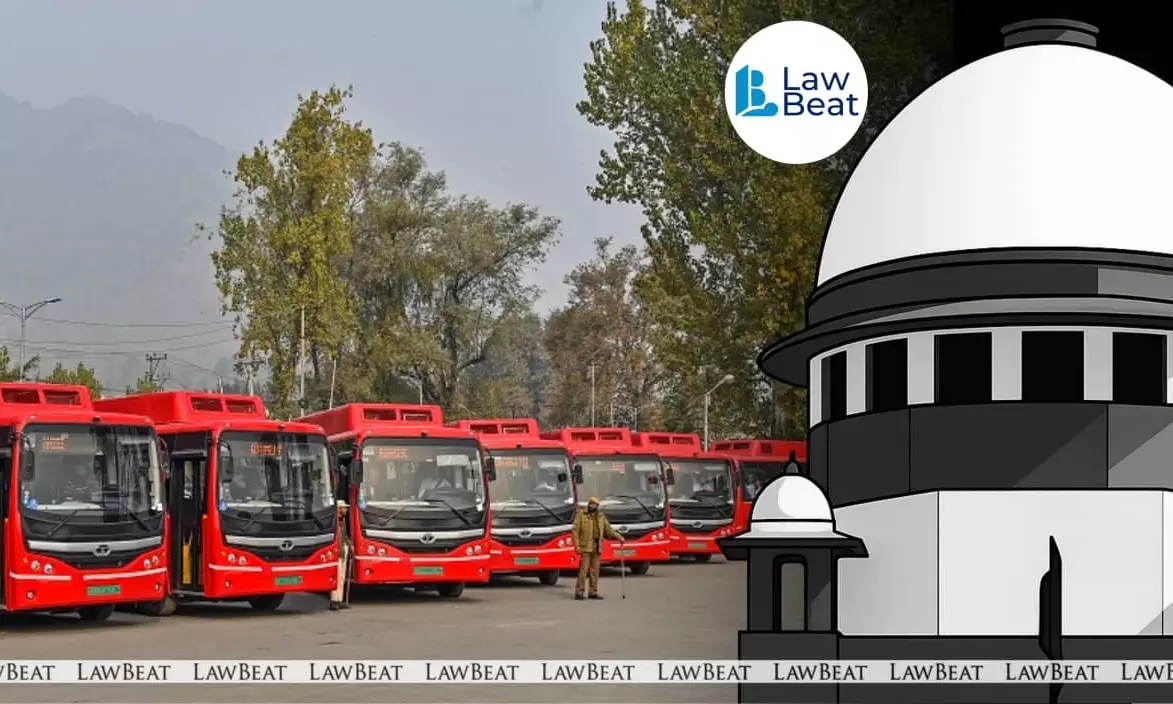
Supreme Court stresses passenger safety through vehicle tracking systems in public transport vehicles.
Despite years of regulatory mandates and repeated court monitoring, less than 1% of transport vehicles in the country are equipped with Vehicle Location Tracking Devices (VLTDs), prompting the Supreme Court to direct States and Union Territories to ensure strict enforcement of safety norms aimed at protecting passengers, particularly women, children and the elderly.
In a significant order passed in May, a Bench of Justices J B Pardiwala and K V Vishwanathan directed all State Governments and Union Territories to strictly enforce Rule 125H of the Central Motor Vehicles Rules, 1989 by ensuring installation of vehicle location tracking devices and panic buttons in a time-bound and verifiable manner in both new and existing public service vehicles.
"What is disturbing is the fact that less than 1% of transport vehicles have this vehicle location tracking device. This vehicle location tracking device is something which would ensure the safety of passengers, more particularly, women, elderly persons and children," the Bench observed.
Concerns about Vehicle Location Tracking Devices (VLTDs)
The Court's concern stemmed from the fact that a safety mechanism mandated years ago continues to remain absent in the overwhelming majority of public service vehicles.
Bringing the issue to the Court's notice, amicus curiae and senior advocate Gaurav Agrawal pointed to Rule 125H, which provides for installation of a "vehicle location tracking device" and an "emergency button" in public service vehicles.
He informed the Court that the Central Government had already issued the Motor Vehicles (Vehicle Location Tracking Device and Emergency Button) Order, 2018, requiring public service vehicles to be equipped with such systems, subject to certain exceptions.
Agrawal also referred to the Supreme Court's judgment in S Rajaseekaran v. Union of India (2017), where the Court had taken note of the Centre's notification mandating the fitment of vehicle location tracking devices in public service vehicles.
How do VLTDs and panic buttons improve public transport safety?
According to the amicus, VLTDs use GPS technology to continuously transmit a vehicle's location to a Central Command and Control Centre operated by the government or a licensed agency.
In emergencies such as abduction, hijacking or medical distress, authorities can immediately identify the exact location of the vehicle and initiate a response.
Court was informed that States including Delhi, Uttar Pradesh and Karnataka have established command centres and that more than 100 incidents have reportedly been resolved in a timely manner through alerts generated by panic buttons and vehicle tracking systems.
"Vehicle Location Tracking Devices are not mainly regulatory tools - they are life-saving systems. They transform passive public transport into actively monitored safe zones, allowing swift emergency response, crime deterrence, and data-driven safety interventions," the amicus submitted.
What happens if public service vehicles do not comply with VLTD rules?
The amicus pointed out that non-compliance attracts statutory penalties under the Motor Vehicles Act.
Under Section 190(2), use of a non-compliant vehicle can lead to fines of up to Rs 10,000 and imprisonment. Section 182A(4) provides for penalties of up to Rs 1 lakh for manufacturers or dealers delivering non-compliant vehicles, while Section 207 empowers authorities to detain and impound vehicles violating the rules.
In an affidavit, the Ministry of Road Transport and Highways (MoRTH) informed the Court that it had introduced enforcement measures through the Vahan portal at the stages of registration, fitness certification, pollution checks and permit issuance.
The ministry stated that mandatory enforcement of Rule 125H through the Vahan system commenced from January 1, 2026. It further informed the court that most States and Union Territories had begun mandatory verification of VLTD status for national permits from April 1, 2026, while others followed in May.
What directions has the Supreme Court issued on VLTD and panic button compliance?
Taking note of the submissions, Court directed that no public service vehicle should be granted a fitness certificate under Section 56 or a permit under Section 66 of the Motor Vehicles Act unless installation of a vehicle location tracking device and emergency button is verified and reflected on the Vahan database.
The Bench also directed all States and Union Territories to ensure retrofitting of VLTDs and panic buttons in public service vehicles registered up to December 31, 2018, observing that the objective of Rule 125H was to enhance passenger safety.
Further, Court ordered integration of VLTD functionality with the Vahan database for real-time compliance monitoring.
On a suggestion by the amicus that manufacturers should provide pre-fitted tracking devices at the time of manufacture, Court directed the Union Government to hold consultations with manufacturers and submit a report.
The Bench also examined compliance relating to Speed Limiting Devices (SLDs) and directed States to file fresh affidavits supported by verified Vahan data indicating the extent of compliance.
Why did the court raise concerns over the National Road Safety Board?
Apart from vehicle safety technology, Court expressed serious concern over the delay in constituting the National Road Safety Board.
"We take serious notice of the fact that past six years, we have been debating on this issue of constitution of the Board but till this date, the same has not been constituted," the Bench observed.
Granting what it described as one final opportunity, Court directed that the Board be constituted within three months.
Court also directed compliance with its earlier directions regarding pedestrian crossings in cities identified in the Road Accidents Report, 2023.
Case Title: S Rajaseekaran Vs Union of India
Bench: Justices J B Pardiwala and K V Vishwanathan
Date of Judgment: May 13, 2026