
High Courts Must Exercise Caution In Granting Interim Relief In Disciplinary Matters: Supreme Court
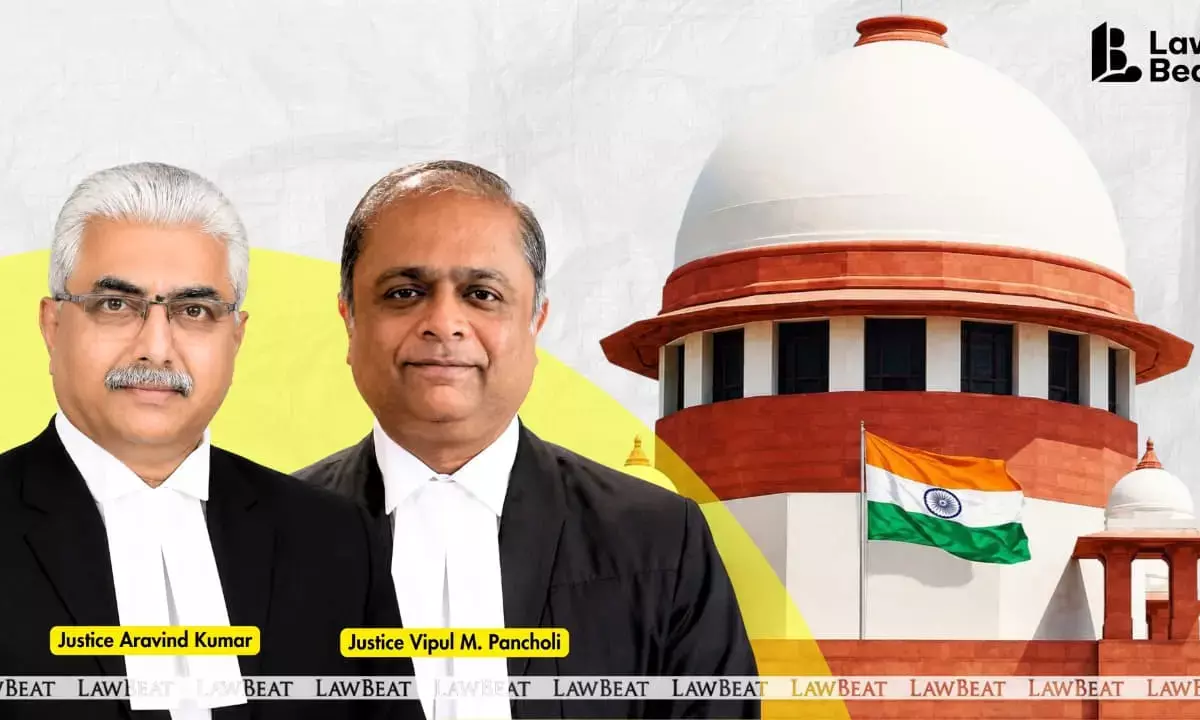
Supreme Court cautions against granting final relief in garb of interim relief in a writ petition.
The Supreme Court has said high courts should exercise caution while granting interim relief in disciplinary matters to ensure that such relief does not effectively amount to granting the final relief sought in a writ petition.
A Bench of Justices Aravind Kumar and Vipul M Pancholi said the validity of a departmental inquiry report, particularly where an unconditional apology has been tendered, should be adjudicated on merits in the main proceedings rather than through a roving inquiry at the interim stage.
Dealing with a plea filed by the State of Uttar Pradesh, Court held that the Allahabad High Court erred in granting, at the interlocutory stage, the main relief of restoration of position to one Yadvendra Singh in a pending writ petition concerning departmental disciplinary proceedings against him.
An anonymous complaint was made against Singh on November 8, 2024, alleging that he had posted objectionable content against the government, constitutional institutions and authorities. The government directed a preliminary inquiry into the allegations.
Accordingly, a preliminary inquiry was conducted and a report was submitted after obtaining Singh's reply. He was thereafter placed under suspension under Rule 4(1) of the Uttar Pradesh Government Servants (Discipline and Appeal) Rules, 1999, and disciplinary proceedings were initiated under Rule 7 of the Rules.
On June 3, 2025, a chargesheet containing four charges, along with the relevant annexures, was issued against Singh. The Commissioner, Varanasi Division, appointed the inquiry officer. Thereafter, on June 6, 2025, Singh tendered an unconditional apology for his objectionable posts.
Singh also appeared before the inquiry officer for an oral hearing on August 14, 2025. After considering his reply to the chargesheet and the material placed before him, the inquiry officer submitted his report on September 24, 2025, holding that all the charges were proved.
Based on the inquiry report, a show-cause notice was issued to Singh under Rule 9(4) of the Rules, granting him 15 days to submit his representation.
After considering his representation, the authorities passed an order on January 17, 2026, imposing a penalty under Rule 3 of the Rules and reverting him to the post of ‘District Backward Class Welfare Officer’.
Singh approached the Allahabad High Court, which on July 1, 2026, stayed the operation of the January 17, 2026 punishment order, observing that the matter required consideration.
Subsequently, on August 13, 2026, the high court modified its earlier order and allowed Singh to continue as ‘Deputy Director, Backward Class Welfare’, the post he was holding when the January 17, 2026 order was passed.
Due to non-implementation of the August 13 order, contempt proceedings were initiated, which were stated to be pending.
The State challenged both the July 1 and August 13 orders before the Supreme Court.
Having heard the parties and perused the record, the Bench noted that Singh had, in his representation dated June 6, 2025, tendered an unconditional apology for the objectionable posts, "or in other words admitted his guilt".
However, the Bench said whether this was sufficient for the inquiry officer to submit a report holding the charges proved was an issue that would have to be decided in the pending writ petition after considering the rival contentions.
"If this court were to embark upon conducting a roving inquiry on the basis of the rival contentions now raised, it is likely to prejudice the rights of either of the parties in the pending writ application. Hence, we refrain from expressing any opinion in that regard," the Bench said.
Court also noted that Singh was working as ‘Deputy Director, Backward Class Welfare’ when the January 17, 2026 penalty order was passed, and that he was thereafter reverted to the post of ‘District Backward Class Welfare Officer’.
The said order was challenged in the writ petition, following which the high court stayed its operation on July 1, 2026. The government subsequently filed an application seeking vacation of the stay, which remained pending.
"In this scenario, the high court ought to have examined either the continuation of the interim order of July 01, 2026 or vacating or modifying or varying the said order," the Bench said.
During the contempt proceedings, the government restored Singh's position as that of a “Suspended Deputy Director”.
The Bench declined to express an opinion on that action. It then observed that the high court, through its August 13 order, "seems to have virtually granted the main relief, though it is disguised as an interim relief".
"It is this process which was undertaken by the high court is erroneous and liable to be set aside," the Bench said.
Accordingly, Court set aside the August 13, 2026 order and granted liberty to both parties to raise their contentions before the high court.
The Supreme Court directed the high court to consider the government's pending application seeking vacation of the July 1 stay order and decide it on merits. It may vacate, set aside, modify or affirm the July 1 order as it deems appropriate.
Court also directed that the contempt proceedings initiated by Singh would not proceed until appropriate orders were passed on the government's stay-vacation application.
Case Title: State of Uttar Pradesh & Anr Vs Yadvendra Singh
Bench: Justices Aravind Kumar and Vipul M Pancholi
Judgment Date: September 29, 2026