
High Courts Must Exercise Restraint in Remarks Against Trial Judges: Supreme Court
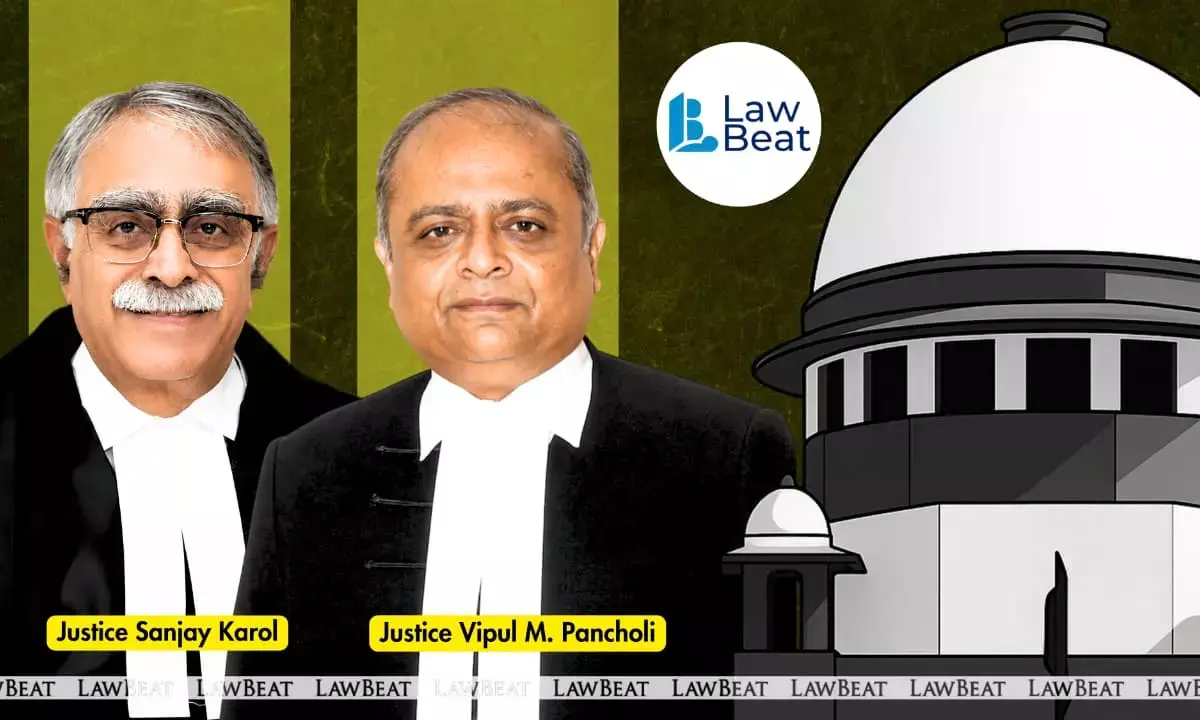
Supreme Court underscores restraint while reviewing subordinate judges' decisions.
The Supreme Court has held that judicial remarks against lower courts must be guided by justice, fair play, and restraint, while setting aside a Kerala High Court direction to send a trial judge for training after terming the trial court's judgment to be of poor quality.
A Bench of Justices Sanjay Karol and Vipul M Pancholi said adverse remarks on a judge's professional competence should not be made lightly, as they can undermine Section 63 Indian Succession Act. Such observations, it said, should be made only when necessary for deciding the case and must adhere to the principles of sobriety and moderation.
Court passed the judgment while allowing an appeal filed by Lakshmi. It also reiterated the duty of the first appellate court to deliver a reasoned judgment under Order XLI Rule 31 of the Civil Procedure Code (CPC).
Order XLI Rule 31 of the CPC requires an appellate court's judgment to clearly state the points for determination, its findings, the reasons for those findings, and the relief granted if the trial court's decree is reversed or modified.
Can a high court make adverse remarks against a trial judge?
Answering this, the Supreme Court said appellate courts must adopt the role of "a friend, philosopher and a guide" rather than wielding "the heavy-handed baton of superior authority" while pointing out errors committed by subordinate courts.
The Bench said the single judge of the high court ought to have kept in mind the principles laid down in State of UP v Mohd. Naim (1963), which emphasise that the independence of judges and magistrates must be preserved and that they should be allowed to perform their duties freely, fearlessly and without undue interference, even by the Supreme Court.
Accordingly, the apex court set aside the high court's judgment, including its direction to send the trial judge for training.
Supreme Court on duty of first appellate court
The Bench also examined the requirement of a reasoned judgment by the first appellate court under Order XLI Rule 31 CPC.
It said the first appellate court's judgment must clearly state the points for determination, the decision on each point, and the reasons supporting those conclusions.
"While it is the final court of fact, its judgment must reflect an application of mind and provide reasons for its conclusion, especially in cases of reversal, to ensure judicial accountability and transparency," the Bench said.
The Supreme Court found that the high court failed to discharge its role as the first appellate court because it did not adequately examine the facts and law and failed to provide cogent reasons for reversing the trial court's judgment.
Why did the Supreme Court restore the trial court's findings?
The dispute concerned the alleged last Will and testament of one Thankam. The appeal challenged the Kerala High Court's judgment dated November 30, 2022.
Thankam, the mother of the plaintiff and defendant nos. 1, 2, 4 and 5, died on August 27, 2011. According to the defendant-respondents, she had executed a registered Will on March 22, 1999, bequeathing her property to them. The plaintiff claimed she had no knowledge of the Will and, after her mother's death, filed a suit for partition.
The trial court held that the Will had not been proved in accordance with Section 63 of the Indian Succession Act, 1925, and passed a preliminary decree directing the property to be divided into ten shares, with the plaintiff entitled to a 2/10th share.
However, the high court reversed this finding and also directed that the trial judge be sent for training.
The Supreme Court held that the high court had improperly reversed the trial court's conclusion without discussing the mandatory requirements of Section 63 of the Indian Succession Act.
Section 63 of the Indian Succession Act lays down the manner in which an unprivileged Will must be executed. It requires the testator to sign or affix their mark to the Will, or have it signed by another person in their presence and under their direction, and mandates that the Will be attested by at least two witnesses.
The Bench reiterated that a Will must ordinarily be proved by examining at least one attesting witness to establish that the testator signed the document, or directed another person to sign it in the testator's presence, after understanding the nature and effect of the dispositions made.
"While mathematical precision is not required, the court must satisfy itself regarding the genuineness of the Will through the application of a prudent mind," the Bench observed.
Case Title: Lakshmi Vs Gopi & Ors
Bench: Justices Sanjay Karol and Vipul M Pancholi
Date of Judgment: July 15, 2026