
Illegal MoU Cannot Support Money Recovery Suit: Supreme Court
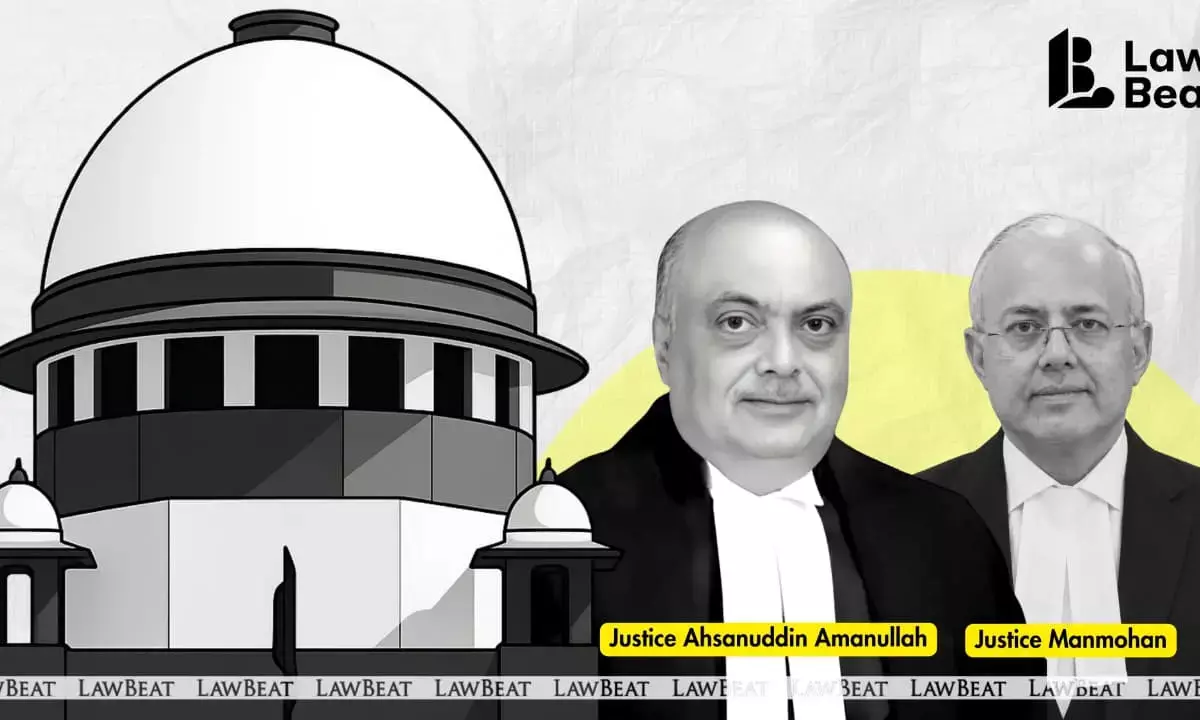
SC rejects suit based on unlawful MoU.
The Supreme Court has held that when a memorandum of understanding (MoU) executed between parties is forbidden by law, immoral and opposed to public policy, it cannot form the basis of a suit for recovery of money. In such a case, the plaint can be rejected for not disclosing a valid legal basis for the claim, Court clarified.
A Bench of Justices Ahsanuddin Amanullah and Manmohan also reiterated the settled principle that when parties to a legal dispute are in pari delicto, meaning both are equally at fault or guilty, neither can seek relief from the court.
Court made the observations while allowing an appeal filed by Poosa Sri Krishna and nine others against a Telangana High Court order dated January 3, 2025. The high court had upheld the trial court's decision rejecting the appellants' application under Order VII Rule 11 of the Code of Civil Procedure (CPC), 1908, seeking rejection of the plaint.
Why Did The Supreme Court Find The MoU Illegal?
The appellants, represented by Balaji Srinivasan, argued that the suit was essentially a money recovery suit. However, the claim was based on the allegation that the original plaintiff had paid money to the appellants for procuring loans from various banks.
According to the appellants, the plaint itself stated that the money was to be used for "overhead expenses", although these expenses were not specified.
They argued that the disclosure in the plaint showed that at least part of the money was meant to be paid to bank officials in their individual capacity. This, they said, clearly indicated that the money was being paid as an extraneous consideration for securing sanction of the loans.
The appellants further contended that the plaint repeatedly referred to the unlawful object of the transaction and indicated that part of the money was to be paid as kickbacks to bank officials. It was also alleged that the arrangement was intended to ensure that the illegally sanctioned loans would subsequently be waived.
On this basis, the appellants argued that when the very foundation of a claim is illegal and fraudulent, no proceeding based on such a claim can be maintained before a court.
They therefore submitted that their application under Order VII Rule 11(d) of the CPC, seeking rejection of the plaint, ought to have been allowed.
What Did The Respondents Argue?
Opposing the appeal, counsel for the respondents, Shravan Kumar Yammanur, argued that neither the trial court nor the High Court had committed any error.
He submitted that the language of the plaint only indicated that the money was to be used for various purposes, including processing loan requirements and completing formalities. According to him, this could not be interpreted to mean that the money was intended to satisfy illegal demands of bank officials in their personal capacity.
The respondents also alleged that the appellants had themselves committed fraud by representing to the original plaintiff that parting with a large amount of money would result in substantial benefits.
The counsel argued that the Court should not leave the plaintiff without a remedy after she had allegedly been defrauded of a huge amount of money.
He also relied on the Supreme Court's 1967 judgment in Sita Ram v Radha Bai and Others, arguing that the principle of in pari delicto has certain exceptions.
According to him, where a transaction was initially entered into for an illegal purpose but the illegal transaction did not ultimately fructify, a suit for recovery of the money may still be maintainable.
He further argued that rejecting the plaint would result in unjust enrichment of the appellants at the cost of causing permanent legal injury to the original plaintiff.
Both The MoU And Its Object Were Unlawful
The Supreme Court, however, disagreed with the respondents.
The Bench said the plaint itself contained sufficient material to show that the consideration or object of the MoU was "forbidden by law, immoral, opposed to public policy" and would defeat the provisions of law. It also found the transaction to be fraudulent.
"Consequently, the underlying agreement between the parties was void being violative of Section 23 of the Indian Contract Act, 1872," the Bench said.
Court found substance in the appellants' argument that the money allegedly given by the plaintiff was meant for an illegal and fraudulent purpose on two grounds.
First, the money was allegedly intended to satisfy the demands of bank officials in their personal capacity.
Second, the plaint itself stated that after demonetisation, demonetised currency notes were collected or procured and given to the appellants for exchange for consideration. Court held that such a transaction was legally impermissible.
What Is The Principle Of In Pari Delicto?
The Supreme Court held that the principle of in pari delicto clearly applied to the case. The principle means that a plaintiff who has participated in wrongdoing cannot recover damages arising from that wrongdoing.
The Bench also rejected the respondents' reliance on the Sita Ram judgment, saying that the facts of that case were distinguishable and that the exceptions recognised in that judgment did not come to the respondents' aid in the present case.
Court noted that, according to the original plaintiff's own case, she had already parted with the money demanded by the appellants, while the appellants had not fulfilled their part of the alleged agreement to procure the loans.
At the same time, Court observed that the illegal purpose had been substantially carried into effect, since the plaint specifically alleged that demonetised notes had been procured as consideration under the agreement.
The Supreme Court accordingly rejected the suit pending before the Additional District Judge at Godavarikhani, Peddapalli district, Telangana.
Case Title: Poosa Sri Krishna & Ors Vs Gattu Kishan Rao & Anr
Bench: Justices Ahsanuddin Amanullah and Manmohan
Date of Judgment: August 31, 2026