
Insurance Is Personal Contract; Third Parties Cannot Claim Under Policy: Supreme Court
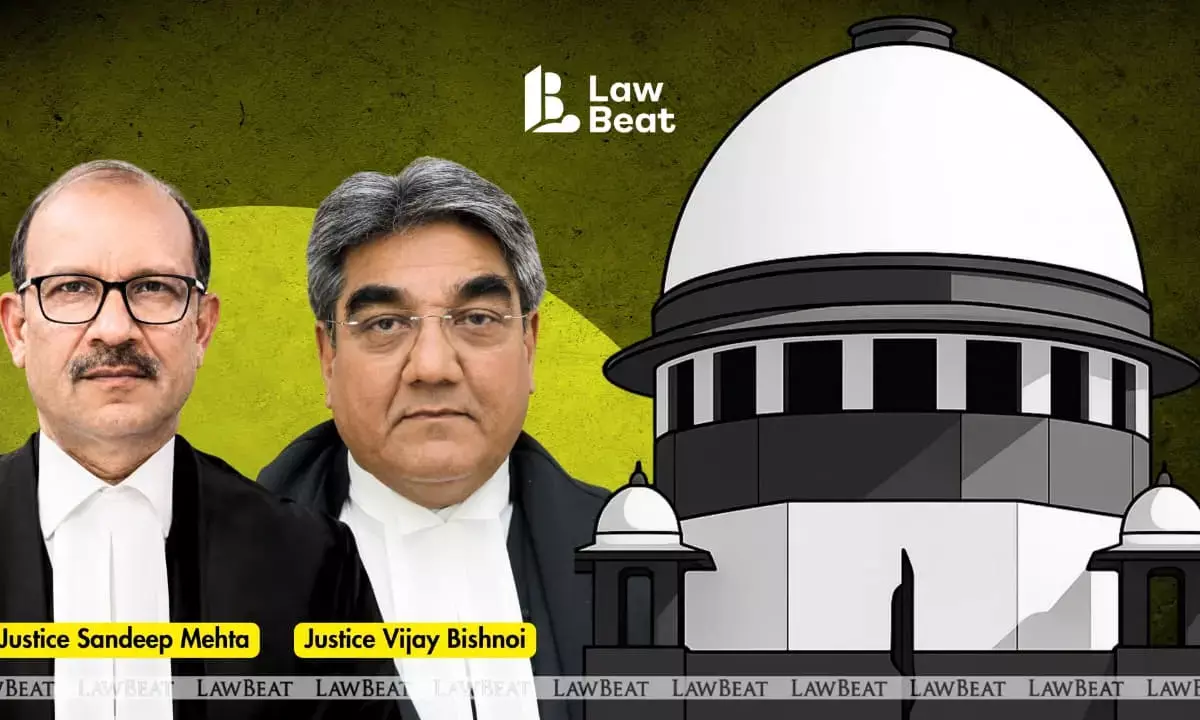
The Supreme Court clarified that insurance is a personal contract.
The Supreme Court of India has held that an insurance contract is a personal agreement between the insured and the insurance company, and no third party can claim benefits under that contract unless there is a contractual relationship with the insurer.
A Bench of Justices Sandeep Mehta and Vijay Bishnoi made the observation while dismissing an appeal filed by K Prakashchand against an order of the National Consumer Disputes Redressal Commission (NCDRC), which had rejected his insurance claim.
Court also clarified that its earlier decision in Sundaram Finance Ltd. v. State of Kerala (1966), dealing with hire-purchase agreements, could not be relied upon unless the nature of the agreement between the parties was clearly established.
Why did the Supreme Court reject the financier's insurance claim?
The dispute arose after the appellant financed the purchase of a vehicle by one Somashekhar. The vehicle was covered under a comprehensive insurance policy issued by Oriental Insurance Company for the period between February 8, 2003 and February 7, 2004.
According to the appellant, the borrower surrendered the vehicle on December 13, 2003 after defaulting on loan instalments due to financial difficulties. While the vehicle was allegedly in the appellant's custody, it was stolen.
A police complaint was lodged on December 15, 2003. As the vehicle could not be traced, the police filed a closure ('C') report. The appellant thereafter lodged an insurance claim, offering to execute a letter of subrogation in case the insured later raised any claim. However, the insurance company repudiated the claim.
The District Consumer Forum accepted the appellant's case, holding that the arrangement was one of hypothecation rather than hire-purchase. It treated the appellant as a pledgee with an interest in the insurance proceeds and directed the insurer to pay Rs 5.27 lakh. The Karnataka State Consumer Commission upheld that order.
However, the NCDRC reversed the concurrent findings. It noted that although the insurance policy carried an endorsement referring to hire-purchase/hypothecation/lease, the insurance company was not a party to the agreement between the financier and the insured. It also found that the agreement itself had never been placed on record, and therefore there was no privity of contract between the financier and the insurer.
What did the Supreme Court say about the insurance contract?
Before the Supreme Court, the appellant argued that the transaction was essentially a loan secured by hypothecation. Relying on Sundaram Finance Ltd., he contended that although the documents described the borrower as the owner, the financier remained the real owner until the loan was repaid. Alternatively, he argued that the arrangement was akin to a pledge and was covered by IMT-7 of the insurance policy. He also submitted that once the endorsement regarding hire-purchase/hypothecation was made in the policy, the insurer could not deny liability on the ground of lack of privity.
The insurance company, on the other hand, argued that the appellant was not the registered owner of the vehicle and had no contractual relationship with the insurer. It further contended that surrender of the vehicle did not make the financier its owner, and that an insurance policy is a personal contract between the insurer and the insured. Consequently, no claim by a third party could be entertained.
Accepting the insurer's submissions, the Supreme Court held that the National Commission had rightly concluded that there was no privity of contract between the appellant and the insurance company. The agreement relied upon by the appellant was executed only between the financier and the borrower, and the insurer was neither a party to it nor supplied with a copy after its execution.
"Since, the Insurance Company did not have any notice of any agreement taking place in between the parties, it cannot be called upon to make good the loss of the appellant," the Bench observed.
Court further noted that the appellant had failed to establish several key facts. There was no documentary proof to show that the borrower had actually surrendered the vehicle. The appellant also failed to provide details regarding the alleged theft, including the place, date and time of the incident. The bench said these deficiencies cast doubt on the appellant's case.
Court also observed that the insured person had absconded and had never informed the insurance company about any arrangement with the appellant. It further found that the proposed letter of subrogation was ineffective because it had been executed by the appellant and not by the insured himself.
TheBench also held that reliance on Sundaram Finance Ltd. was misplaced because the nature of the agreement between the parties had never been clearly established as a hire-purchase, hypothecation or lease arrangement.
Finding no error in the NCDRC's reasoning, the Supreme Court dismissed the appeal.
Case Title: K Prakashchand Vs Oriental Insurance Co Ltd
Bench: Justices Sandeep Mehta and Vijay Bishnoi
Date of Judgment: June 18, 2026