
Judicial Review Of President, Governor's Clemency Powers Highly Restricted: Supreme Court
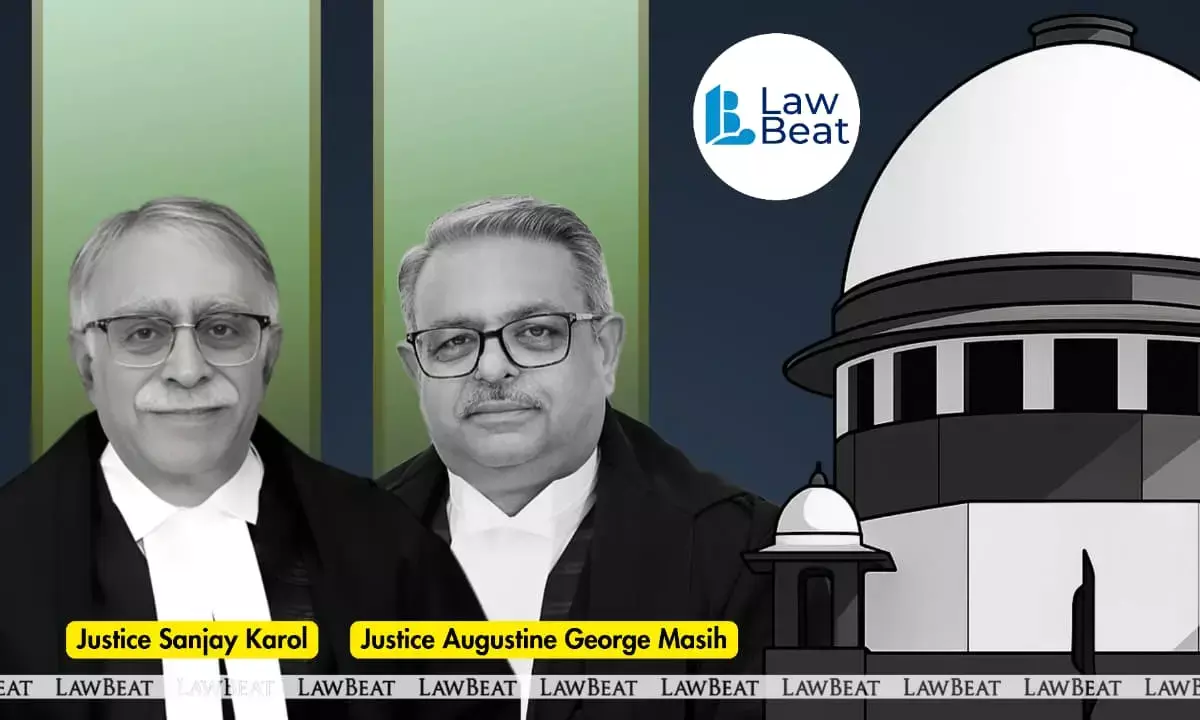
Supreme Court limits judicial review of clemency powers.
The Supreme Court has held that judicial review of the President's or Governor's clemency powers under Articles 72 and 161 of the Constitution is highly restricted and can be exercised only on limited grounds such as lack of application of mind, mala fide, extraneous considerations or manifest arbitrariness.
A Bench of Justices Sanjay Karol and Augustine George Masih said courts cannot sit in appeal over the executive decision while exercising judicial review of clemency powers.
The Bench made the observations while dismissing a batch of petitions filed under Article 32 challenging sentences modified by the President under Article 72, noting that no grounds for judicial review were made out in the cases.
Can Article 32 be used to bypass other legal remedies?
The Supreme Court held that filing a writ petition under Article 32 cannot be used as a shortcut to circumvent other available statutory or constitutional remedies.
The Bench said the jurisdiction of the Supreme Court under Article 32 is extraordinary and discretionary and is designed to protect fundamental rights.
"It is not an absolute right to bypass established procedures or to ventilate grievances that should be addressed through appropriate lower forums or existing statutory mechanisms," the Bench said.
Court, however, noted that a petition under Article 32 is maintainable where there is a violation of fundamental rights or grave injustice.
Referring to its 2025 judgment in Vasanta Sampat Dupare Vs Union of India, the Bench noted that an Article 32 petition by a convict seeking the benefit of a subsequent judgment that causes a shift in jurisprudence after his conviction and sentence would be maintainable.
"The scope of Article 32 although wide in some sense, is restricted in another sense. The right of a prisoner to approach this court obviously cannot be outrightly restricted but this right cannot be used to circumvent other procedures, using it as a shortcut to ventilate their grievances before a court of law," the Bench said.
Court also observed that the importance of Article 32 is reflected in the fact that the Constitution itself makes the right to approach the Supreme Court for enforcement of fundamental rights available as a fundamental right.
"The sanctity of this power is evidenced by the fact that an opportunity to approach the highest Court of the country is itself being made a fundamental right in the Constitution and that is perhaps the reason why Dr. Ambedkar had termed this as the “most important Article” in the Constitution," Court noted.
Why can courts not sit in appeal over clemency orders?
The Bench noted that in two of the writ petitions, the petitioners were not alleging an incorrect exercise of power by the constitutional authorities. Instead, they were asking the Supreme Court to independently exercise the power and reduce their sentences after the President had already exercised the power under Article 72.
Court said this would effectively mean sitting in appeal over an executive decision, which is not permissible.
"The powers given to the President or the Governor are unaffected and unencumbered by any other provision of the Constitution. If the argument advanced by the counsel for the petitioner is accepted, we would be sitting in appeal, (not judicial review) over the exercise of an executive power, which is not permissible," the Bench said.
Court reiterated that judicial review of the exercise of clemency powers is confined to limited grounds such as lack of application of mind, mala fide, extraneous considerations and manifest arbitrariness.
Is imprisonment for remainder of natural life constitutionally valid?
The Supreme Court also affirmed that "life imprisonment" means imprisonment for the remainder of the convict's natural life and that courts can impose a special category of sentence without remission in rare cases.
The Bench noted that imprisonment for life under Section 53 read with Section 45 of the Indian Penal Code (corresponding to Section 4 and Section 2(17) of the Bharatiya Nyaya Sanhita (BNS), respectively) means imprisonment for the remainder of the convict's life.
It further held that courts have the authority to create a special category of sentence that excludes the possibility of remission in the rarest of rare cases, and that such a sentence is constitutionally valid.
Court referred to the Constitution Bench judgment in Union of India Vs V Sriharan (2016), where a majority of three judges upheld the special category of imprisonment for the remainder of natural life without remission.
"Given the conclusion of the majority, we only wonder how the petitioners have raised this contention. A five-judge bench has said that sentences for the remainder of natural life are valid," the Bench said.
It observed that the issue had already been settled by the Constitution Bench and questioned how the petitioners could contend before a two-judge bench that such sentences were unconstitutional or violated the statutory power of remission under Section 432 of the CrPC [corresponds to Section 473 of the Bharatiya Nagarik Suraksha Sanhita, 2023 (BNSS)].
Court termed such an endeavour a "misuse, if not the abuse of process of law", particularly since the argument concerning the CrPC had already been answered by the Constitution Bench.
What happens when a sentence is imposed without a 'without remission' condition?
The Supreme Court clarified that when a sentence is awarded as imprisonment for life without the specific addition of "without remission", the State's power under Section 432 CrPC to reduce the sentence remains unaffected.
Therefore, an application for remission in such a case would remain maintainable.
However, in select cases where the "without remission" condition is imposed, Court said it is done after considering the facts of the case, the gravity of the crime and the nature of the offence.
"In those select few cases where the ‘without remission’ condition is utilised, which is obviously done so, in the attending facts of that case keeping in view the gravity of crime, nature of offence and the fact that reduction of the sentence therein to an ‘ordinary sentence’ would be unjust, the statutory right being denuded, cannot be termed to be offensive to the Constitution," the Bench said.
Court also referred to Swamy Shraddananda (2), which recognised this special category of sentence and held that it must be used after due regard to the facts of the case and not as an ordinary measure.
What were the four petitions before the Supreme Court?
Court was dealing with four writ petitions.
Ramasrey alias Fakkad had contended that Section 302 of the IPC (corresponding to Section 103 of the BNS) provides only two punishments, death or imprisonment for life, and does not provide for imprisonment for the remainder of natural life. He therefore argued that imposing such a sentence was unconstitutional.
Ramasrey had been sentenced to death by a court in Agra in a kidnap and murder case. The Allahabad High Court subsequently modified the sentence to imprisonment for the remainder of his natural life. The Supreme Court dismissed his petition.
A similar plea was filed by Chander Kant Jha.
Another petition, filed by Atbir Singh, challenged the validity of the President's order accepting his mercy petition and modifying his death sentence to imprisonment for the remainder of his natural life without parole.
The fourth petition was filed by three convicts, Sarabjit Singh, Gurdev Singh alias Baldev Singh and Satnam Singh. They challenged the President's order accepting their mercy petition and modifying their death sentences to imprisonment for the remainder of their natural lives with no remission.
Why were the petitions dismissed?
In the case of Ramasrey alias Fakkad, Court noted that he had not availed the statutory or constitutional remedies available to him. He had not filed petitions seeking remission before the State Government or the constitutional authorities, as applicable.
Court made a similar observation in the case of Jha, who had also not approached the State Government or the constitutional authorities for remission. In his case, since it had already been directed that he would not be released on remission for the remainder of his life, the question of remission did not arise. The court also noted that the powers under Articles 72 and 161 remained unaffected.
In the other two petitions, Court pointed out that orders had already been passed by the President and no ground for judicial review was made out on the facts of the cases.
The court accordingly dismissed all four petitions.
Case Title: Ramasery alias Fakkad Vs Union of India
Bench: Justices Sanjay Karol and Augustine George Masih
Date of Judgment: July 29, 2026